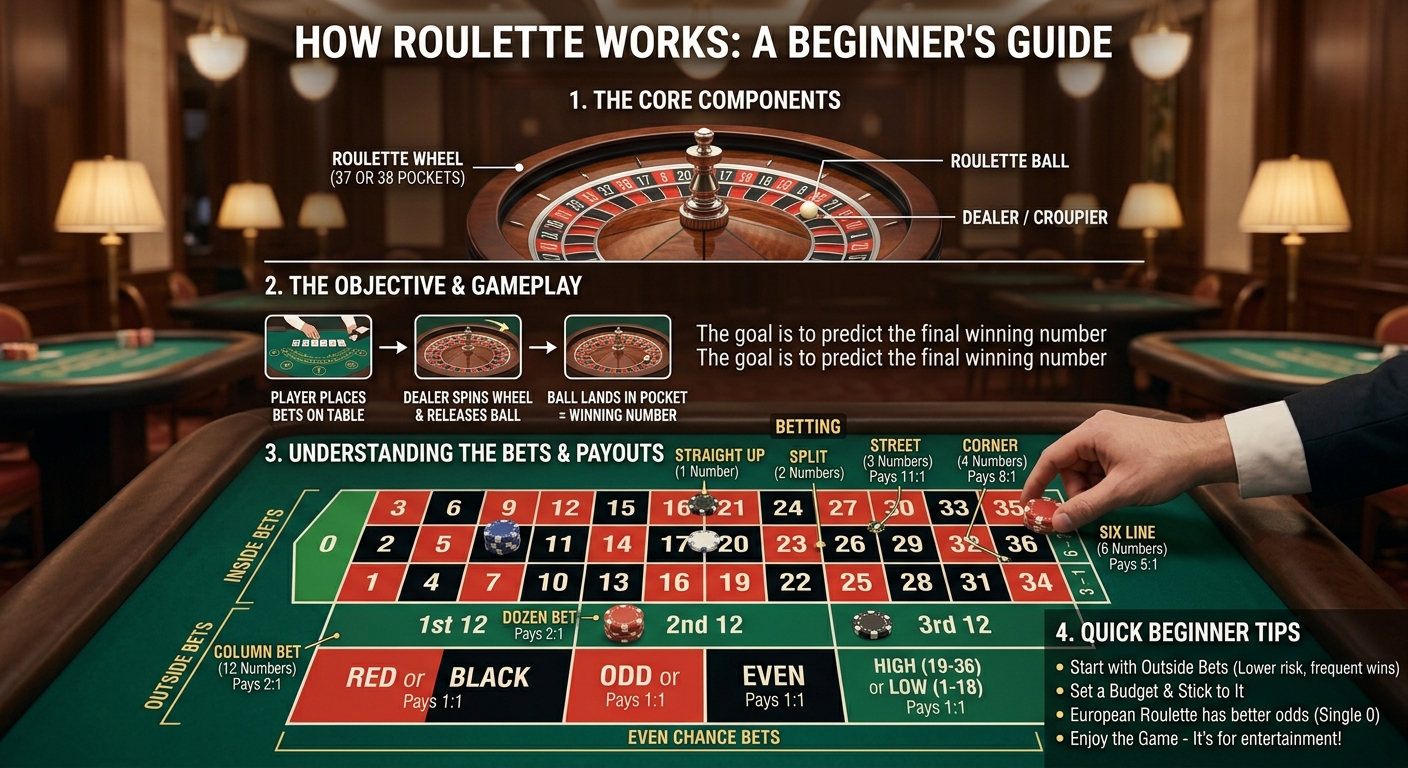
How Roulette Works: A Beginner’s Guide
Roulette is one of the most recognizable casino games, known for its spinning wheel and the suspense of waiting for the ball to land. On FUNFOR.YOU you can experience the full roulette experience without using real money, which makes it an ideal place for beginners to learn the rules, try different bets, and understand the underlying odds.
What Is Roulette?
Roulette is a game of chance played on a wheel and a matching table. The wheel contains numbered pockets, each colored either red, black, or green. A small ball is spun in the opposite direction of the wheel’s rotation, eventually losing momentum and settling into one of the pockets. The number and colour of that pocket determine the outcome of each round.
European vs. American Wheels
There are two common wheel layouts:
- European roulette has 37 pockets: numbers 1‑36 plus a single zero (0). The single zero gives the game a lower house edge.
- American roulette adds a double zero (00) to the European layout, creating 38 pockets. The extra pocket increases the house edge slightly.
Both versions follow the same basic betting rules; the only practical difference for a beginner is the slightly higher chance of losing on an American wheel.
Understanding the Table Layout
The roulette table mirrors the wheel’s numbers and adds a variety of betting options. The main sections are:
- Inside bets – placed on specific numbers or small groups of numbers. These bets have higher payouts but lower probabilities of winning.
- Outside bets – placed on broader categories such as colour, odd/even, or high/low numbers. These bets win more often but pay less.
Each betting spot on the table shows the amount you can win if the ball lands in the corresponding pocket(s). The payouts are fixed; for example, a straight‑up bet on a single number typically pays 35 to 1.
How a Round Is Played
Playing a round of roulette follows a simple sequence:
- Place your bets – Choose the amount you wish to wager and place chips on the desired betting spots before the dealer announces “no more bets.”
- Spin the wheel – The dealer (or the simulation software) spins the wheel and releases the ball.
- Result – When the ball rests in a pocket, the winning number and colour are announced.
- Payout – Winning bets are paid according to the table’s payout schedule; losing bets are collected.
On a free‑play platform the same steps occur, but no real money changes hands.
Basic Betting Options Explained
Below are the most common bets a beginner might try, grouped by risk and reward.
Outside Bets
- Red or Black – Bet on the colour of the winning pocket. Pays 1 to 1.
- Odd or Even – Bet on whether the number will be odd or even (zero is excluded). Pays 1 to 1.
- Low (1‑18) or High (19‑36) – Bet on the range of the number. Pays 1 to 1.
Inside Bets
- Straight‑up – Bet on a single number. Pays 35 to 1.
- Split – Bet on two adjacent numbers. Pays 17 to 1.
- Street – Bet on a row of three numbers. Pays 11 to 1.
- Corner (or Square) – Bet on a block of four numbers. Pays 8 to 1.
Each bet type has a known probability of winning, which is determined by the number of pockets that satisfy the bet.
Step‑by‑Step Example
Let’s walk through a simple round where you place an outside bet on red using the European wheel.
- Set your stake – Suppose you decide to wager 10 virtual chips on red.
- Place the chip – On the table layout, locate the red betting area and place your 10‑chip there.
- Spin the wheel – The simulation spins the wheel and releases the ball.
- Outcome – The ball lands in pocket 23, which is red.
- Payout – Because you guessed the colour correctly, you receive your original 10 chips back plus an equal amount as winnings (1 to 1 payout). You now have 20 chips.
If the ball had landed on a black number or zero, you would lose the 10 chips you wagered. This example shows how an outside bet offers a relatively high chance of winning (just under 50 % on a European wheel) but modest returns.
House Edge and Randomness
The house edge is the built‑in statistical advantage that the casino (or the simulation’s operator) retains over the long run. For European roulette the edge is roughly 2.7 % because of the single zero; for American roulette it is about 5.3 % because of the additional double zero. This edge means that, on average, a player will lose a small percentage of the total amount wagered over many spins.
It is important to understand that each spin is independent. The outcome of one spin does not influence the next, no matter what patterns appear. This independence is a core principle of randomness in roulette.
Managing Your Play
Even though FUNFOR.YOU uses virtual chips, practicing good bankroll management helps build healthy habits for any future real‑world play.
- Set a bankroll limit – Decide how many virtual chips you are comfortable using in a session and stop when you reach that limit.
- Set a time limit – Determine how long you will play and take breaks to avoid fatigue.
- Avoid chasing losses – Increasing your bets to try to recover a previous loss typically leads to larger losses because the house edge remains unchanged.
Remember that roulette outcomes are random; no system can guarantee a win.
Responsible‑Gambling Reminder
FUNFOR.YOU is a free‑play simulation designed for entertainment and learning. No real money is wagered, and no cash can be won or cashed out. If you ever decide to play for real money elsewhere, consider the following responsible‑gambling practices:
- Play only with money you can afford to lose.
- Set strict limits on how much you spend and how long you play.
- If you feel that gambling is becoming a problem, seek help from a local support service or a reputable gambling‑harm organization. You can search online for “gambling help” in your region to find appropriate resources.
Always check the laws where you live before engaging in any form of gambling.
Frequently Asked Questions
Is roulette a game of skill?
No. Roulette outcomes are determined by chance. While you can choose different bet types, none of them can alter the random nature of the spin.
Can I increase my chances of winning by using a betting system?
Betting systems, such as the Martingale, do not change the house edge. Over time they can increase the risk of large losses without improving the overall probability of profit.
What is the difference between “inside” and “outside” bets?
Inside bets focus on specific numbers or small groups of numbers and offer higher payouts with lower winning probabilities. Outside bets cover broader categories, pay less, but win more frequently.
Why does the American wheel have a higher house edge?
The extra double zero adds another losing pocket, which raises the proportion of losing outcomes and therefore increases the house edge.
Do the virtual chips on FUNFOR.YOU have any real‑world value?
No. The chips are purely for simulation and learning purposes; they cannot be exchanged for money or prizes.
Conclusion
Roulette combines a simple set of rules with a wide range of betting choices, making it an accessible entry point for new casino players. By understanding the wheel layout, the table bets, the role of the house edge, and the importance of responsible play, you can enjoy the game on FUNFOR.YOU without risking real money. Use the platform to practice, observe patterns of randomness, and develop a disciplined approach that can serve you well in any future gaming activities.