Most casino games ask you to guess what a random process will do. Chui Niu asks you to work out what other people are hiding — which makes it a completely different kind of game, and a considerably more social one.
The name (吹牛) translates roughly as boasting, which tells you most of what you need to know about it. In English it is usually called liar’s dice.
The setup
Every player gets a cup and a set of dice. You roll, then look at your own dice while keeping them hidden from everyone else. From that moment you know exactly one sixth of the information you need and have to infer the rest.
Bidding
Play goes round the table. Each bid is a claim about all the dice on the table, not just your own — this is the part that trips up new players. A bid names a quantity and a face: “four fives” means there are at least four dice showing five, counting everybody’s.
Each bid must raise the last one, by increasing the quantity, or by keeping the quantity and naming a higher face. “Four fives” can be followed by “four sixes” or “five twos”, but not by “four threes”.
Because you can only ever go up, the bidding walks steadily towards claims that cannot possibly be true. That is the engine of the game: eventually someone has to be wrong.
Challenging
Instead of raising, you can challenge the last bid. Every cup is lifted and the dice are counted.
- If the bid was true — there were at least that many — the challenger loses.
- If the bid was false, the bidder loses.
At our tables the loser forfeits a fixed number of chips, and the winner of the round starts the next one. Some house rules instead remove a die from the loser, which shrinks their information over time; ours keeps everyone in with a chip forfeit.
The counting
Assume five players with five dice each: twenty-five dice on the table. Any given face should appear about a sixth of the time, so roughly four of any number is the natural expectation.
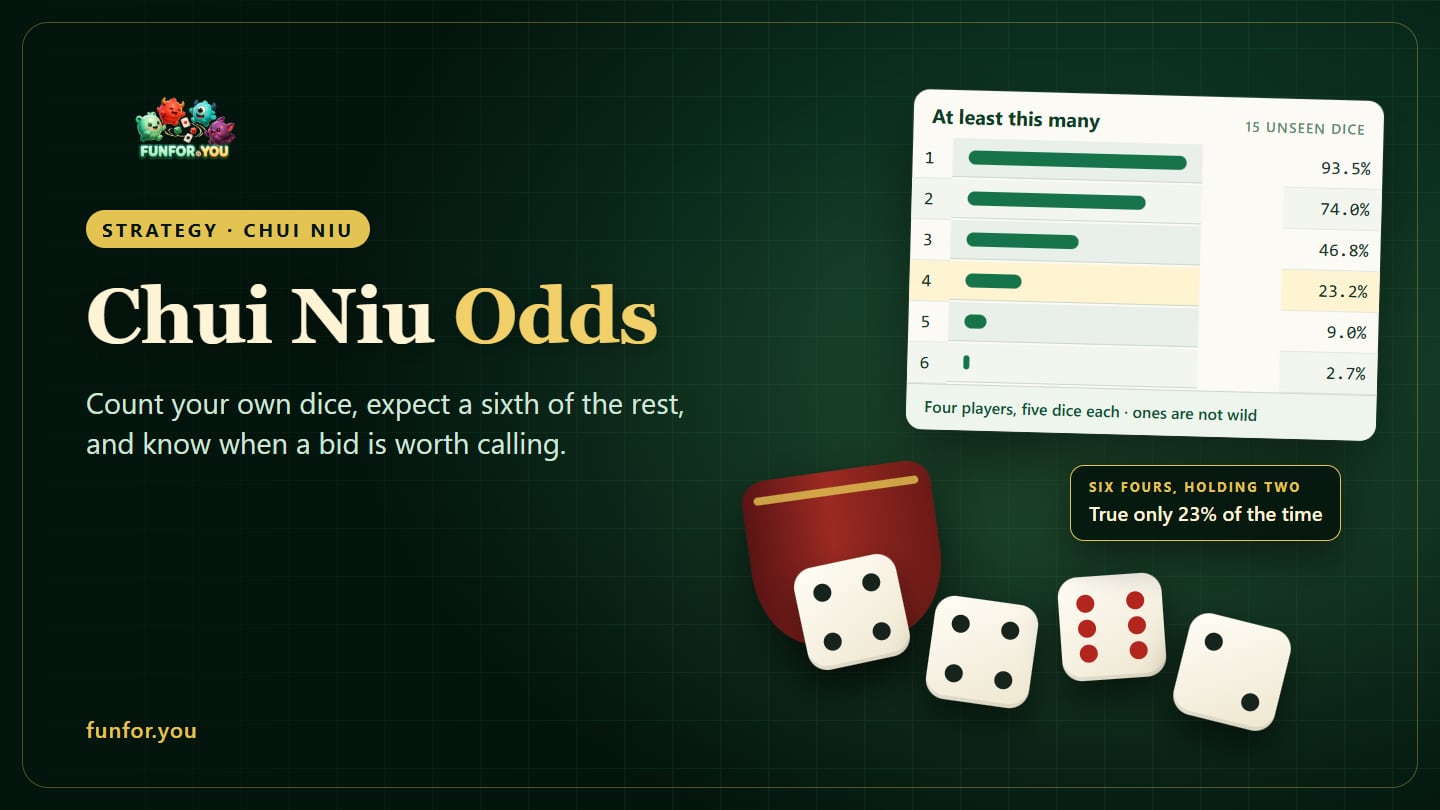
Now the useful part. You can see five of those dice — your own. If you hold two fours, then a bid of “six fours” only requires four more among the twenty unseen dice, against an expectation of a little over three. That is a fairly ordinary claim. If you hold no fours at all, the same bid needs six from twenty, which is a stretch.
So the same bid is strong or weak entirely depending on what is under your own cup. Good players are constantly doing this arithmetic; the rest is reading people.
Ones wild
A common variant makes ones count as any face, which changes the maths substantially — it roughly doubles the effective supply of every number and pushes bids much higher. Our default has this off, so a one is just a one. Worth checking before you sit down anywhere else.
Bluffing well
Three things separate decent players from beginners.
Bid what you hold. The safest raise is usually one built on your own dice, because you know part of it is true.
Watch what people avoid. A player who never bids threes probably has none. That is information, and it is free.
Occasionally bid against your hand. If you only ever bid your own dice, attentive opponents will read your cup from your bids. An occasional lie is not recklessness, it is maintenance.
Knowing when to challenge
The instinct is to challenge when a bid sounds outrageous. The better instinct is to challenge when it is just past plausible — because a player who has been pushed into a bid they cannot support will make exactly that kind of bid. Wildly implausible bids are often a player who genuinely holds four of something.
Why it is worth playing
Chui Niu has something the table games do not: your decisions genuinely matter, and they matter against other people rather than against a fixed edge. There is no house advantage to grind you down, because there is no house in the round — only the table.
You can play Chui Niu free on FUNFOR.YOU, with play chips and nothing to cash out.