How Randomness Works in Casino Games
Welcome to FUNFOR.YOU, a free‑play casino simulation platform where you can explore games without risking real money. If you are completely new to casino games, one of the first concepts you will encounter is randomness. This article explains what randomness means in the context of casino games, why each result is independent, and how that knowledge helps you play responsibly.
What Is Randomness?
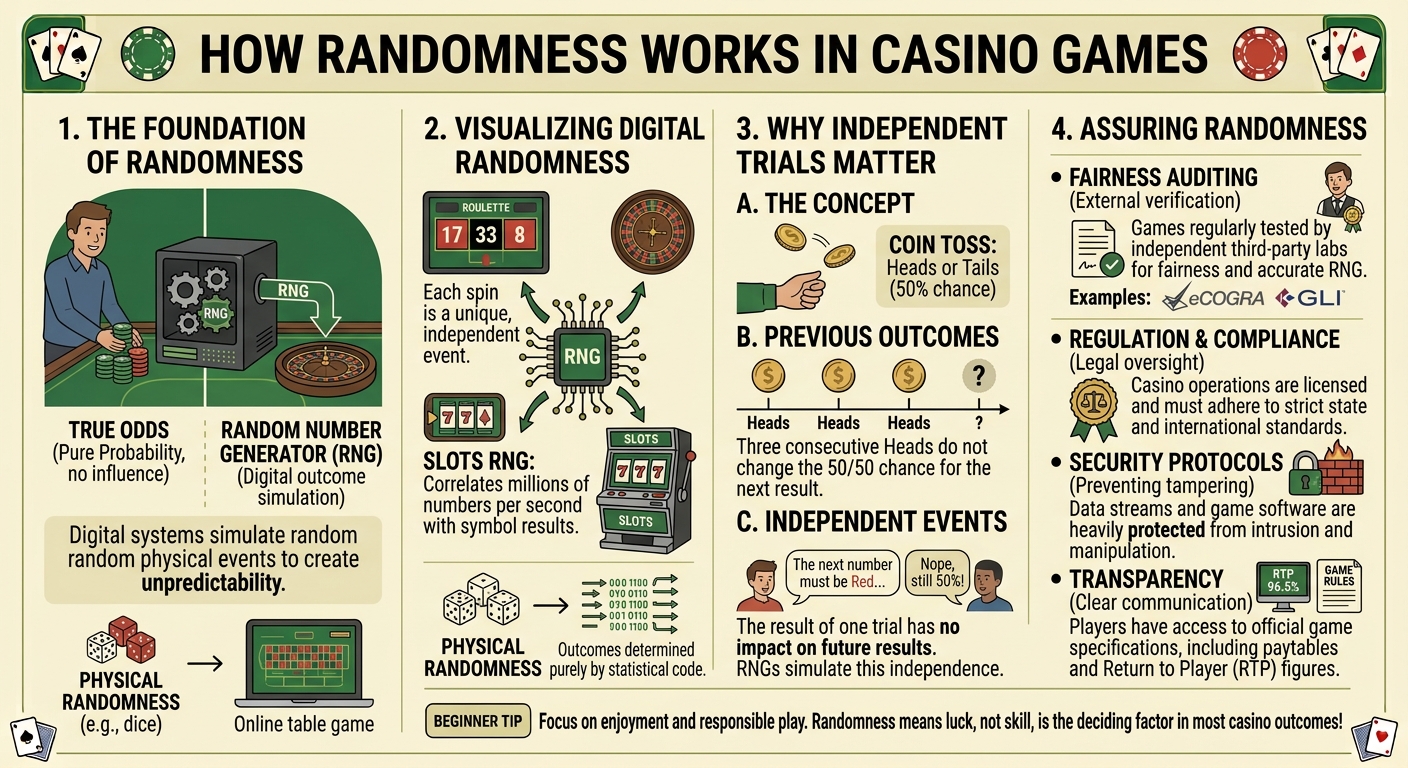
In simple terms, randomness is the lack of a predictable pattern. When a roulette wheel spins, a deck of cards is shuffled, or dice are rolled, the outcome cannot be known in advance. The process that creates the outcome is called a random number generator (RNG) in digital games, or a physical mechanism (like a wheel or dice) in live games. Both aim to produce results that are statistically independent – the result of one event does not influence the next.
Why Independence Matters
Independence means that each spin, hand, or roll is a fresh event. Even if a roulette wheel lands on red five times in a row, the probability of red on the next spin is still the same as it was on the first spin. This principle is often misunderstood as a “hot streak” or “cold streak,” but mathematically the odds reset every time.
Key Terms
- Probability: The chance that a specific outcome will occur, expressed as a fraction, percentage, or odds.
- House Edge: The built‑in advantage that the casino (or the simulation) holds over the player, expressed as a percentage of each bet.
- Volatility: A measure of how much the size of wins and losses can vary over a short period.
How Randomness Is Created in Simulations
FUNFOR.YOU uses computer‑based RNGs that are regularly tested to meet industry standards for fairness. The RNG produces a long sequence of numbers that are mathematically random. When you place a bet, the system maps those numbers to game outcomes – for example, a number between 1 and 37 might correspond to a specific pocket on a roulette wheel.
Step‑by‑Step Example: Simulated Roulette Spin
- You select a bet (e.g., “red”).
- The RNG generates a random integer from 0 to 36.
- If the number corresponds to a red pocket (18 of the 37 possible numbers), you win; otherwise, you lose.
- The house edge for European roulette is built into the payout – a win returns 1:1, but the extra zero (0) ensures the casino retains a small advantage.
Notice that the chance of landing on red is always 18/37, roughly 48.6%, no matter what happened on previous spins.
Understanding the House Edge
The house edge is not a penalty; it is a statistical fact that ensures the game operator (or the simulation platform) expects to retain a small portion of all wagers over the long run. Different games have different edges – for example, blackjack typically has a lower edge than slot machines, but the exact value depends on the specific rules and player decisions.
Because the edge is built into the game design, no betting system can eliminate it. Randomness guarantees that each individual outcome is fair, while the edge guarantees that, on average, the platform retains its margin.
Volatility and What It Means for You
Volatility describes how wildly the results can swing in a short session. High‑volatility games (like many slot titles) can produce large wins or losses quickly, while low‑volatility games (such as many table games) tend to produce smaller, more frequent outcomes. Understanding volatility helps you choose games that match your comfort level.
Practical Tips for Beginners
- Set a bankroll limit: Decide how many virtual credits you are comfortable spending in a session and stop when you reach that limit.
- Set a time limit: Allocate a specific amount of time to play and stick to it, regardless of wins or losses.
- Remember the 18+ rule: FUNFOR.YOU is intended for players who are at least 18 years old.
- Don’t chase losses: Because each outcome is independent, increasing your bets after a loss does not improve your chances and can deplete your bankroll faster.
- Focus on fun, not profit: The purpose of a free‑play simulation is entertainment and learning, not earning money.
Responsible‑Gambling Section
Even though FUNFOR.YOU does not involve real money, the habits you develop can affect how you approach gambling elsewhere. Here are some responsible‑gaming practices:
- Self‑assessment: Regularly ask yourself whether you are playing for enjoyment or to escape other problems.
- Take breaks: Pause the game at regular intervals to stay aware of how much time you have spent.
- Seek help if needed: If you feel that gaming is interfering with daily life, consider contacting a local support service for gambling‑related concerns. Look for organizations in your area that provide confidential counseling.
Always check the laws where you live before engaging with any form of gambling, even simulated versions.
Frequently Asked Questions
Is the RNG truly random?
Yes. The RNG used by FUNFOR.YOU is designed to meet industry standards for statistical randomness and is regularly audited.
Can I use a betting system to beat the house edge?
No. Because each outcome is independent, any system that claims to guarantee profit contradicts the mathematics of randomness and the built‑in house edge.
What does “volatility” mean for my gameplay?
Volatility indicates how large and how frequent the swings in your virtual balance might be. Choose low‑volatility games if you prefer steadier, smaller changes; choose high‑volatility games if you enjoy larger, less predictable swings.
How should I decide how much to bet?
Bet amounts should be a small proportion of your total bankroll – a common guideline is 1‑2 % per bet. This helps you stay in the game longer and reduces the risk of rapid depletion.
Is there any way to increase my chances of winning?
The only way to improve your odds is to choose games with a lower house edge and to play within your limits. Randomness ensures that no pattern or prediction can change the odds of an individual spin or hand.
Conclusion
Randomness is the foundation of every casino game, whether played for real money or in a free‑play simulation like FUNFOR.YOU. Understanding that each outcome is independent, that the house edge is built into the rules, and that volatility describes short‑term swings equips you to enjoy games responsibly. Remember to set clear bankroll and time limits, avoid chasing losses, and seek help if gambling ever feels out of control. With these principles in mind, you can explore casino games for fun and learning, knowing exactly how randomness shapes every spin, hand, and roll.