

How Texas Hold'em Works: A Beginner’s Guide
Texas Hold'em is the most widely played poker variant in both live and online settings. This guide is written for complete beginners who want to understand the rules, the flow of a hand, and the basic concepts that make the game enjoyable. The information applies to free‑play simulations where no real money is wagered, so you can practice without financial risk.
What Is Texas Hold'em?
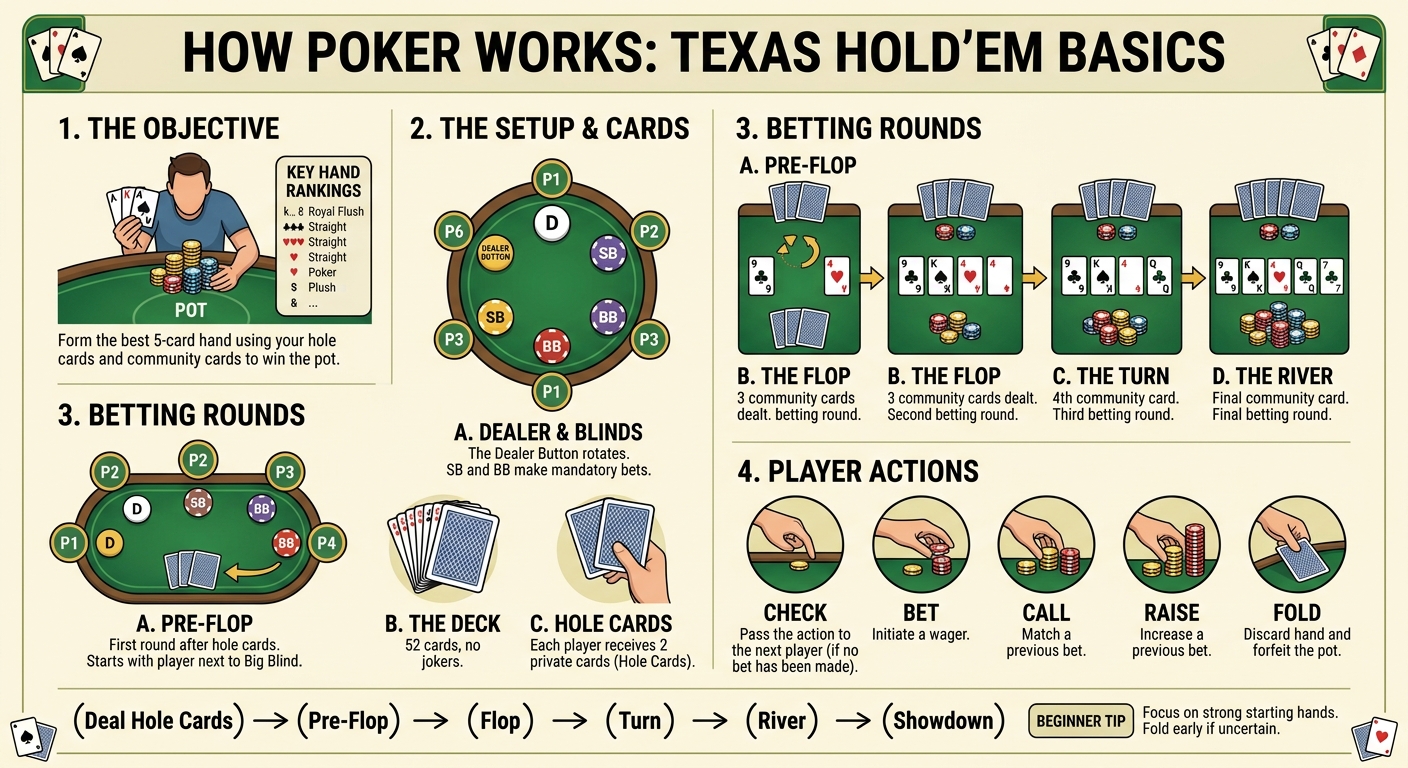
In Texas Hold'em each player receives two private cards (called "hole cards") and shares up to five community cards that are dealt face up in the centre of the table. The goal is to make the best five‑card poker hand using any combination of the two hole cards and the five community cards.
Basic Terminology
Cards and Hand Rankings
Poker hands are ranked from highest to lowest as follows:
- Royal Flush – A, K, Q, J, 10 of the same suit.
- Straight Flush – Five consecutive cards of the same suit.
- Four of a Kind – Four cards of the same rank.
- Full House – Three of a kind plus a pair.
- Flush – Any five cards of the same suit, not in sequence.
- Straight – Five consecutive cards of mixed suits.
- Three of a Kind – Three cards of the same rank.
- Two Pair – Two different pairs.
- One Pair – One pair.
- High Card – When no hand is made, the highest card wins.
Betting Rounds
There are four betting rounds in a standard Hold'em hand:
- Pre‑flop – After hole cards are dealt.
- The Flop – After the first three community cards are revealed.
- The Turn – After the fourth community card is revealed.
- The River – After the fifth and final community card is revealed.
Positions
The seating order determines the order of action. The two players to the left of the dealer button post forced bets called the small blind and big blind. Positions later in the order have more information because they act after earlier players.
Game Flow: Step‑by‑Step
Below is a concise walk‑through of a typical hand, assuming a standard table of up to ten players.
- Dealer Button and Blinds – The dealer button rotates clockwise after each hand. The player immediately left posts the small blind; the next player posts the big blind.
- Deal Hole Cards – Each player receives two private cards face down.
- Pre‑flop Betting – Starting with the player left of the big blind, each participant can fold, call the big blind amount, or raise to increase the pot.
- Flop – The dealer burns one card (places it face down) and then reveals three community cards.
- Flop Betting – Betting resumes, starting with the first active player left of the button.
- Turn – Another burn card is discarded, and a fourth community card is dealt.
- Turn Betting – Another round of betting occurs.
- River – A final burn card is discarded, and the fifth community card is dealt.
- River Betting – The last betting round takes place.
- Showdown – If more than one player remains, all reveal their hole cards. The best five‑card hand wins the pot.
Practical Example Hand
Imagine a table of six players. The button is on Player 3, so Player 4 posts the small blind and Player 5 posts the big blind.
- Hole Cards – Player 1 receives A♠ K♣, Player 2 receives 9♥ 9♦, Player 3 receives J♠ 10♠, Player 4 receives 7♣ 2♥, Player 5 receives Q♦ Q♥, Player 6 receives 5♠ 4♠.
- Pre‑flop Action – Player 1 raises, Player 2 calls, Player 3 folds, Player 4 folds, Player 5 re‑raises, Player 6 folds, Player 1 calls the re‑raise, Player 2 calls.
- Flop – The board shows Q♠ 8♣ 3♦. Player 5 now has three of a kind (Queens). Player 1 has a high‑card Ace, Player 2 still has a pair of Nines.
- Flop Betting – Player 1 checks, Player 2 bets, Player 5 raises, Player 1 folds, Player 2 calls the raise.
- Turn – The fourth community card is Q♥. Player 5 now has four of a kind (Queens). The board reads Q♠ 8♣ 3♦ Q♥.
- Turn Betting – Player 2 checks, Player 5 bets a sizable amount, Player 2 folds.
- River – The final card is 2♣. No hand improvement is possible.
- Showdown – Player 5 reveals the four Queens and wins the entire pot.
This example shows how the community cards can dramatically change hand strength, and why position and betting decisions matter.
Bankroll and Time Management
Even in a free‑play environment, treating a virtual bankroll as if it were real money helps develop disciplined habits. Consider the following guidelines:
- Set a Session Limit – Decide in advance how many virtual chips you will start with and stop when they are gone or when you reach a pre‑determined time limit.
- Avoid Chasing Losses – If a hand goes badly, resist the urge to play more aggressively to recover. Each hand is independent; past results do not affect future outcomes.
- Understand Volatility – Poker can swing widely in the short term. Accept that winning and losing streaks are natural.
- Take Breaks – Regular short breaks reduce fatigue and help you stay focused on the strategic aspects of the game.
Responsible Gambling
Playing poker for fun should always be balanced with personal well‑being. Although FUNFOR.YOU uses simulated chips and no real money changes hands, the same principles apply:
- Check Local Laws – Verify that online gaming, even in a free‑play format, is permitted in your jurisdiction.
- Set Personal Limits – Decide on a maximum amount of virtual chips and a maximum amount of time you will spend each session.
- Recognize Signs of Problematic Play – Feelings of anxiety, irritability, or a compulsion to keep playing despite a set limit may indicate a need to pause.
- Seek Help If Needed – If you notice a pattern of excessive play, consider contacting a local support service for gambling‑related concerns. Many countries have free, confidential helplines and counseling options.
- Remember the Entertainment Purpose – The primary aim of a free‑play simulation is to enjoy the strategic challenge, not to earn income or solve financial problems.
Frequently Asked Questions
- Do I need to know advanced strategies to enjoy Texas Hold'em? No. Understanding the basic flow, hand rankings, and betting rounds is enough to have fun and start learning.
- Is the outcome of each hand random? Yes. The cards are shuffled before each hand, and each draw is independent of previous draws. No pattern can predict future cards.
- Can I win real money on FUNFOR.YOU? No. The site provides a simulated environment where all chips are virtual and cannot be cashed out.
- What should I do if I feel upset after a losing streak? Take a break, step away from the screen, and engage in a different activity. If negative feelings persist, consider reaching out to a local support service.
- How often should I reset my virtual bankroll? It depends on personal preference. Some players reset after each session to keep the experience fresh; others keep a cumulative total to track long‑term progress.
Conclusion
Texas Hold'em combines simple rules with deep strategic possibilities, making it an ideal entry point for new poker players. By learning the terminology, following the step‑by‑step flow, and practicing with concrete examples, you can build confidence in a risk‑free environment. Remember to play responsibly, respect your personal limits, and enjoy the social and intellectual aspects of the game.