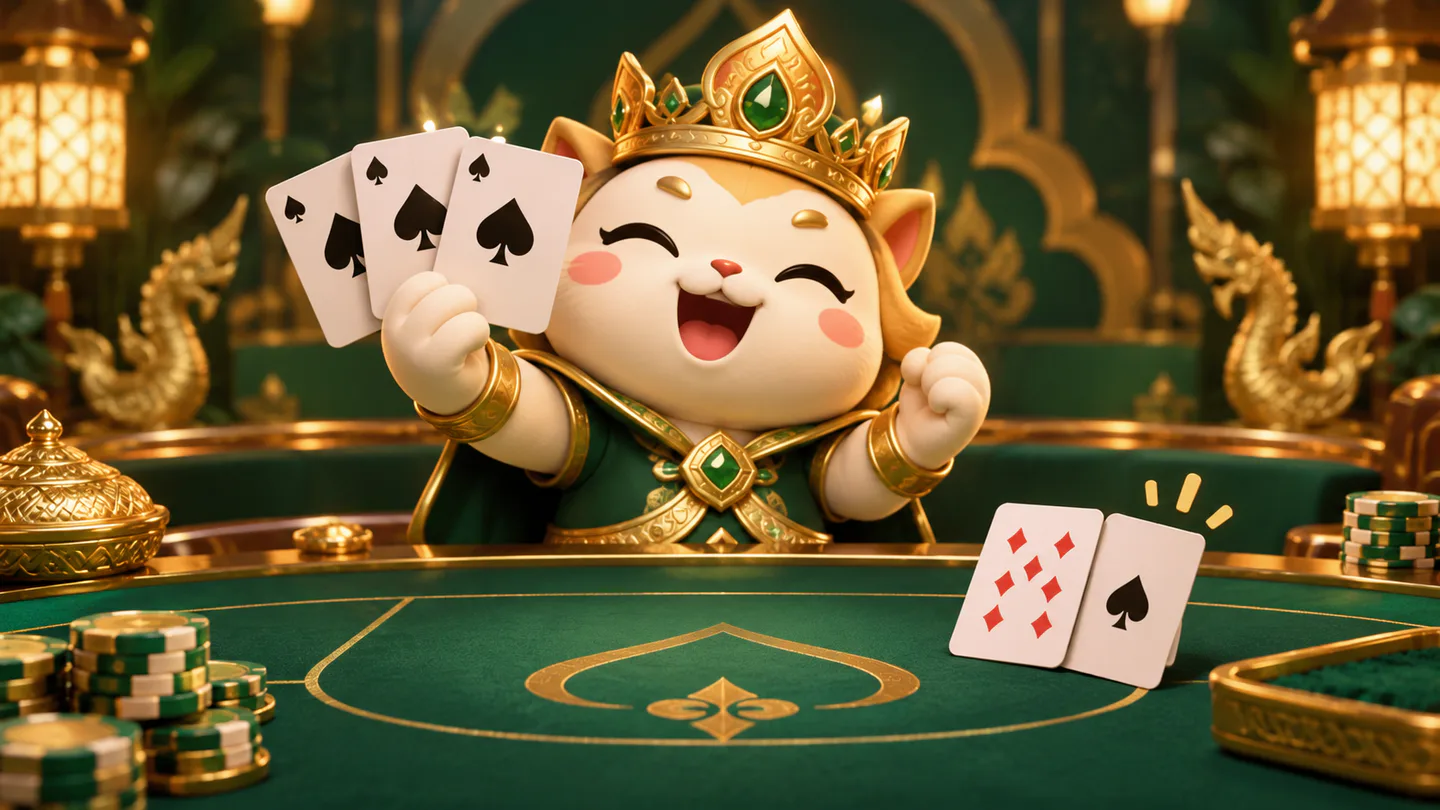
Pok Deng takes its name from its two big ideas. Deng is the multiplier — the extra you win for a pair, a flush, a straight. Pok is the natural: an 8 or 9 on your first two cards. It is the best thing that can happen to you at the deal, and the first thing a new player needs to understand, because it changes what the buttons do.
What makes a Pok
Cards count as in baccarat: ace is one, two through nine are face value, tens and pictures are zero, and only the last digit of the total matters. 4 and 5 make 9; 9 and 9 make 8; king and 8 make 8. Any two cards whose last digit is 8 or 9 are a Pok. Two cards making 7 are not — a 7 is a good hand, but it is an ordinary one.
Why the hand stops
A Pok cannot be improved by drawing, only ruined. Draw to an 8 and the only cards that help are a one or a zero, and a zero does nothing. Draw to a 9 and nothing helps at all. So the rule takes the decision away: a Pok stands automatically. At our tables the Draw and Stay buttons simply do not appear; your hand is set the moment it lands, and the table tells you so.
Pok against Pok
A Pok is a rank, not just a total — the highest rank in the game, above three of a kind, above a straight, above everything in the hand rankings. Two Poks compare on points: Pok 9 beats Pok 8. Two Poks on the same points compare on deng: a suited or paired Pok carries 2×, a mixed one 1×, and the higher deng wins the difference. Equal on everything is a push.
The dealer's Pok
The dealer's two cards are dealt face down and stay that way while you decide. If they turn out to be a Pok, the dealer does not draw, and the dealer's Pok beats every hand at the table that is not itself a Pok — including a three-card 9. This is the situation new players find hardest: you drew to a 5, made a 9, and lost to an 8. You did not play it wrong. A two-card 8 outranks a three-card 9, and there was no way to know what the dealer held.
What this means for your decision
Two things. First, a Pok on your side is settled before you touch a button — enjoy it. Second, when you do not have one, your draw decision is made against a dealer who might. That is the real tension of the game and the reason a 7 is worth standing on: a 7 loses to a dealer Pok whatever you do, and drawing to it only risks the hands it would otherwise beat. The full third-card reasoning is in the Pok Deng third-card decision, and the payout multipliers in deng multipliers.
How often it happens
Roughly one deal in six gives either you or the dealer a Pok. It is common enough to shape every hand and rare enough to still feel like an event. That balance is why the game carries its name.