
Pok Deng deals fast and gives you exactly one decision: draw a third card, or stay. On our tables the game is listed as Poky Dee, and that single choice is the whole of your influence over the hand.
It is also less obvious than it looks, because of how the scoring works.
Scores wrap around
Card points: ace is 1, two through nine are face value, and ten, jack, queen and king are all worth zero. Add your cards and keep only the last digit — a 7 and a 6 make 13, which scores 3.
This is why a third card is not simply an upgrade. Drawing onto a 6 and catching a 7 does not give you 13; it gives you 3. In Pok Deng a card can take your hand backwards, and often does.
Pok ends it immediately
If your first two cards total 8 or 9, that is Pok. The hand stops there, it beats every ordinary hand, and no third card is offered — the decision is made for you.
What the dealer does
Worth knowing before you choose: the dealer has no choice either. They draw a third card when their score is 4 or lower, and stay on 5 or more.
So if you stay on a low score, you are not facing a dealer who might also be stuck low — they will be drawing to improve.
The arithmetic of drawing
Sixteen of the fifty-two cards are worth zero, so roughly three draws in ten leave your score exactly where it was. The rest move it, and which way depends entirely on where you start.
Standing on 6 or 7: only three point values improve you, while six make you worse. Drawing turns a good hand into a worse one about twice as often as it helps. Stay.
Standing on 5: genuinely close. Four values improve you, five hurt you, and the rest change nothing. On points alone it is slightly negative.
Standing on 4 or lower: now drawing is clearly right. More cards help than hurt, and staying on a 2 against a dealer who is about to draw is close to conceding the hand.
The part the arithmetic misses
Points are only half of Pok Deng. The other half is the deng — the multiplier attached to the shape of your hand — and three-card hands are where the big ones live.
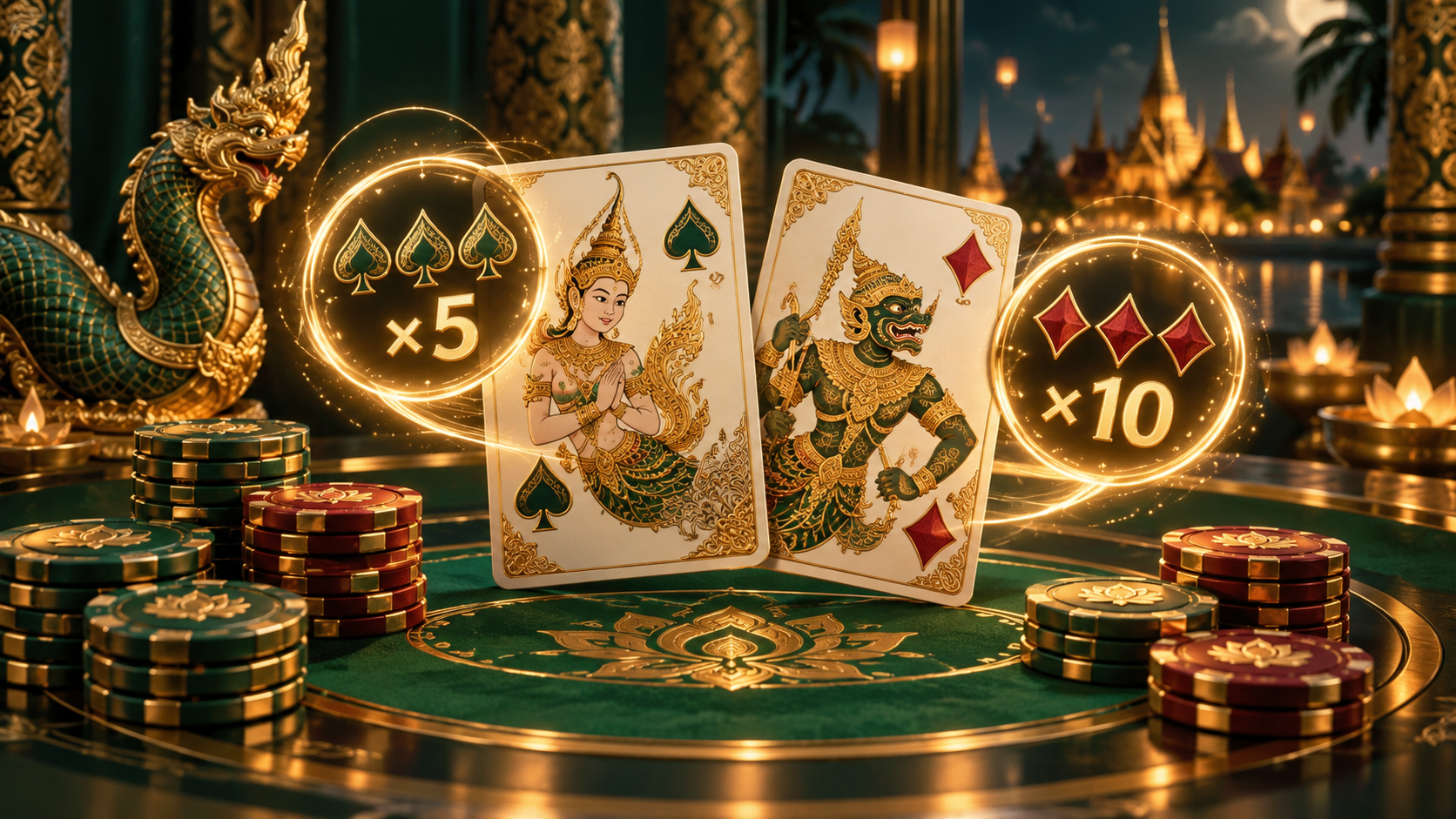
Two cards can earn a deng of 2, for a matching pair or two of the same suit. Three cards open up considerably more: a flush, a straight or three face cards (Sam Lueang) each carry deng 3, while three of a kind (Tong) and a straight flush carry deng 5.
Those hands also outrank ordinary ones outright, regardless of points. So a third card is not only a shot at a better score — it is the only route to the hands that pay several times your stake.
That tilts the marginal cases. Holding two face cards, your score is 0 and you have almost nothing to lose: a third face card makes Sam Lueang, and any other card can only improve a score of zero. Holding two cards of the same suit, or two in sequence, a draw carries real upside beyond the points.
The short version
Stay on 6 or 7. Draw on 4 or less, and draw more readily when your two cards share a suit, sit in sequence, or are both faces. On 5, either is defensible — lean towards drawing when your cards have shape, and staying when they have none.
It is a small edge in a fast game, but it is the only decision you get.