
How Pok Deng Works: A Beginner’s Guide
Pok Deng (sometimes written Pok Deng) is a popular Thai card game that is often featured in free‑play casino simulations. It is played with a standard 52‑card deck and is known for its rapid rounds and straightforward betting structure. This article explains the game from the ground up, provides a clear step‑by‑step walkthrough, and includes responsible‑gaming advice for anyone new to the table.
What Is Pok Deng?
History and Setting
Pok Deng originated in Thailand and is commonly found in local card rooms and online simulations. The name roughly translates to “to win by a point,” reflecting the way a hand can win by a single point difference. While the game is often enjoyed for fun, it is also offered on free‑play sites where no real money is at stake, making it a low‑risk way to learn basic card‑game mechanics.
Basic Components
Deck and Card Values
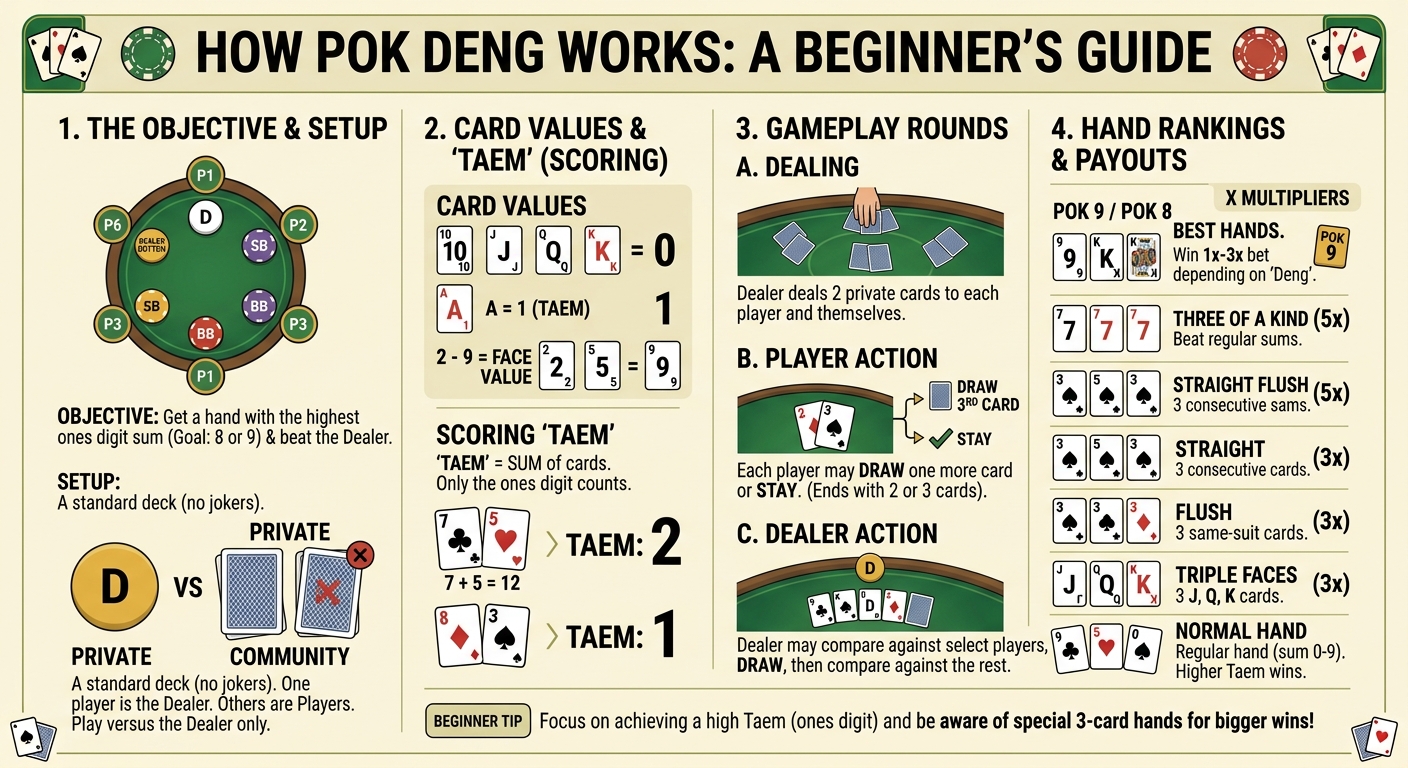
The game uses a single 52‑card deck without jokers. Card ranks are valued as follows:
- Aces count as 1 point.
- Cards 2 through 9 retain their face value.
- 10, Jack, Queen, and King are worth 0 points.
Points are calculated by adding the values of the cards in a hand and then taking the last digit of the total. For example, a hand of 7 ♣ and 9 ♦ totals 16 points, which counts as 6 points.
Hand Types
Pok Deng recognises several special hand types that outrank ordinary point totals. The hierarchy, from highest to lowest, is:
- Pok 8 or Pok 9 – a two‑card hand that totals exactly 8 or 9 points. This is the strongest ordinary hand.
- Three‑of‑a‑Kind – three cards of the same rank (e.g., three Queens). This beats a Pok 8/9.
- Straight Flush – three consecutive cards of the same suit (e.g., 4‑5‑6 of hearts). This beats three‑of‑a‑kind.
- Flush – three cards of the same suit but not in sequence. Beats a regular point total but loses to a straight flush.
- Three‑Card Total – the sum of three cards, reduced to a single digit as described above.
If both player and dealer have the same hand type, the winner is decided by the highest individual card value, and if still tied, the hand is a draw.
How to Play – Step by Step
- Place a Bet – On a free‑play simulation you choose an amount of virtual chips. Remember, this is for entertainment only.
- Dealer Deals Two Cards – Both the player and the dealer receive two face‑up cards.
- Check for Pok – If either hand totals 8 or 9 points, the round ends immediately. The higher Pok wins; a tie results in a push.
- Decide to Draw – If no Pok appears, the player may choose to draw a third card or stand with the two cards. The dealer follows a fixed rule (often drawing on totals of 0‑4 and standing on 5‑9).
- Evaluate the Final Hands – After any draws, compare hand types using the hierarchy above.
- Settle the Bet – In a simulation, the virtual balance is adjusted according to the outcome. No real money changes hands.
Because the dealer’s drawing rule is predetermined, the player’s only decision point is whether to take a third card when the initial total is low.
Practical Example
Imagine you are playing a round with a virtual bankroll of 1,000 chips.
- You bet 50 chips.
- The dealer deals you a 7 ♠ and a 2 ♥. Your two‑card total is 9 points (7 + 2 = 9). This is a Pok 9, the strongest ordinary hand.
- The dealer’s two cards are 10 ♣ and 5 ♦, totaling 5 points.
- Since you have a Pok 9, the round ends immediately and you win. In a free‑play environment the win is recorded, but no cash is earned.
If instead your first two cards were 4 ♣ and 3 ♦ (total 7 points), you would decide whether to draw a third card. Suppose you draw a King ♥ (value 0). Your final total is still 7 points, and you would compare this against the dealer’s final hand to determine the winner.
Key Concepts for Beginners
House Edge and Randomness
Even in a free‑play simulation, the game is programmed to reflect the statistical house edge that exists in real‑money versions. Outcomes are generated by a random number generator (RNG), meaning each card draw is independent and unpredictable. No pattern, system, or skill can guarantee a win.
Volatility
Because rounds are short and bets are settled quickly, Pok Deng can feel volatile – a winning streak can be followed by a rapid loss of several bets. Understanding this helps you keep expectations realistic.
Bankroll Management
Set a virtual bankroll limit before you start playing. Decide how much of that bankroll you are comfortable risking in a single session and stick to it. For example, you might limit yourself to betting no more than 5 % of your total chips on any one hand.
Time Limits
Playing for a set amount of time (e.g., 30 minutes) can prevent fatigue and impulsive decisions. When the timer ends, take a break regardless of how the session is going.
Why Chasing Losses Is Counterproductive
Increasing bet size after a loss, hoping to “recover” the lost chips, statistically raises the chance of a larger loss. Because each hand is independent, past results do not influence future outcomes.
Responsible Gaming
Even on a free‑play platform, it is important to treat the experience responsibly. Follow these guidelines:
- Play only if you are 18 years of age or older.
- Set clear limits for virtual chips and time before you begin.
- Take regular breaks – at least a few minutes every half hour.
- If you notice that playing is affecting your mood, sleep, or daily responsibilities, stop and consider speaking with a local support service for gambling‑related concerns.
Most jurisdictions have organisations that provide confidential help. A quick internet search for “gambling support” in your area will point you toward appropriate resources.
Frequently Asked Questions
Is Pok Deng the same as Baccarat?
No. While both games involve comparing a player’s hand to a dealer’s, Pok Deng uses a 52‑card deck, has distinct hand rankings, and allows the player to draw a third card based on a simple decision.
Can I use a strategy to beat the game?
No strategy can overcome the built‑in house edge because each card is drawn randomly. The best “strategy” is to manage your bets responsibly.
Do free‑play simulations use real money?
All chips on a free‑play site are virtual and have no monetary value. They exist solely for entertainment and learning purposes.
What is the typical house edge in Pok Deng?
The exact edge varies with the specific rules used by a platform, but it is generally modest compared with many other casino games. The edge arises from the dealer’s drawing rules and the payout structure.
How do I know if I’m developing a problem?
Signs can include playing longer than intended, feeling anxious when not playing, or neglecting other activities. If any of these apply, seek help from a local counseling service or a gambling‑support organisation.
Conclusion
Pok Deng offers a fast, easy‑to‑learn card experience that is well suited for beginners, especially on free‑play simulation sites. By understanding the deck, hand rankings, and the simple decision to draw a third card, you can enjoy the game responsibly. Remember that outcomes are random, the house retains a small edge, and the most important skill is managing your virtual bankroll and time. Play for fun, stay within your limits, and enjoy the unique flavor of this Thai classic.