

What Is the House Edge and Why It Matters
Welcome to the world of free‑to‑play casino simulations. Before you start spinning virtual reels or dealing virtual cards, it helps to understand one core concept: the house edge. Knowing what it is and how it works lets you set realistic expectations and make safer choices while you enjoy the games.
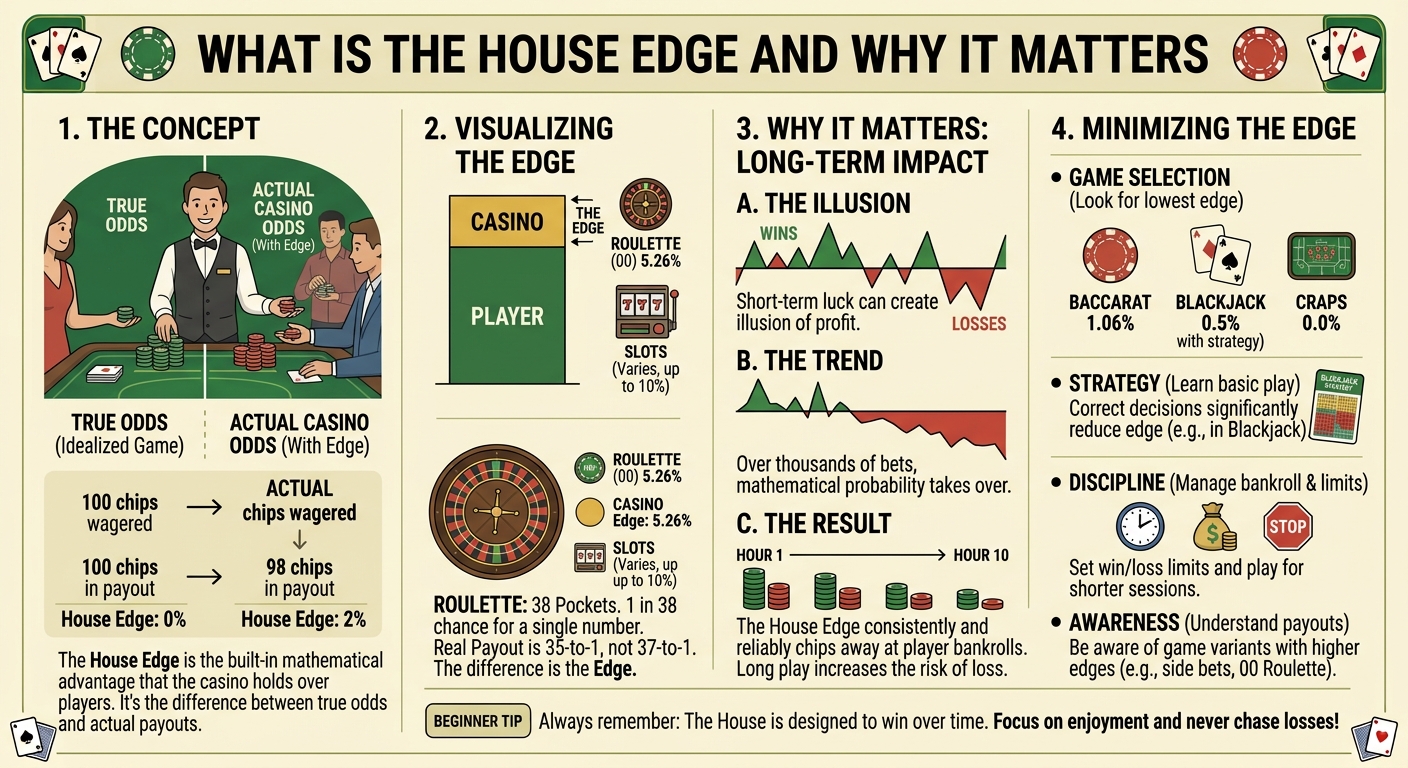
Understanding the House Edge
The house edge is the average percentage of each wager that the casino expects to keep over the long run. It is not a fee you pay directly; rather, it is built into the game’s rules and payout structure. For example, if a game returns ninety‑five percent of the money wagered to players over many thousands of bets, the house edge is five percent.
How It Is Calculated
To calculate the edge, you compare the total amount a player could theoretically win with the amount they actually wager. In a simple example, imagine a game where a player bets $1 on a single outcome that pays $2 when it wins, and the chance of winning is 45 %. The expected return is 0.45 × $2 = $0.90 per $1 bet. The house keeps the remaining $0.10, which is a 10 % house edge.
Randomness and Independence of Outcomes
All casino games rely on random number generators (RNGs) or physical randomness (like shuffled cards). Each spin, roll, or hand is independent of the previous one, meaning past results do not influence future outcomes. This independence ensures that the house edge remains consistent over time, regardless of short‑term streaks.
Volatility and Its Relationship to the House Edge
Volatility describes how much a player’s bankroll can swing in the short term. A high‑volatility game may produce large wins and large losses quickly, while a low‑volatility game tends to produce smaller, more frequent results. Volatility does not change the house edge, but it affects how quickly a player might feel the impact of that edge.
Practical Steps for Beginners
Set a Bankroll Limit
Decide how much virtual currency you are comfortable spending in a session and stick to that amount. Treat the bankroll as a fixed resource, not something to chase.
Set a Time Limit
Choose a reasonable amount of time to play and stop when the timer goes off. This helps prevent fatigue‑driven decisions.
Choose Games with a Lower House Edge
Some games, such as certain versions of blackjack or video poker, are designed with a smaller edge compared to many slot simulations. Selecting these games can extend your playing time and reduce the speed at which the edge erodes your bankroll.
Example: Simulated Slot Game
Imagine a virtual slot that returns ninety‑seven percent of all wagers over the long run. If you bet 100 virtual credits, the expected loss is about three credits. In practice, you might win a big payout early or lose a few credits in a row, but over many spins the average loss will approach three percent of the total amount wagered.
Responsible Gambling
Even though FUNFOR.YOU uses no real money, the same principles of responsible play apply. Always be 18 + or older when you access the site. Check the laws where you live before playing any gambling‑related simulations. If you ever feel that playing is affecting your mood, sleep, or daily responsibilities, pause and consider seeking help from a local support service or a trusted professional. Remember that the house edge ensures the casino (or simulation) will keep a portion of the wagers over time; it is not a guarantee of profit for any player.
Frequently Asked Questions
- Can I beat the house edge? No strategy can permanently overcome the built‑in advantage. Skill can affect short‑term results in some games, but the edge remains over the long run.
- Does a higher payout mean a lower house edge? Not necessarily. A high payout on a rare outcome can coexist with a high edge if the overall return to player is low.
- Will I lose money quickly? The speed of loss depends on volatility and bet size. Larger bets on high‑volatility games can deplete a bankroll faster.
- Is the house edge the same for every game? No. Each game has its own rules and payout structure, resulting in different edges.
Conclusion
The house edge is a fundamental concept that explains why casinos, even virtual ones, retain a portion of all wagers. By understanding how it is calculated, recognizing the role of randomness, and managing your bankroll and time, you can enjoy free‑play casino simulations with realistic expectations and a responsible mindset.