
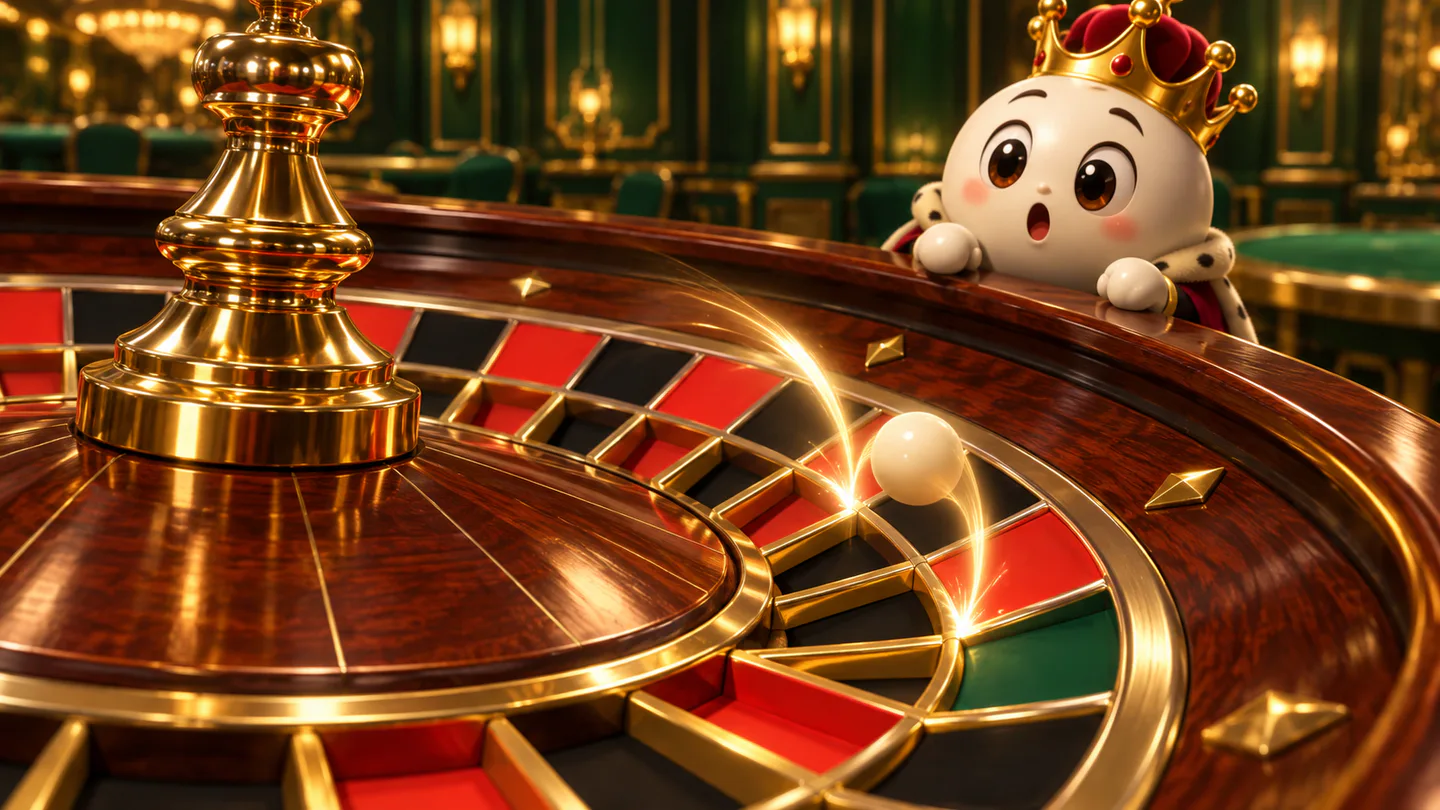
Watch a roulette ball closely and you will notice it almost never stays where it first lands. It drops into a pocket, cracks against the brass divider, hops one or two places, and settles. If you called the number the moment it left the outer track, you were usually a few pockets out. That is not a flaw in the wheel. It is the whole reason roulette works.
Frets, deflectors, and the drop
A wheel has two things designed to disturb the ball. Around the sloped bowl are deflectors — small diamond-shaped studs that catch the ball as it loses speed on the track and throw it inward at an angle nobody can plan. Between the pockets are frets, the raised dividers the ball strikes on the way in.
The ball arrives at the pockets still moving against the direction of the wheel. It cannot simply stop; it has to lose its remaining energy somewhere. It hits a fret, bounces back, hits another, and comes to rest a pocket or two behind its first contact. Where exactly depends on the ball's speed to a hundredth, the wheel's speed, and the precise point of impact on the fret — quantities no eye can read.
This is what defeats prediction
People who have tried to beat roulette by timing the ball — and some very clever ones have, as we cover in what Einstein said about roulette — can sometimes estimate where the ball will leave the track. What they cannot estimate is the scatter afterwards. Two or three pockets of bounce, in either direction, is enough to turn a good guess into an ordinary bet. The frets are there precisely so that the last few centimetres are chaos.
What an online wheel is showing you
On a screen, there is no ball and no brass. The winning number is chosen by the game's random number generator before the animation starts — the same as every casino-style game here, as explained in how randomness works in casino games. The wheel you watch is a faithful replay of a physical landing: the ball is drawn to arrive a few pockets early, strike the fret, hop back, and settle on the number that was already decided.
Why bother animating the bounce, then? Because a ball that glides straight into its pocket looks like what it is, a number being displayed. A ball that fights the frets looks like a wheel. Neither version changes your odds; one of them is honest about what a real wheel does.
The practical conclusion
Two things follow. First, no amount of watching the flight tells you anything about the result — not on a real wheel, and certainly not here, where the number is fixed before the ball moves. Second, every bet on the layout carries the same house edge regardless of where the ball bounces, which we walk through in why every roulette bet has the same house edge. The bounce is theatre. Good theatre — but the arithmetic was settled before the curtain went up.