Ask a regular which side to back and they will say Banker, with the air of someone sharing a secret. They are half right. Banker does win more often. It also pays less. The two facts are connected, and the connection is the whole story of baccarat's house edge.
The numbers
Over a very long run, roughly 45.9% of hands are won by Banker, 44.6% by Player, and 9.5% are ties. Ignore the ties and Banker wins a little over 50.7% of the decided hands. That is a real, permanent lean — and it is not luck or superstition. It is the drawing rules.
Where the lean comes from
Player acts first and follows a simple rule: draw on 5 or less, stand on 6 or 7. Banker acts second and follows a table that depends on what Player drew. If Player took a third card, Banker's decision to draw is tuned to the value of that card — drawing more readily when Player's card was weak, standing more readily when it was strong. Banker, in other words, gets to respond. Player does not.
That is the entire advantage. There is no hidden information and no skill involved; the tableau simply hands the second-moving side a better decision rule. The full table is walked through in the third-card rule explained.
Why the commission exists
If Banker paid even money like Player, backing Banker would be a winning bet — the only one in the casino. So a winning Banker bet pays 95 for 100 instead of 100. At our tables that 5% is taken from the profit and rounded down to whole chips.
Run the arithmetic and the commission takes back almost all of the lean, but not quite. The house keeps about 1.06% of Banker wagers and about 1.24% of Player wagers in the long run. Banker is still the marginally better side — by a fifth of a percent — and both are among the lowest house edges anywhere on a casino floor.
What this means at the table
Three things. First, there is no side that wins for you; both lose slowly, Banker slightly more slowly. Second, the difference between them is small enough that it will never show up in a session — it is a long-run number, not a tactic. Third, the tie bet, which pays 8:1 and sounds generous, keeps over 14% for the house, which is why it is the worst bet on the table.
The temptation to be avoided
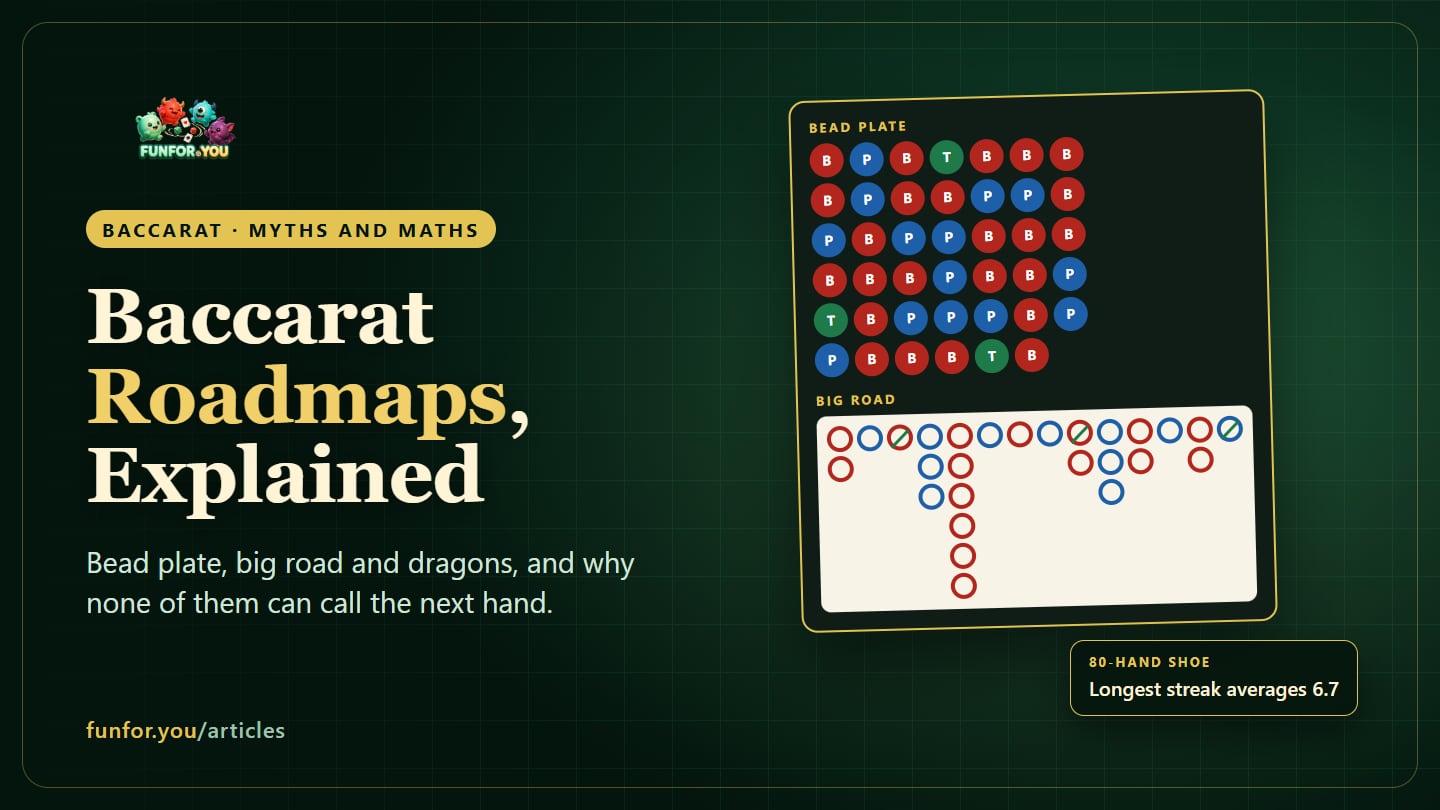
Because Banker wins a majority of decided hands, it is easy to feel it is “due” after a run of Player wins, or that you should switch sides when Player has been hot. Neither is true. Each hand is dealt fresh from the shoe and the 50.7% applies to the next hand exactly as it applied to the last. The lean is real; the streaks are noise. Keep them separate and baccarat is one of the most honest games there is.