
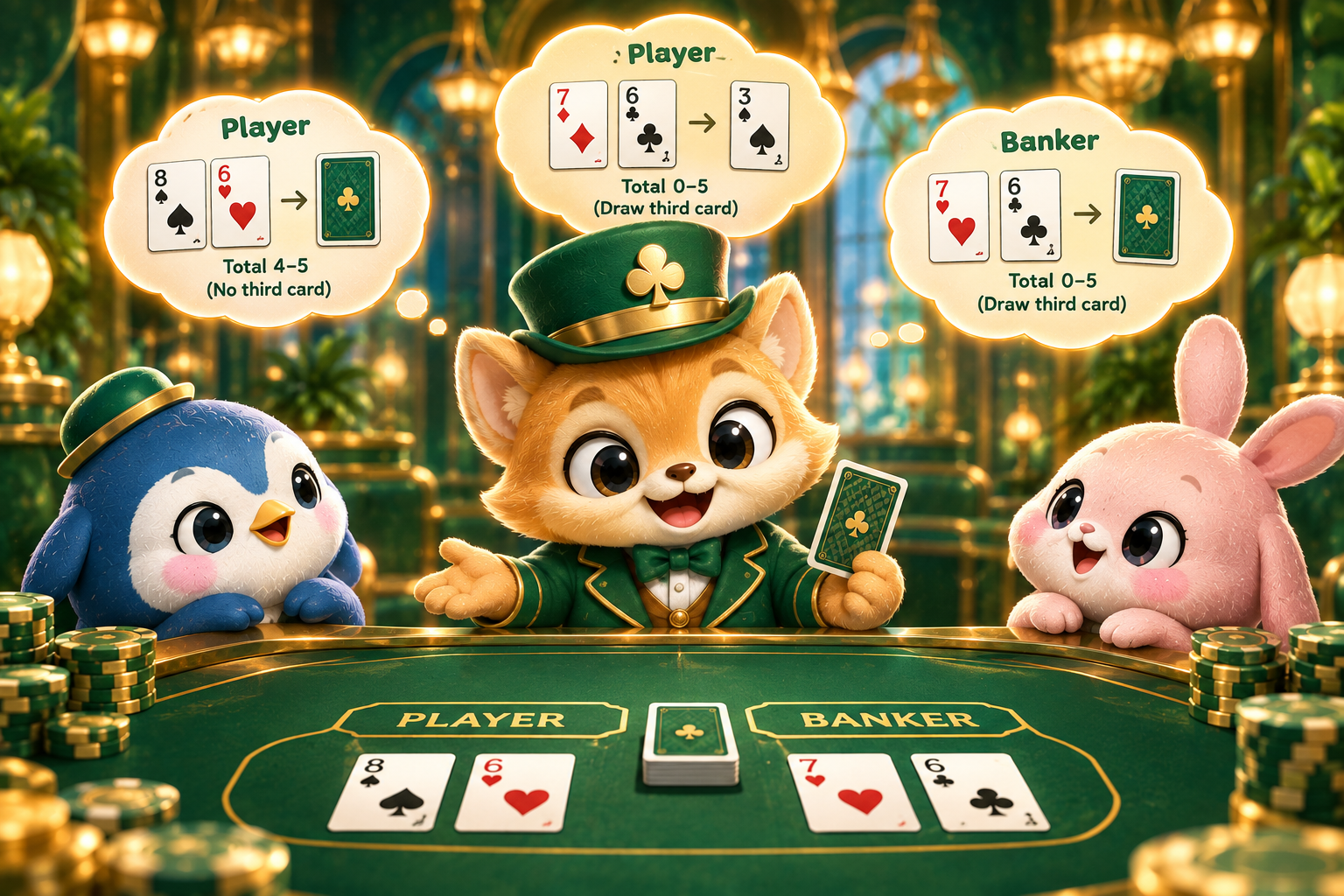
New baccarat players usually follow the first two cards fine, then get lost the moment a third one appears. Sometimes it goes to the player, sometimes the banker, sometimes both, sometimes neither — and nobody at the table seems to ask for it.
That is because nobody decides. The third card is fixed by rule, and understanding the shape of that rule takes about two minutes.
First, the totals
Card values: aces are 1, two through nine are face value, and tens and face cards are 0. Add the two cards and drop the tens digit — a 7 and an 8 make 15, which is 5. Nothing can be higher than 9.
Naturals end it
If either side's first two cards total 8 or 9, that is a natural. No third card is dealt to anyone, the hands are compared and the round is over.
The player's rule is simple
If no natural appeared, the player hand goes first, and it has only one rule:
- Total 0 to 5 — draw a third card.
- Total 6 or 7 — stand.
That is the whole thing.
The banker's rule is where the chart comes from
The banker acts second, and it reacts to what the player just did.
If the player stood (they had 6 or 7), the banker uses the same rule the player did: draw on 0 to 5, stand on 6 or 7.
If the player drew, the banker's decision depends on its own total and on the card the player received:
- Banker 0, 1 or 2 — always draws.
- Banker 3 — draws unless the player's third card was an 8.
- Banker 4 — draws if the player's third card was 2 through 7.
- Banker 5 — draws if it was 4 through 7.
- Banker 6 — draws only if it was 6 or 7.
- Banker 7 — always stands.
The pattern underneath is intuitive once you see it: the weaker the banker's hand, the more willing it is to draw, and the better the card the player just took, the more the banker needs to respond.
Why you never need to know this
Here is the part that matters. Baccarat has no decisions in it. You are not the player hand and you are not the banker hand — you are simply betting on which of the two will win, and the drawing rules run themselves.
You could know the chart perfectly and it would change nothing about how you bet. It is worth understanding only so the game stops feeling arbitrary.
What does matter is the bet you pick
The one real decision in baccarat is which of the three bets you place.
Banker wins slightly more often than player, which is why it pays 0.95 to 1 rather than even money. Even after that deduction it remains the best bet on the table.
Player pays 1 to 1 and is very close behind — a fraction of a percent worse.
Tie pays 8 to 1, which sounds generous and is not. Ties are rare enough that this is by far the worst bet available, costing several times what the other two do. If a hand does tie, banker and player bets are returned rather than lost.
So the practical summary of baccarat is short: bet banker, occasionally bet player, and leave the tie alone.