
How Baccarat Works: A Beginner’s Guide
Baccarat is a popular card game often seen in casino settings, but its core mechanics are simple enough for anyone to learn. This guide is written for complete beginners and focuses on the free‑to‑play version offered by FUNFOR.YOU, where no real money is involved. All explanations are plain, factual, and free of promises about winning.
What Is Baccarat?
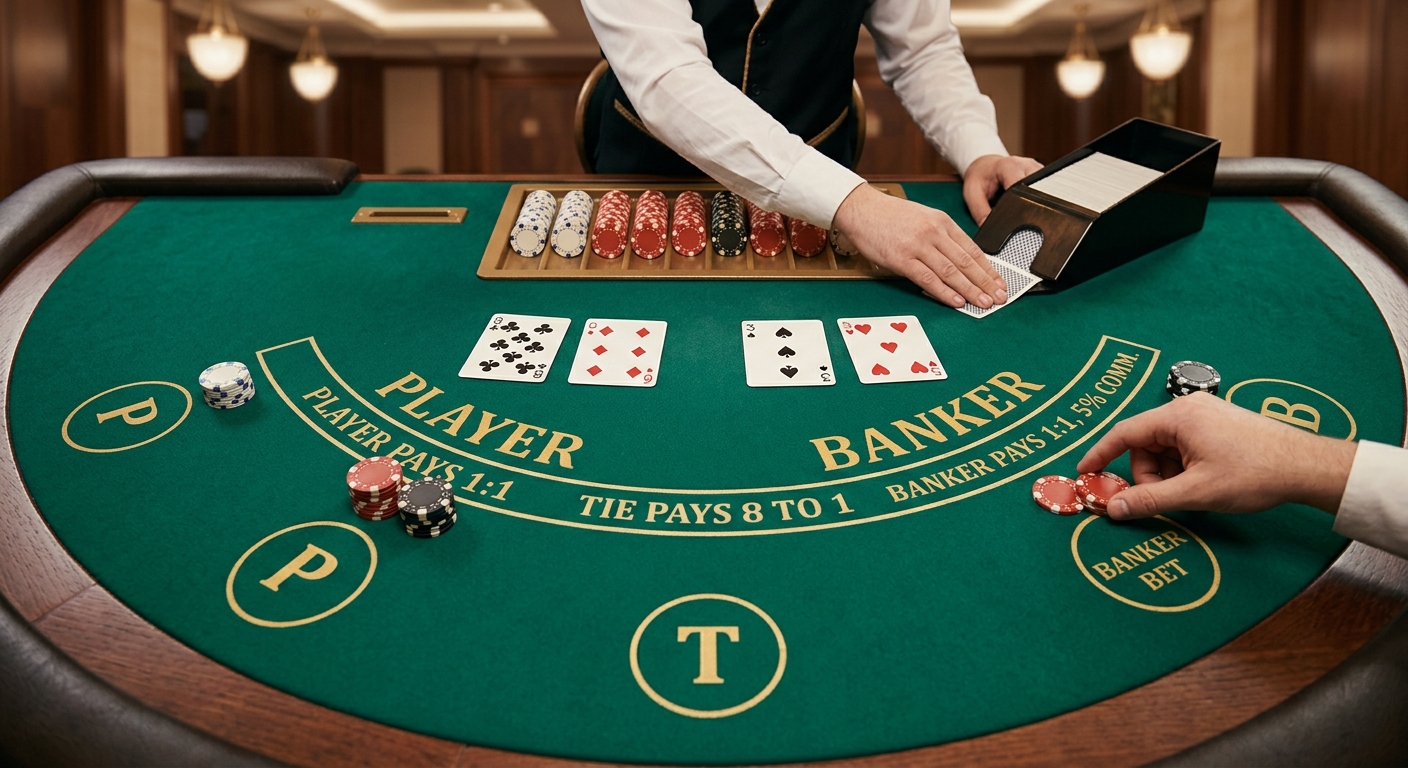
Baccarat is a comparing‑cards game played between two hands: the Player and the Banker. A third option, the Tie, allows a bet that both hands will end with the same total. The goal is to predict which hand will finish closest to a total of nine.
The Basic Rules
Each round follows a short sequence:
- Players place bets on Player, Banker, or Tie.
- Two cards are dealt to each hand.
- Depending on the totals, a third card may be drawn according to fixed rules.
- The hand with the total nearest to nine wins.
Card values are straightforward: cards 2 through 9 count at face value, tens and all face cards count as zero, and aces count as one. When adding the two cards, only the unit digit of the sum matters. For example, a hand of 7 and 8 totals 15, but the baccarat value is 5.
Understanding the Three Main Bets
The game offers three distinct betting options, each with its own probability and house edge. The Banker bet wins slightly more often because the Banker hand follows a set of drawing rules that give it a modest advantage. The Player bet is simpler to understand and has a slightly higher house edge than the Banker bet. The Tie bet pays the most, but it is the least likely outcome and therefore carries the highest house edge.
Step‑by‑Step Playthrough
1. Place Your Bet
Before any cards are dealt, decide which outcome you think will win. On the simulation interface, click the button that corresponds to Player, Banker, or Tie. Remember, this is a virtual game for entertainment only.
2. Deal the First Two Cards
The dealer (or the software) automatically deals two cards to each hand. Add the values using the baccarat rules described earlier.
3. Apply the Drawing Rules
Both hands may receive a third card. The rules are deterministic, meaning they do not depend on player choice. In short:
- If either hand has a total of 8 or 9, it is called a “natural” and no more cards are drawn.
- If the Player’s total is 5 or less, the Player draws a third card.
- If the Player stands (total 6 or 7), the Banker draws only if its total is 5 or less.
- If the Player does draw, the Banker’s decision follows a detailed chart based on the Banker’s total and the Player’s third card. The simulation handles this automatically.
4. Determine the Winner
After any third cards are dealt, compare the final totals. The hand closest to nine wins. If both totals are equal, the result is a Tie.
Practical Example
Imagine the following virtual hand:
| Hand | First Card | Second Card | Total (raw) | Baccarat Value |
|---|---|---|---|---|
| Player | 7 | 4 | 11 | 1 |
| Banker | 5 | 6 | 11 | 1 |
Both hands show a baccarat value of 1, so a third card is needed. The Player’s total is 1 (which is 5 or less), so the Player draws a third card – let’s say a 9. The new Player total becomes 1 + 9 = 10, which counts as 0.
The Banker now follows the drawing chart. With a total of 1 and the Player’s third card being a 9, the Banker also draws a third card – suppose it is a 2. The Banker’s final total is 1 + 2 = 3.
Final values: Player = 0, Banker = 3. The Banker hand wins, so a bet on Banker would be paid according to the simulation’s payout rules.
Key Concepts: House Edge and Randomness
Even though the drawing rules are fixed, the cards themselves are dealt from a shuffled deck, making each round independent and random. No pattern or system can reliably predict the outcome. The house edge is the built‑in statistical advantage that the game operator retains over the long term. It varies by bet type, but it is always present, meaning that over many simulated rounds the average result will favor the house.
Managing Your Play Session
Because FUNFOR.YOU uses a virtual currency, the financial risk is zero, but it is still wise to treat the experience responsibly.
- Set a bankroll limit. Decide how much virtual credit you are comfortable spending in one session and stop when you reach that amount.
- Set a time limit. Allocate a reasonable amount of time for the game and stick to it.
- Avoid chasing losses. If you lose a bet, do not increase subsequent wagers in an attempt to recover. This can lead to rapid depletion of your virtual bankroll.
- Check the laws where you live. While the simulation does not involve real money, some jurisdictions have rules about simulated gambling.
Responsible Gambling
Even in a free‑to‑play environment, it is important to maintain healthy habits. Consider the following practices:
- Play only if you are 18 years of age or older.
- Take regular breaks – a short pause every 20‑30 minutes helps keep perspective.
- If you feel that the game is affecting your mood or daily routine, stop and seek support from a local counseling service or a community organization that deals with gambling‑related concerns.
Many countries have independent helplines and support groups for people who feel they need help with gambling habits. A quick online search for “gambling support” together with your location will point you to appropriate resources.
Frequently Asked Questions
What is the main objective of baccarat?
The objective is to bet on the hand (Player or Banker) that will finish with a total closest to nine. A Tie bet predicts that both hands will end with the same total.
Do I need any skill to win at baccarat?
No skill can change the random nature of the cards. The game’s outcome is determined by chance, and the house edge ensures that the casino retains a statistical advantage over the long run.
Why is the Banker bet considered the safest?
Because the Banker’s drawing rules give it a slightly higher probability of winning compared to the Player bet. However, the advantage is modest and does not guarantee profit.
Can I use a betting system to beat the house?
No. Betting systems cannot overcome the built‑in house edge, and they may lead to larger losses if used without limits.
Is it legal to play baccarat on FUNFOR.YOU?
The site offers a simulation that does not involve real money, which is generally permissible in most regions. Nonetheless, you should verify that online simulations are allowed in your jurisdiction.
Conclusion
Baccarat’s elegance lies in its simple rules and quick pace. By understanding the three betting options, the deterministic drawing rules, and the importance of responsible play, beginners can enjoy the game on FUNFOR.YOU without misconceptions about guaranteed wins. Remember to treat the simulation as entertainment, set clear limits, and seek help if you ever feel the experience is affecting you negatively.