Walk past a baccarat table in almost any casino and you will see a screen of coloured circles, columns and tiny symbols. These are roadmaps: records of every hand in the current shoe, drawn in several different ways. Players study them, name the patterns, and bet on what they think the patterns say comes next.
This guide explains how to read the main roadmaps, what the patterns really are, and what the numbers say about streaks. The short version: roadmaps are an accurate record of the past and no guide at all to the next hand. The longer version explains why.
Key takeaways
- The bead plate records every hand in order; the big road redraws the same results as streaks.
- The derived roads (big eye boy, small road, cockroach road) are calculated from the big road. They contain no new information.
- Excluding ties, Banker wins about 50.7% of hands and Player about 49.3%, whatever came before.
- Long streaks are normal: in a typical shoe, the longest run of one side averages between six and seven hands.
- Following a streak and betting on it ending are opposite versions of the same mistake. Neither changes the house edge.
The bead plate: every hand, in order
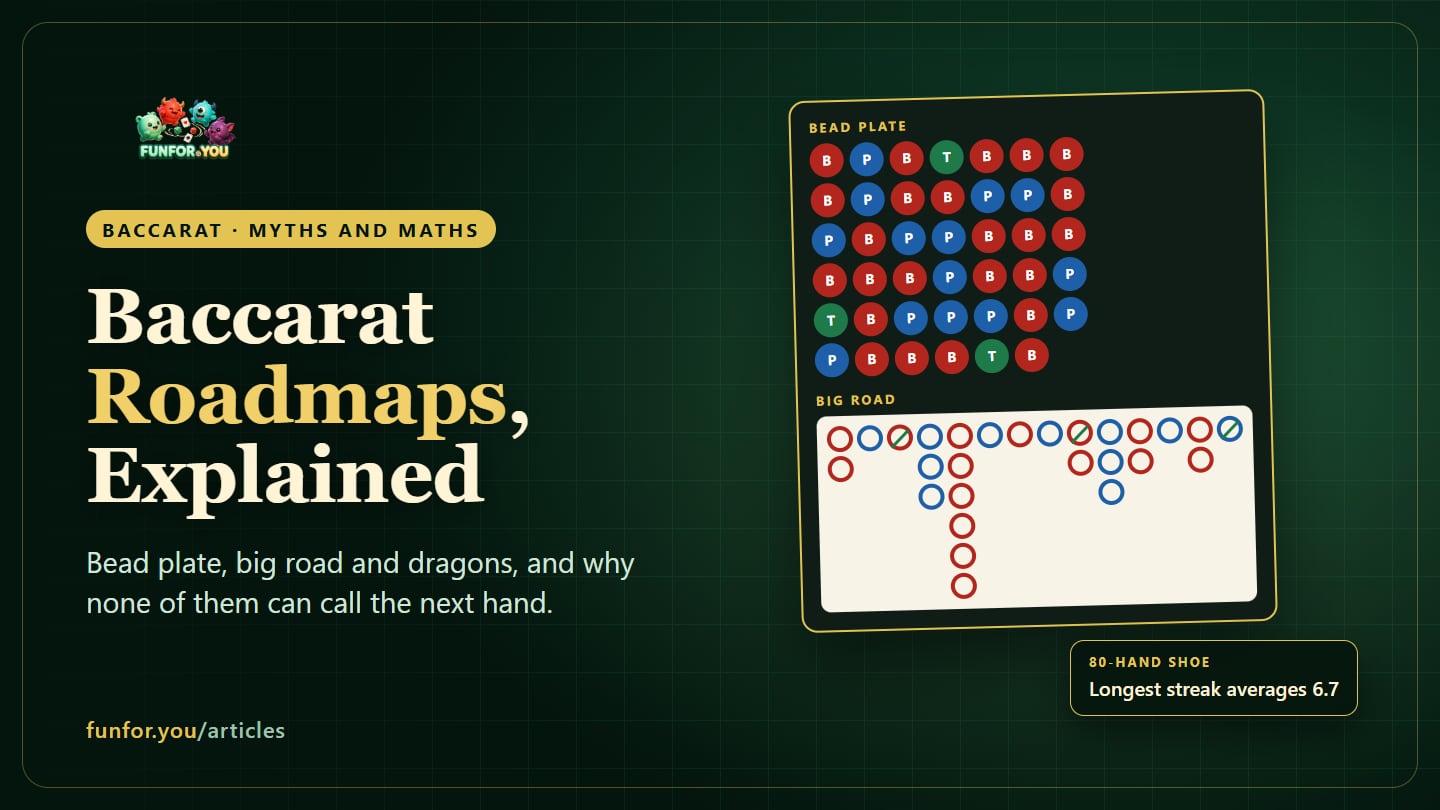
The bead plate is the simplest roadmap. Each hand is one circle, coloured by the result: red for Banker, blue for Player, green for Tie. Circles fill a grid six rows deep, top to bottom, then start a new column. Some screens add a small dot for a pair or print the winning total inside the circle.
It is a plain history, and the easiest roadmap to check against your own memory. Our baccarat tables show the same kind of record: the latest results as a row of coloured dots, blue for Player, red for Banker and green for Tie.
The big road: the same results as streaks
The big road redraws the bead plate so that streaks stand out. Each column is one streak: every consecutive Banker win goes down the same column, and a new column starts when the winner changes. Ties do not start a column; they are marked with a slash on the result before them. When a streak reaches the bottom of the grid, it turns right and runs along the bottom row, a shape players call a dragon's tail.
Players give the shapes names. A dragon is a long streak of one side. A chop, or ping-pong, is a run of single-hand columns, Banker, Player, Banker, Player. Double pairs, steps and other patterns all describe how the column lengths change.
The derived roads: patterns of patterns
Many scoreboards also show three smaller roads: the big eye boy, the small road and the cockroach road. Each one compares the big road with itself: it asks whether the newest column is behaving like an earlier column, one, two or three columns back, and draws red for "repeating" and blue for "not repeating".
They look like three more sources of information. They are not. Every mark on them is calculated from the big road, which is calculated from the bead plate, which is just the list of results. Three different drawings of the same past cannot tell you more about the future than the past itself can.
What the numbers say
With eight decks and standard drawing rules, the long-run results of baccarat are well known:
| Result | Share of all hands | Share of decided hands |
|---|---|---|
| Banker wins | 45.86% | 50.68% |
| Player wins | 44.62% | 49.32% |
| Tie | 9.52% | — |
Banker wins slightly more often because of the drawing rules, which our guide to why Banker wins more often explains. That small edge is why a Banker win pays 95% of the stake rather than evens.
How long streaks really run
A streak of six Bankers feels remarkable. From any given hand, it is fairly unlikely:
| Streak starting from a given hand | Banker | Player |
|---|---|---|
| 3 in a row | 13.0% | 12.0% |
| 4 in a row | 6.6% | 5.9% |
| 5 in a row | 3.3% | 2.9% |
| 6 in a row | 1.7% | 1.4% |
| 8 in a row | 0.44% | 0.35% |
| 10 in a row | 0.11% | 0.09% |
But a shoe is not one hand. An eight-deck shoe typically deals around 80 hands, about 72 of them decided and 8 of them ties, and a streak can start at any of them. We simulated 200,000 shoes of 80 hands using the standard probabilities above, counting streaks the way the big road does, with ties ignored:
- The longest streak in a shoe averaged 6.7 hands.
- A streak of six or more appeared in 69% of shoes.
- A streak of eight or more appeared in 26%, and ten or more in about 7%.
- The winning side changed about 35 times per shoe.
So a dragon is not a sign that something unusual is happening. Most shoes contain one. A shoe with no streak longer than four would be the unusual one.
Why the board cannot predict the next hand
In baccarat, the next hand is decided by the next cards out of the shoe. The cards do not know who won the last five hands. Strictly, the cards already dealt change the make-up of the shoe very slightly, but the effect on who wins the next hand is tiny, far too small to see in a pattern of reds and blues, and it does not follow streaks or chops.
That leaves two popular strategies, and they contradict each other:
- Following the dragon assumes a streak will continue because it has been continuing. This is the hot-hand fallacy.
- Betting on the chop assumes a streak is "due" to end. This is the gambler's fallacy.
After five Bankers in a row, the chance that the next decided hand is Banker is still about 50.68%, the same as after five Players, and the same as on the first hand of the shoe.
Patterns do not change the house edge
Whatever pattern you follow, every bet keeps its own house edge. With a 5% commission on Banker wins and 8 to 1 on the Tie, the standard figures are about 1.06% on Banker, 1.24% on Player and around 14.4% on the Tie. Choosing which of those bets to make by reading a roadmap changes when you make them, not what they cost. That is true of every betting system, as our guide to why betting systems cannot beat the odds shows, and it is why the Tie bet stays the worst bet on the table however green the board looks.
So what are roadmaps good for?
They are a clear record of the shoe, and they are part of the ritual of the game, which is part of its fun. Enjoy them as that. Just do not stake anything on them, and do not let a pattern talk you into betting more or playing longer than you planned.
You can play baccarat on FUNFOR.YOU's free tables with play chips, where a Banker win pays 95% of the stake (rounded down to whole chips), a Tie pays 8 to 1, and Player and Banker bets are returned when the hand is a tie. If you are new to the game, start with how baccarat works.
Frequently asked questions
What is a dragon in baccarat?
A long streak of one side, usually six or more, drawn as a long column on the big road. Simulations of normal shoes show that most shoes contain at least one.
What is the big eye boy?
One of three derived roads. It compares each new column of the big road with the pattern one column earlier and marks whether the pattern is repeating. It is calculated entirely from the big road.
Does following streaks work?
No. Each hand's chances are the same whatever the previous hands were, so following or opposing a streak has the same house edge as betting at random.
Why do casinos show roadmaps?
Players like them, and a player who believes in patterns tends to keep playing to see what the board does next. They are a record, not a forecast.
How long is the longest streak in a normal shoe?
In a shoe of about 80 hands, the longest streak of one side averages between six and seven hands. A streak of eight or more happens in roughly a quarter of shoes.