
Understanding the Gambler’s Fallacy
Welcome to FUNFOR.YOU, a free‑to‑play casino simulation site where no real money is wagered. This article explains the gambler’s fallacy, a frequent mistake made by beginners, and shows how to keep your play enjoyable and responsible.
What Is the Gambler’s Fallacy?
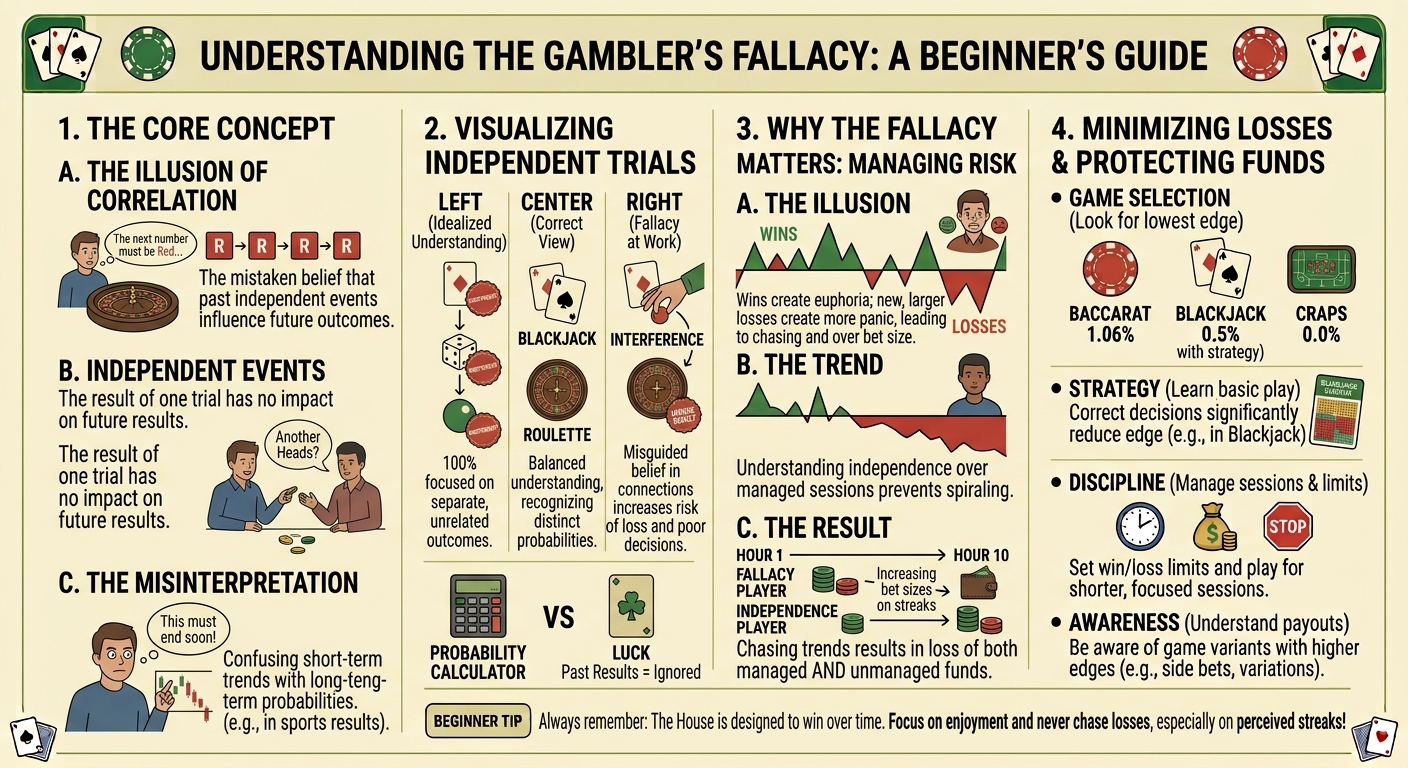
The gambler’s fallacy is the belief that a random event is more likely to happen because it has not occurred recently. In simple terms, many people think that after a long streak of one result, the opposite result is “due.” This belief ignores the fact that each event in a truly random process is independent of the ones before it.
Why Random Events Are Independent
In games that rely on chance—such as roulette, slots, or dice—each spin, spin, or roll is separate from the previous one. The outcome does not carry memory of past results. The house edge, which is the built‑in advantage the casino (or simulation) holds, remains constant regardless of any streaks.
Step‑by‑step: Checking Independence
- Identify the random mechanism (e.g., a roulette wheel spin).
- Ask whether the mechanism has any physical or programmed memory of past outcomes. In a fair wheel or a well‑designed simulation, the answer is no.
- Remember that the probability for each individual outcome stays the same each time. For a red/black roulette wheel, the chance of red is roughly the same on every spin.
Common Situations Where the Fallacy Appears
- Believing that a slot machine will “pay out” after a long series of losses.
- Thinking a roulette wheel will land on black after ten consecutive reds.
- Assuming a dice will show a six because it has not appeared in the last several rolls.
Practical Example: Roulette Spins
Imagine you are playing a simulated roulette wheel on FUNFOR.YOU. You observe the following sequence of ten spins:
Red, Red, Red, Red, Red, Red, Red, Red, Red, Red
It feels natural to think that black is “due.” However, the probability of black on the next spin is still the same as it was on the first spin—approximately 48% on a European wheel (the exact number is not essential for this guide). The previous ten reds do not increase the chance of black.
If you place a larger bet on black because you expect it to happen, you are acting on the gambler’s fallacy. The outcome remains independent, and the bet carries the same risk as any other single spin.
How the Fallacy Affects Your Play
Relying on the gambler’s fallacy can lead to several problems:
- Unnecessary risk: You may increase bet size after a streak, hoping the opposite result will appear, which can quickly deplete a bankroll.
- Chasing losses: Believing a win is “due” often encourages players to keep playing in hopes of recouping earlier losses, a behavior that typically worsens the situation.
- Distorted perception of randomness: Over time, you may develop an inaccurate sense of how games work, making it harder to enjoy them responsibly.
Responsible‑Gambling Practices
Even in a free‑to‑play environment, it is wise to treat your time and virtual bankroll with the same care you would use with real money. Here are some practical steps:
- Set a bankroll limit: Decide how many virtual credits you are comfortable spending in a session and stop when you reach that limit.
- Set a time limit: Determine a maximum amount of time for each play session and stick to it.
- Avoid chasing losses: If you experience a streak of unfavorable outcomes, pause the game, take a break, and remember that each new outcome is independent.
- Stay 18+: FUNFOR.YOU is intended for adults aged 18 and over. If you are under that age, please discontinue use.
- Check local laws: Even though no real money is involved, it is good practice to be aware of the gambling regulations in your jurisdiction.
- Seek help if needed: If you notice that playing—even in a simulation—starts to affect your mood, sleep, or daily responsibilities, consider reaching out to a local support service for gambling‑related concerns. Look for community health resources or counseling services in your area.
Frequently Asked Questions
- Is the gambler’s fallacy ever correct? No. In a truly random process, past outcomes do not influence future ones. The fallacy is a misconception, not a strategy.
- Can I use patterns to win at slots? No. Slot outcomes are generated by random number generators, and no pattern can predict the next result.
- Does a long losing streak mean I’m more likely to win soon? No. Each spin, roll, or deal has the same probability as any other, regardless of previous results.
- Should I increase my bet after a losing streak? Increasing a bet in hopes of a “due” win is risky and often leads to faster loss of your bankroll. It is better to keep bets consistent and within your pre‑set limits.
- How can I tell if I’m falling into the gambler’s fallacy? If you find yourself thinking “it’s due” or “I’m due for a win,” pause and remind yourself that each event is independent.
Conclusion
The gambler’s fallacy is a natural but misleading intuition about random events. By understanding that each spin, roll, or draw is independent, you can avoid unnecessary risk and keep your play on FUNFOR.YOU enjoyable and responsible. Remember to set limits, stay aware of your motivations, and seek support if gaming ever feels out of control.