How Blackjack Works: A Beginner’s Guide
Welcome to the world of blackjack, one of the most popular card games in both brick‑and‑mortar and online casinos. This article is written for complete beginners who want to understand how the game works on a free‑play simulation site like FUNFOR.YOU. No real money is involved, and the focus is on learning the rules, the flow of a hand, and how to play responsibly.
What Is Blackjack?
Blackjack, also known as 21, is a comparing‑card game played between one or more players and a dealer. The objective is to have a hand value closer to 21 than the dealer’s hand without exceeding 21. The game uses one or more standard 52‑card decks. Because the outcome of each hand depends on shuffled cards, results are random and independent from one hand to the next.
Key Terms and Card Values
Card Values
- Number cards (2‑10): worth their face value.
- Face cards (Jack, Queen, King): each worth 10 points.
- Ace: can be counted as 1 or 11, whichever benefits the hand without busting.
Hand Totals
A “hand” is the total of the point values of the cards a player or the dealer holds. If the total exceeds 21, the hand “busts” and automatically loses.
Other Common Terms
- Hit: request another card.
- Stand (or Stand Pat): keep the current hand and end the turn.
- Double Down: double the original bet, receive exactly one more card, then stand.
- Split: if the first two cards are a pair, separate them into two independent hands, each with its own bet.
- Blackjack (or Natural): an Ace combined with a 10‑point card on the initial deal, totaling 21.
How a Hand Is Played
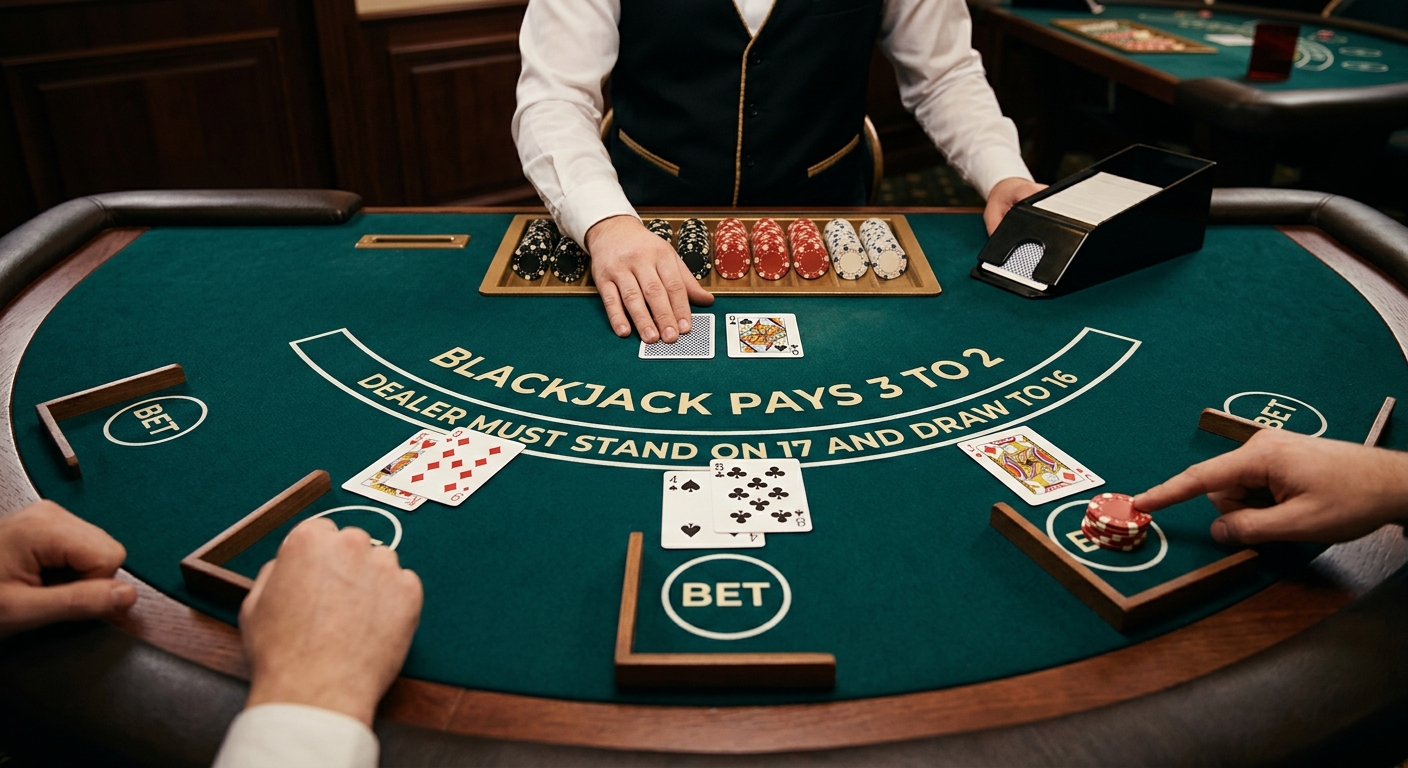
The following step‑by‑step outline shows a typical round of blackjack on a free‑play simulation platform.
- Place a Bet: Choose an amount within the allowed limits and confirm the bet.
- Deal the Cards: The dealer gives each player two cards and deals themselves a single card face up. There is no hidden “hole” card at our tables: the dealer’s remaining cards are drawn in the open only after every player has finished.
- Check for Immediate Blackjack: If a player’s first two cards total 21 — an ace with a ten, jack, queen or king — they have a Pontoon and are paid 3:2 immediately. Because the dealer holds only one card at this point, there is no dealer blackjack to tie with.
- Player Decisions: Starting with the player to the dealer’s left, each player decides to hit, stand, double down, split or surrender based on their hand and the dealer’s up‑card. A 21 made at any point is paid on the spot, and five cards without busting win outright.
- Dealer’s Turn: After all players have finished, the dealer draws their remaining cards face up. The dealer must hit until reaching 17 or higher, and hits once more on a soft 17. If every player has already busted, been paid, or surrendered, the dealer does not draw at all.
- Determine Outcomes: Each player’s hand is compared to the dealer’s hand. The higher total wins, ties result in a “push” (no win or loss), and any bust loses.
- Collect or Lose Bets: In a free‑play environment, points are added or subtracted from the player’s virtual balance according to the outcome.
Practical Example
Below is a simple example of a single hand. The numbers represent point totals, not actual money.
| Step | Action | Player Hand | Dealer Hand |
|---|---|---|---|
| 1 | Bet placed | – | – |
| 2 | Initial deal | 7♣ 5♦ (12) | 9♥ (one card) |
| 3 | Player hits | 7♣ 5♦ 6♠ (18) | 9♥ |
| 4 | Player stands | 18 | 9♥ |
| 5 | Dealer reveals hole card | 18 | 9♥ 7♣ (16) |
| 6 | Dealer hits | 18 | 9♥ 7♣ 5♠ (21) |
| 7 | Outcome | Lose (player 18 | Dealer wins |
In this scenario the player chose to hit once, improving the hand to 18, but the dealer later reached 21 and won the round.
Managing Your Play
Understanding the House Edge
The house edge is the statistical advantage that the casino (or the simulation’s programmed rules) has over the player. In blackjack, the edge is typically a few percent when basic strategy is followed. Because the game is based on random shuffles, no system can eliminate this edge.
Setting a Bankroll Limit
Even in a free‑play setting, it is helpful to treat the virtual balance like a bankroll. Decide how many points you are comfortable losing in a session and stop when that limit is reached. This habit translates to real‑world play if you ever move to a money‑based environment.
Time Limits
Decide in advance how long you will play. Taking regular breaks reduces fatigue, which can affect decision‑making.
Why Chasing Losses Is Counterproductive
Because each hand is independent, increasing bet size after a loss does not improve the odds. In fact, it raises the risk of larger swings and can lead to a rapid depletion of the virtual balance.
Responsible Gambling
FUNFOR.YOU is a free‑play simulation intended for entertainment only. No real money is wagered, and no cash can be withdrawn. Nevertheless, it is important to play responsibly:
- Play only if you are 18 years of age or older.
- Set clear limits for virtual points and time.
- Take regular breaks and avoid playing when feeling stressed or upset.
- If you feel that your gaming habits are affecting other areas of life, consider speaking with a local support service. Look for organisations that provide confidential help for gambling‑related concerns.
Always check the laws where you live before accessing any online gaming platform, even if it is free‑play only.
Frequently Asked Questions
Is blackjack purely a game of chance?
Yes. The cards are shuffled randomly, and each hand’s outcome is independent of previous hands. Skillful decisions can affect the probability of winning a particular hand, but they cannot change the underlying randomness.
Can I use a “system” to guarantee a win?
No. No system, pattern, or betting strategy can overcome the built‑in house edge. All strategies are based on probability, not certainty.
What does “soft 17” mean?
A “soft 17” is a hand that totals 17 where an Ace is counted as 11 (e.g., Ace‑6). Some rule sets require the dealer to hit on a soft 17, while others require a stand. At our tables the dealer hits a soft 17 once more and stands on a hard 17 or above.
Do I need to know advanced strategy to enjoy the game?
No. Understanding the basic actions—hit, stand, double, split—and the value of each card is enough to start playing. As you become more comfortable, you can explore basic strategy charts that suggest statistically optimal moves.
Is it possible to lose more than my virtual balance?
No. Because no real money is at stake, the simulation only deducts points from your virtual balance. Once the balance reaches zero, you can either reset the balance (if the platform allows) or stop playing.
Conclusion
Blackjack is a straightforward yet engaging card game that combines simple arithmetic with decision‑making. By learning the card values, the flow of a hand, and responsible‑play habits, beginners can enjoy the game on a free‑play platform without risking real money. Remember to set limits, take breaks, and seek help if you ever feel your gaming habits are becoming problematic. Enjoy the experience, stay within your limits, and have fun mastering the basics of blackjack.