Basic strategy is the mathematically best decision for every combination of your hand and the dealer's face-up card, worked out by computer for a given set of table rules. It does not beat the house. What it does is remove your own mistakes from the game, which in a typical multi-deck game with standard rules brings the house edge down to roughly half a percent. A player who guesses gives away much more than that.
Below is the full chart, followed by the reasoning behind the decisions that feel wrong at the table. If you are new to the game, start with how blackjack works.
Key takeaways
- Read the chart in order: pairs first, then soft hands (hands with an ace counted as 11), then hard totals.
- Stand on 12 to 16 when the dealer shows a weak card (2 to 6, or 4 to 6 for a 12); hit them against 7 or higher.
- Always split aces and eights. Never split tens or fives.
- Never take insurance.
- The chart depends on the rules. Change the rules and some cells change, so use the chart that matches your table.
How to read the chart
Find your hand down the left, the dealer's upcard across the top, and play the letter where they meet:
- H hit · S stand · P split
- D double if allowed, otherwise hit
- Ds double if allowed, otherwise stand
- R surrender if allowed, otherwise hit
The chart below is for the most common casino rules: four to eight decks, the dealer stands on soft 17, doubling after a split is allowed, and late surrender is offered.
Hard totals
| You | 2 | 3 | 4 | 5 | 6 | 7 | 8 | 9 | 10 | A |
|---|---|---|---|---|---|---|---|---|---|---|
| 8 or less | H | H | H | H | H | H | H | H | H | H |
| 9 | H | D | D | D | D | H | H | H | H | H |
| 10 | D | D | D | D | D | D | D | D | H | H |
| 11 | D | D | D | D | D | D | D | D | D | H |
| 12 | H | H | S | S | S | H | H | H | H | H |
| 13 | S | S | S | S | S | H | H | H | H | H |
| 14 | S | S | S | S | S | H | H | H | H | H |
| 15 | S | S | S | S | S | H | H | H | R | H |
| 16 | S | S | S | S | S | H | H | R | R | R |
| 17+ | S | S | S | S | S | S | S | S | S | S |
Soft totals
| You | 2 | 3 | 4 | 5 | 6 | 7 | 8 | 9 | 10 | A |
|---|---|---|---|---|---|---|---|---|---|---|
| A,2 / A,3 | H | H | H | D | D | H | H | H | H | H |
| A,4 / A,5 | H | H | D | D | D | H | H | H | H | H |
| A,6 | H | D | D | D | D | H | H | H | H | H |
| A,7 | S | Ds | Ds | Ds | Ds | S | S | H | H | H |
| A,8 / A,9 | S | S | S | S | S | S | S | S | S | S |
Pairs
| You | 2 | 3 | 4 | 5 | 6 | 7 | 8 | 9 | 10 | A |
|---|---|---|---|---|---|---|---|---|---|---|
| A,A | P | P | P | P | P | P | P | P | P | P |
| 10,10 | S | S | S | S | S | S | S | S | S | S |
| 9,9 | P | P | P | P | P | S | P | P | S | S |
| 8,8 | P | P | P | P | P | P | P | P | P | P |
| 7,7 | P | P | P | P | P | P | H | H | H | H |
| 6,6 | P | P | P | P | P | H | H | H | H | H |
| 5,5 | D | D | D | D | D | D | D | D | H | H |
| 4,4 | H | H | H | P | P | H | H | H | H | H |
| 2,2 / 3,3 | P | P | P | P | P | P | H | H | H | H |
The logic behind the chart
Why you stand on a stiff hand against a weak dealer card
Hard 12 to 16 are "stiff" hands: likely to bust if you hit, and likely to lose if you stand against a strong dealer total. The dealer's upcard decides which risk is worse. When the dealer shows 4, 5 or 6, the dealer must keep drawing to reach 17 and busts often, so you stand and let the dealer take the risk. Against 7 or higher the dealer usually finishes on 17 or more, so standing on 15 mostly loses and you hit. Our breakdown of dealer bust rates by upcard shows the numbers, and hit or stand covers the close calls.
Why 12 is different against a 2 or 3
With 12, only a ten-value card busts you, and there are four of those among the thirteen ranks. The dealer's 2 or 3 is weak but not weak enough, so taking one card is slightly better than standing.
Why you double on 10 and 11
Doubling puts more money down in the spots where you are most likely to win. With 10 or 11, a single card often makes 20 or 21, and against a weak or middling dealer card that is exactly the moment to be betting more. The exception with these rules is 11 against an ace: the dealer is strong enough that hitting is marginally better. See when to double down.
Why soft hands are doubled so often
A soft hand cannot bust on the next card, because the ace can drop from 11 to 1. That makes it a safe hand to double against a dealer who is likely to bust. Soft 18 (ace-seven) is the one people misplay: it looks strong, but against a dealer 9, 10 or ace it is an underdog, and hitting improves it. The soft hands guide goes through each one.
Aces and eights, tens and fives
Split aces because two hands starting from 11 are worth far more than one soft 12. Split eights because 16 is the worst hand in the game and two hands starting from 8 are better. Never split tens, since 20 already wins most of the time, and never split fives, because 10 is a doubling hand, not two weak ones. Split and surrender covers the pairs in the middle.
Surrender and insurance
Surrender gives up the hand for half your bet back. It is right only when your hand loses more than half the time whichever way you play it: hard 16 against 9, 10 or ace, and hard 15 against 10. Insurance is a side bet that the dealer has blackjack. It pays 2:1, which is only fair if at least a third of the unseen cards are tens. In a six-deck shoe, the chance is about 31%, so the bet loses roughly 7% of what you stake over time. Take it with a strong hand or a weak one; the answer is the same.
When the rules change, the chart changes
Basic strategy is calculated for specific rules. The most common variation is a dealer who hits soft 17. That makes the dealer slightly stronger, and a handful of cells move: double 11 against an ace, double soft 19 (ace-eight) against a 6, double soft 18 against a 2, and, where surrender is offered, surrender 15 and 17 against an ace, and a pair of eights against an ace.
The blackjack table on this site plays a Pontoon-style game, which changes more. The dealer takes a single card and draws last, a 21 is paid the moment you make it, and five cards without busting win at 3:2. The dealer hits soft 17, you can split once and double after a split. Those rules change the value of reaching 21 and of drawing to a low four-card hand, so several decisions differ from the standard chart. Pontoon vs blackjack explains the differences, and the five-card trick covers the rule that changes the most.
How to learn basic strategy quickly
- Learn the hard totals from 12 to 16 first. They come up most often and cost the most when misplayed.
- Add the doubling hands: 9, 10 and 11, then the soft doubles.
- Learn the pairs last, in the order aces and eights, tens and fives, then the rest.
- Practise one block at a time until you stop hesitating, then add the next.
- Play with the chart beside you. At the blackjack table here you play with free play chips, so mistakes cost nothing while you learn.
What basic strategy will not do
It will not make you win every session. The house keeps a small edge, and over a few dozen hands luck swamps everything; variance and house edge explains why both are true at once. It also cannot be improved by card counting in online games that shuffle continuously, as this explainer shows. What it does is guarantee you are never the reason you lost a hand.
The Blackjack playbooks
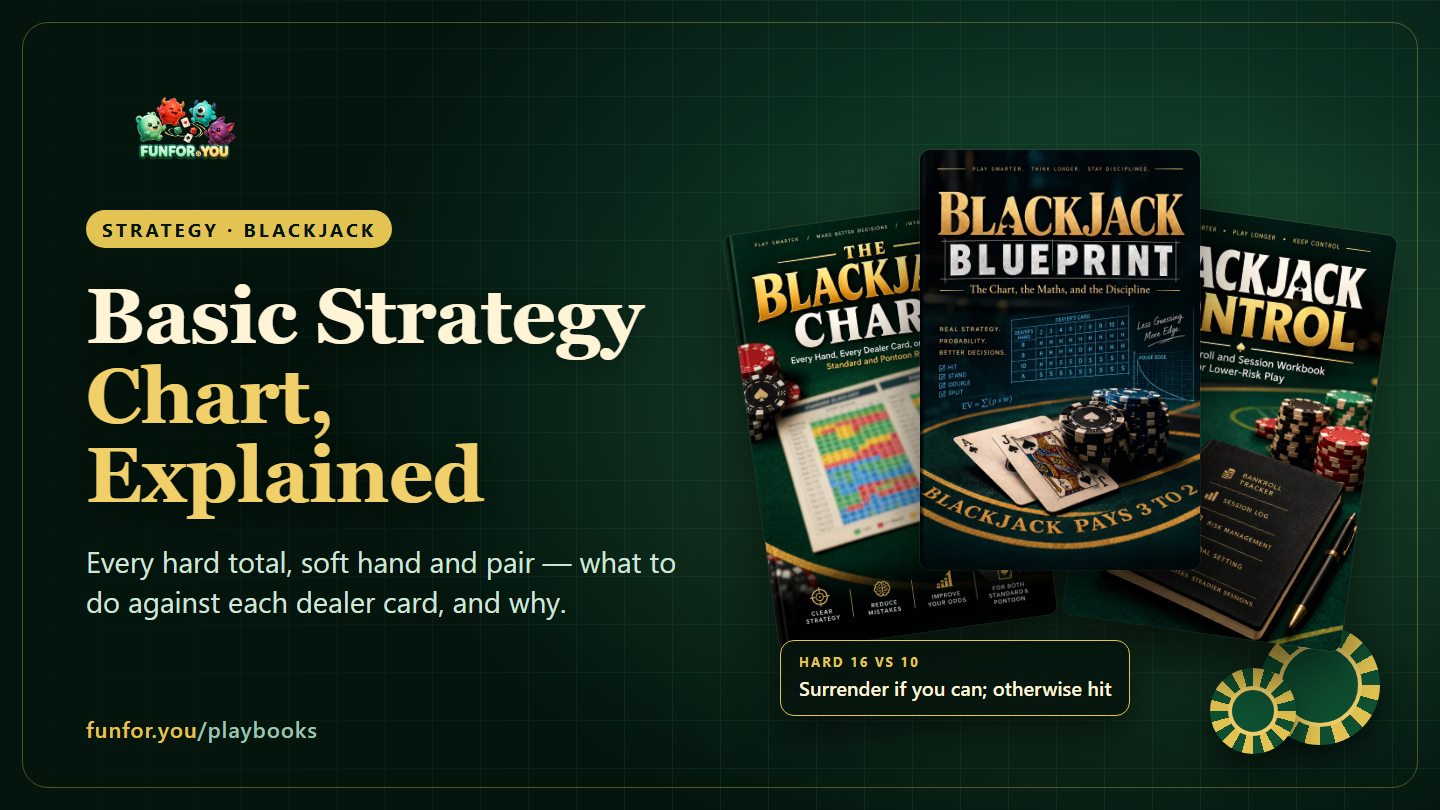
If you want the whole picture in one place, the Blackjack series of the strategy playbooks has three parts. Blackjack Blueprint covers the chart, the maths and the discipline. The Blackjack Chart puts every hand against every dealer card on one page, for both standard rules and this site's Pontoon rules. Blackjack Control is a bankroll and session workbook for lower-risk play.
Frequently asked questions
Does basic strategy guarantee I will win?
No. It minimises the house edge; it does not remove it. You will still have losing sessions. Over time, you lose less than a player who guesses.
Why should I hit 16 against a 7 when I will probably bust?
Because standing is worse. The dealer showing 7 usually finishes on 17 or more, and 16 loses to all of those. Hitting 16 loses often, but standing loses more often.
Should I take even money when I have blackjack and the dealer shows an ace?
Even money is insurance under another name, so the answer is the same: no. Over time you collect more by letting the hand play out.
Is the chart the same for online blackjack?
Only if the rules are the same. Check the number of decks, whether the dealer hits soft 17, and whether doubling after splits and surrender are allowed, then use the chart for those rules.
Is it worth memorising the whole chart?
The hard totals and the pairs rules give you most of the benefit. Soft hands and surrender are worth learning next, once the basics are automatic.