
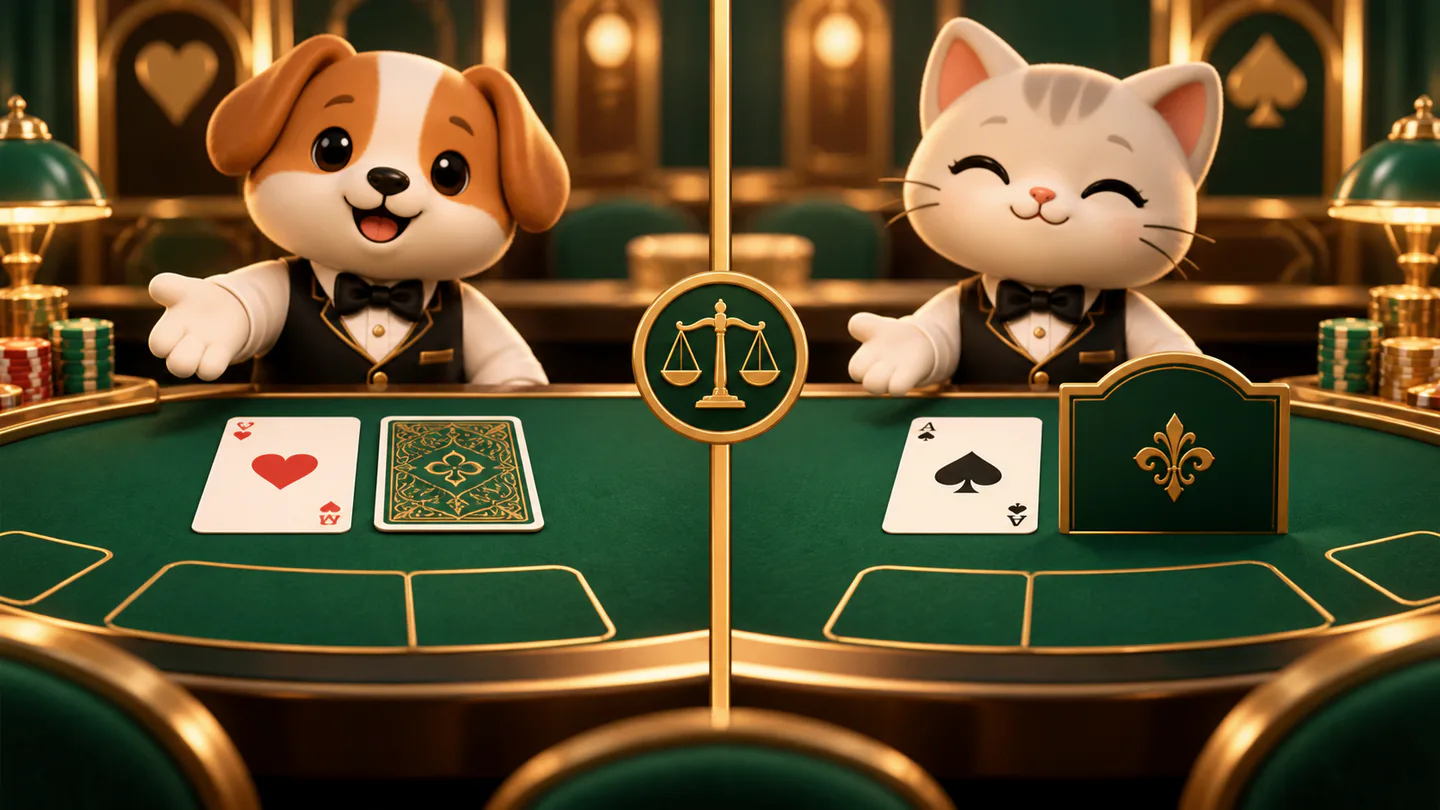
If you learned blackjack anywhere else, our tables will look familiar and then surprise you within one hand. The dealer has a single card. Your 21 pays before the dealer does anything. A hand of five small cards wins. These are not quirks — they are Pontoon, the version of twenty-one played across much of Asia and Australia, and they change the game more than the shared card values suggest.
1. The dealer draws last, not alongside you
In classic blackjack the dealer takes two cards at the start, one hidden, and that hand is already complete while you decide. In Pontoon the dealer shows one card and takes nothing more until every player is finished. Only then do they draw, face up, to a fixed rule.
The practical difference: there is no hidden card to guess about. What you see is the whole of the dealer's hand at the moment you act. The dealer's eventual total is decided by cards that have not left the shoe yet.
2. A 21 is paid the moment you make it
Hit to 21, double to 21, make 21 on a split hand — it is settled at once, without waiting to see what the dealer does. In blackjack a 21 can still be tied by a dealer 21; here it cannot, because the dealer never gets to play against it. This is the single biggest strategic change: reaching 21 is a guaranteed win, not a strong position.
3. Five cards without busting win outright
Draw five cards and stay at 21 or under and the hand is paid 3:2 immediately — whatever the total. A five-card 16 beats a dealer 20, because the dealer never draws against it. This changes the arithmetic of hitting a low four-card hand, which we cover in hit or stand.
4. Pontoon pays 3:2, and only on the first two cards
An ace with a ten-value card on your opening two is a Pontoon, paid 3:2 on the spot. An ace and a ten made after a split is an ordinary 21 — a certain win, but at 1:1. The distinction matters when you are deciding whether to split a pair of tens.
5. The dealer does not always draw at all
If every hand at the table has already busted, been paid, or surrendered, there is nothing left to beat, and the dealer's single card is simply cleared. You only see a dealer hand when there is a standing hand for it to play against.
What stays the same
Card values, hard and soft totals, the 17 rule (the dealer hits a soft 17 here and stands on a hard 17 or above), doubling on your first two cards, splitting a pair, surrendering on your first two. If you know how blackjack works, you know ninety percent of Pontoon. The other ten percent is the order things happen in — and that is where the edge moves.
Free play chips only, as with every game here: nothing is bought, nothing is cashed out. The rules are the same as a real table; the money is not.