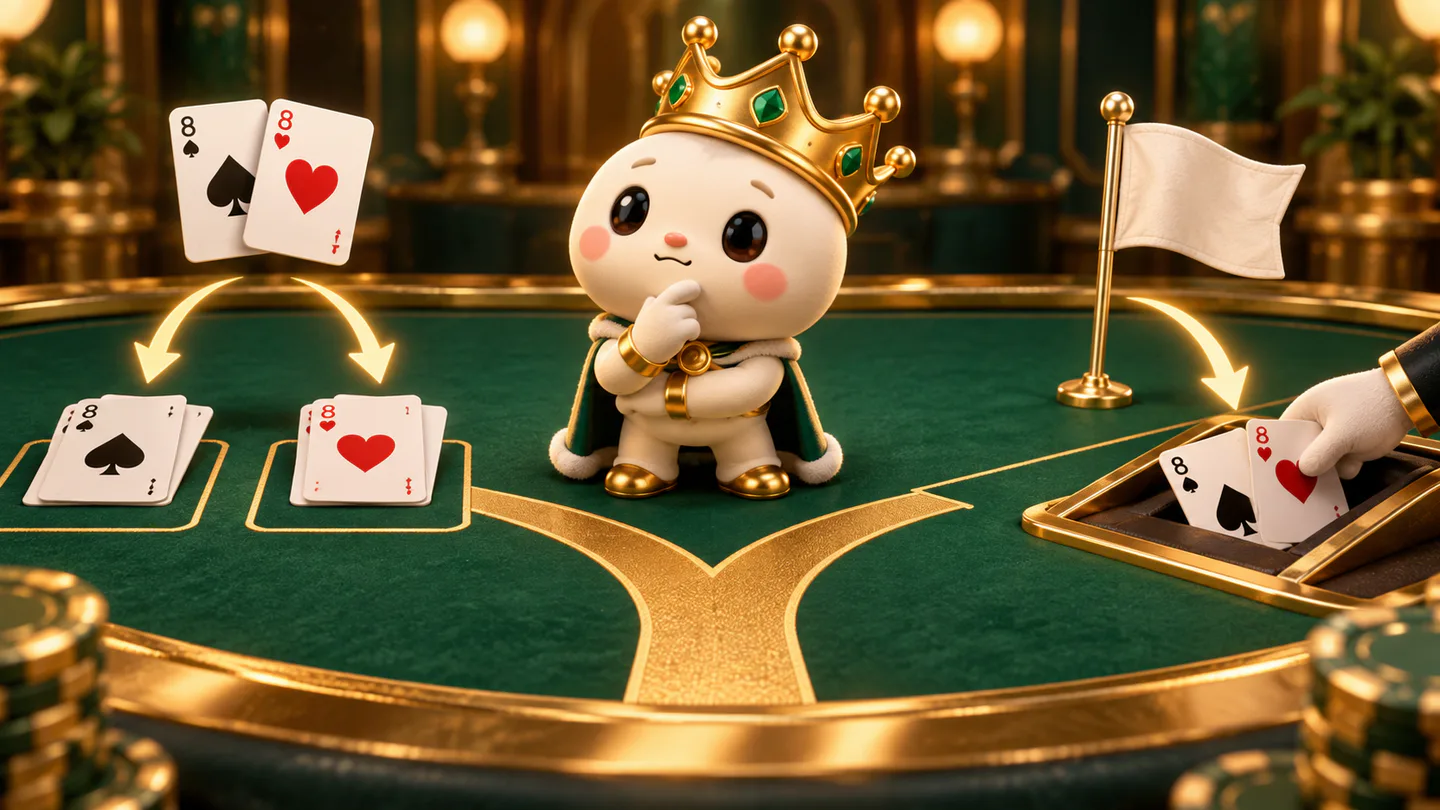
Two of the buttons on our blackjack table appear only for a moment. Split and Surrender are offered on your first two cards and disappear the instant you hit, stand or double. They are the only decisions in the game you cannot come back to, which is exactly why they are worth understanding before the cards are dealt.
Splitting: one hand becomes two
Dealt a pair, you may split it: a second wager equal to the first goes down, and each card becomes the start of its own hand. The first hand plays out completely — hit, stand, double, or an immediate 21 — and only then does the second hand receive its card and take its turn. Each hand wins or loses on its own.
Three rules to know here:
- Split aces get one card each and no more. No hitting, no doubling. An ace and a ten made this way is a 21 paid 1:1, not a Pontoon at 3:2.
- Any 21 on a split hand pays 1:1, whatever the rank you split. A pair of kings that draws an ace is a certain win, not a natural.
- You can double after a split, and you can split once. No re-splitting.
The pairs worth splitting
Aces. Always. Two starting points of 11 are worth far more than a soft 12, even with the one-card restriction.
Eights. Almost always. A 16 is the worst total in the game; two hands starting on 8 are two chances at a real hand.
Twos, threes, sevens against a dealer showing 2 to 7. The dealer is weak and you want more chips on the table.
Sixes and nines against a weak dealer card only. Nines are already an 18; split them only when the dealer looks likely to bust.
The pairs that are not
Tens. A 20 is the second-best hand you can hold. Breaking it into two hands that hope for a ten each is the classic way to turn a winner into two coin-flips.
Fives. A 10 is a doubling hand, not two hands of 5. Fours are similar: an 8 plays fine as one hand.
Surrender: taking half back
Surrender gives up the hand and returns half your wager. It is offered only on your first two cards and never on a split hand. It feels like defeat, and most players never use it, which is a mistake in exactly two situations.
Hard 16 against a dealer 9, 10 or ace, and hard 15 against a dealer 10. In those spots your hand loses more than half the time whether you hit or stand, so keeping half is the better outcome. Everywhere else, play the hand.
One Pontoon-specific note: because the dealer here draws last and hits a soft 17, a dealer showing an ace is a little stronger than at a classic table, which makes surrendering a 16 against it a little more clearly right.
The dealer's fixed script is what makes all of this calculable — see why the dealer's fixed rules are the house edge. Practice chips only; the decisions are real.