Here is the thing that surprises people about blackjack: the dealer is not trying to beat you. The dealer is not trying to do anything. They follow a script with no judgement in it whatsoever, and that script is where the entire house edge lives.
The script
At our tables the dealer draws while their total is below 17, draws once more on a soft 17 (an ace still counted as eleven), and stops on a hard 17 or more. That is the whole of it. No reading the table, no adjusting to what you did, no choosing to take one more.
Note that this includes a soft 17 — a 17 built with an ace counted as eleven, like ace-six. Some casinos have the dealer hit that; ours stands. The difference is small but it runs in the player’s favour, so it is worth knowing which version you are sitting at.
Why a fixed script beats a thinking opponent
If the dealer had judgement, they could be wrong. A rule cannot be wrong; it just is. But that is not where the edge comes from either.
The edge comes from one structural fact: you act first.
If you draw to 22, you have lost. Immediately, before the dealer turns over a single card. It does not matter that the dealer then goes on to bust too. Your money is already gone.
That is the whole mechanism, and it is worth sitting with, because everything else in blackjack is decoration on top of it. Both of you bust roughly as often as each other. But when you both bust in the same hand, only one of you gets paid, and it is not you.
What gives the player anything back
If that were the entire game it would be unplayable. Three things push back.
A natural pays 3:2. Ace plus a ten-value card on the first two cards pays one and a half times your bet, not even money. The dealer gets no such bonus for the same hand. This is the single largest concession the house makes, and it is why you should always check the payout before sitting at any blackjack table anywhere — a table paying 6:5 instead of 3:2 is a substantially worse game wearing the same name.
You can double. When the situation favours you, you can increase your bet mid-hand. The dealer cannot. Being able to put more money in exactly when the odds have tilted your way is real value.
You can stop. The dealer must draw on 16 whether they like it or not. You can stand on 16 when the dealer shows a weak card and let them break their own hand. Choosing not to act is a privilege the dealer does not have.
Which actions our tables offer
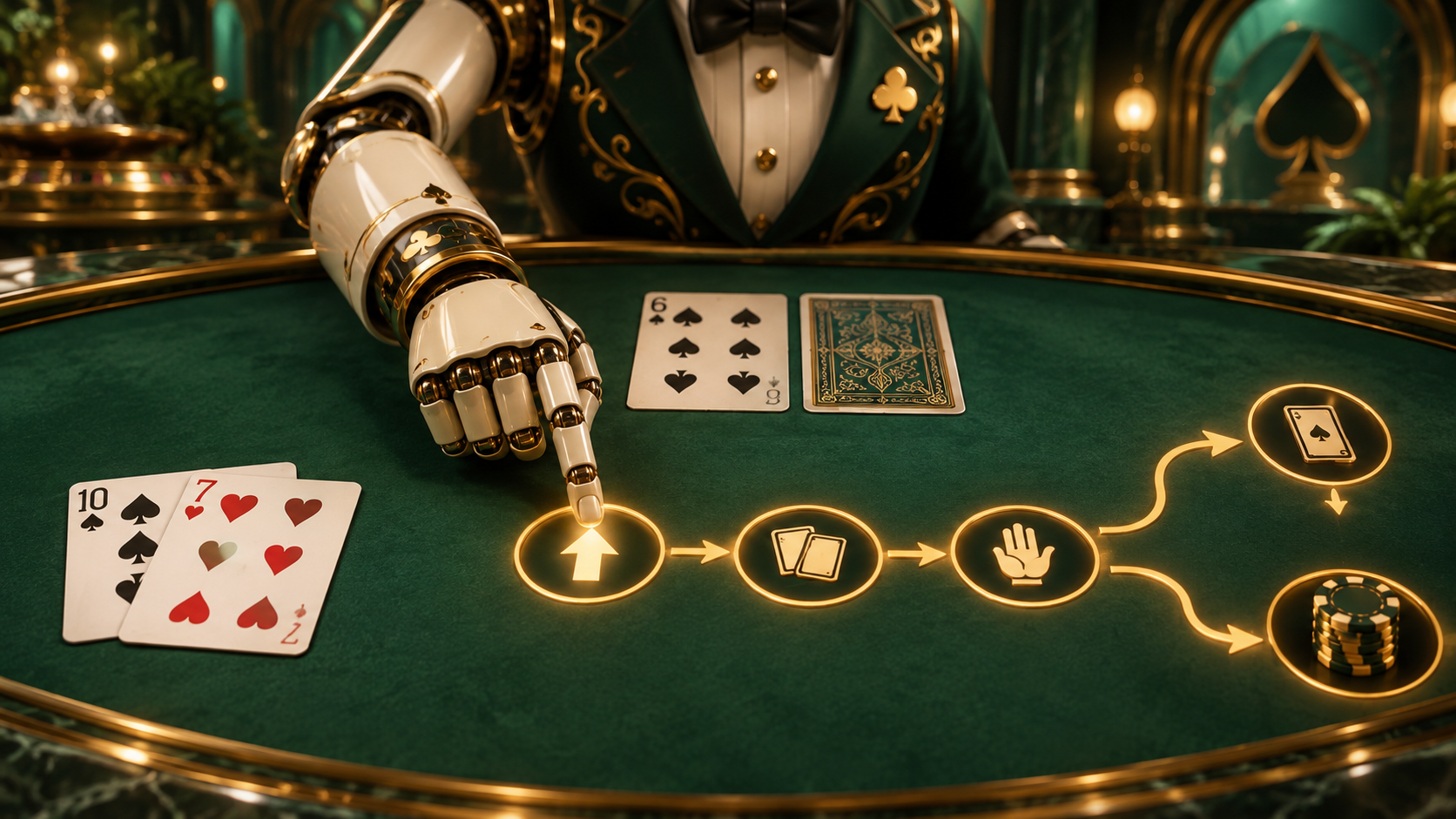
Ours are hit, stand, double, split and surrender, played Pontoon-style: the dealer shows a single card and takes the rest only after you have finished, a 21 is paid the moment you make it, and five cards that do not bust win outright. Worth saying plainly, because most blackjack advice online assumes a hidden hole card and a dealer whose hand is already complete while you decide.
What follows from all this
Because the dealer’s behaviour is completely fixed, their upcard tells you everything you can know about how the hand is likely to go. That is why every piece of real blackjack advice is phrased as a response to the dealer’s upcard rather than to your total alone.
The broad shape of it: a dealer showing 2 through 6 is in trouble, because they are forced to draw into a total that busts often. A dealer showing 7 through ace is strong, and you generally need to build a real hand rather than sitting on 14 and hoping.
None of this makes blackjack a winning game. It narrows the gap more than any other game on a casino floor, which is a different claim and the honest one.
Where the myths come from
Two worth retiring. The dealer does not have a hidden ten — at our tables there is no hidden card at all. The dealer draws in the open after you finish, and each card they draw is a ten roughly three times in thirteen. And a bad player at another seat did not cost you the hand; over any run of hands their choices help you as often as they hurt, because they are not connected to your cards at all.
You can play blackjack free on FUNFOR.YOU with play chips, including rooms where the whole table takes on the house together.