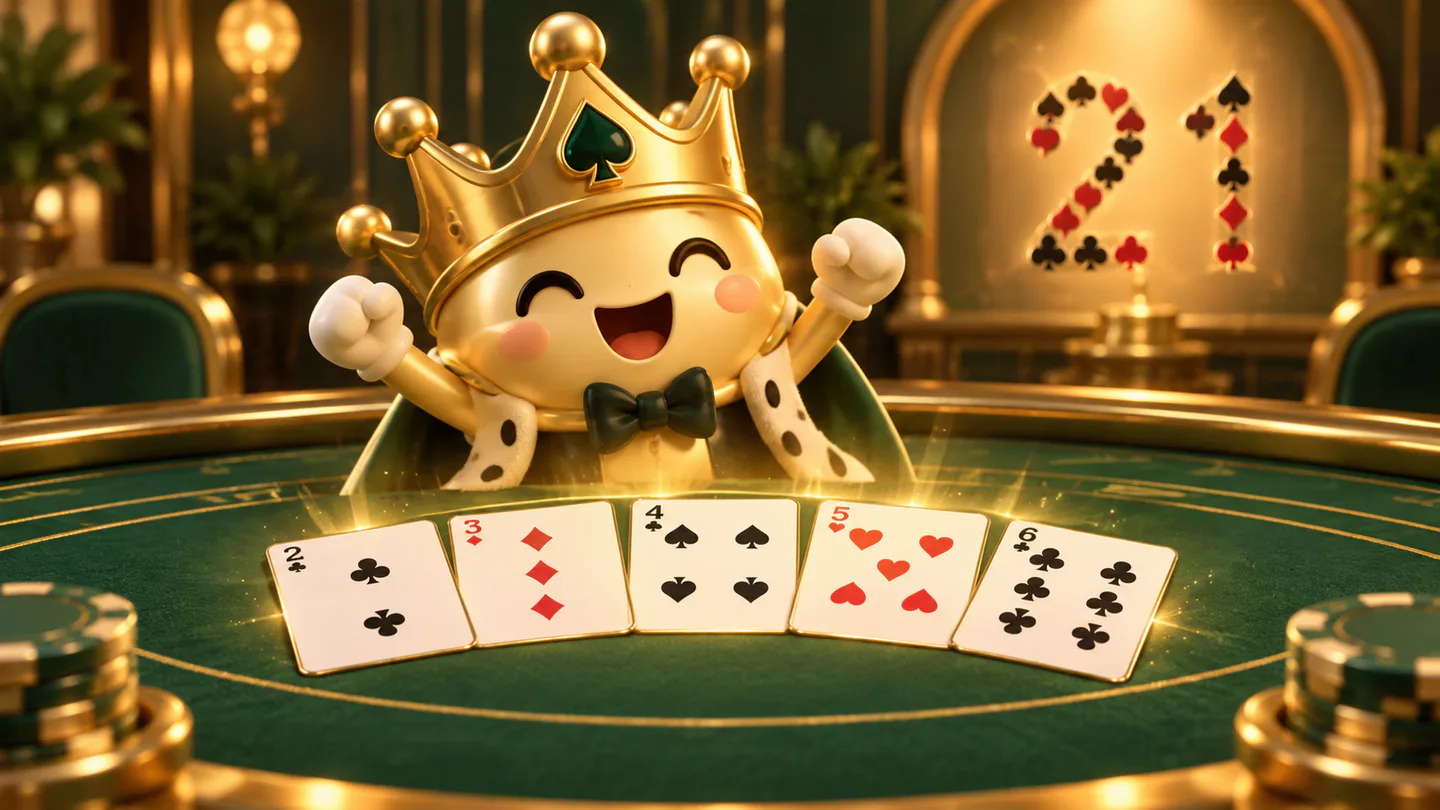
Most of the time twenty-one is a race to a number. The five-card trick is the exception: a hand that wins because of how many cards it holds, not what they total. Draw a fifth card and stay at 21 or under, and the hand is paid 3:2 on the spot. The dealer never plays against it.
Why the rule exists
It is older than blackjack itself. In pontoon and its ancestors, five cards without busting was treated as a feat — and it is. The average card is worth about 6.5 points, so five of them “should” total around 32. Getting five under 22 means you were dealt small cards repeatedly, and the rule rewards that instead of leaving you with an ugly 17 that the dealer beats with a 19.
How often it actually happens
Rarely, if you never try for it, and surprisingly often if you do. Starting from a two-card total of 8 or below, the chance of surviving three more draws is roughly one in seven. From a four-card total of 11 or less it is better than one in two — any card up to a ten fits. The rule is not a lottery; it is a specific, reachable target from specific starting points.
When it changes your decision
The five-card rule only ever matters when you are holding four cards. Three examples:
- Four cards totalling 11 or less. You cannot bust. Hit — every card either makes five under 22, or makes 21, and both are paid immediately.
- Four cards totalling 12 to 15. Ordinary advice against a strong dealer card is to hit anyway; here the fifth card is even more attractive, because a small card now wins outright rather than leaving you to face the dealer with a 17.
- Four cards totalling 16 or 17. This is where the rule flips the usual answer. A standard chart says stand on 17. Here, if the dealer's card is strong, a fifth card of 4 or less wins on the spot — and that is five cards in thirteen. It is not always right, but it is far closer than the chart suggests.
What it does not change
Two- and three-card decisions. Do not hit a hard 16 on three cards “because a five-card trick might be coming” — you need two more safe cards, not one, and the odds of that are poor. The rule rewards a hand that is already four cards deep, not a plan made at two.
It also does not apply to a doubled hand: doubling gives you exactly one card, so a double can never reach five. And a split hand can make a five-card trick like any other.
For the rest of the Pontoon differences, see what changes when the dealer shows one card. This is free-play: the chips are practice chips, and the rule is worth practising.