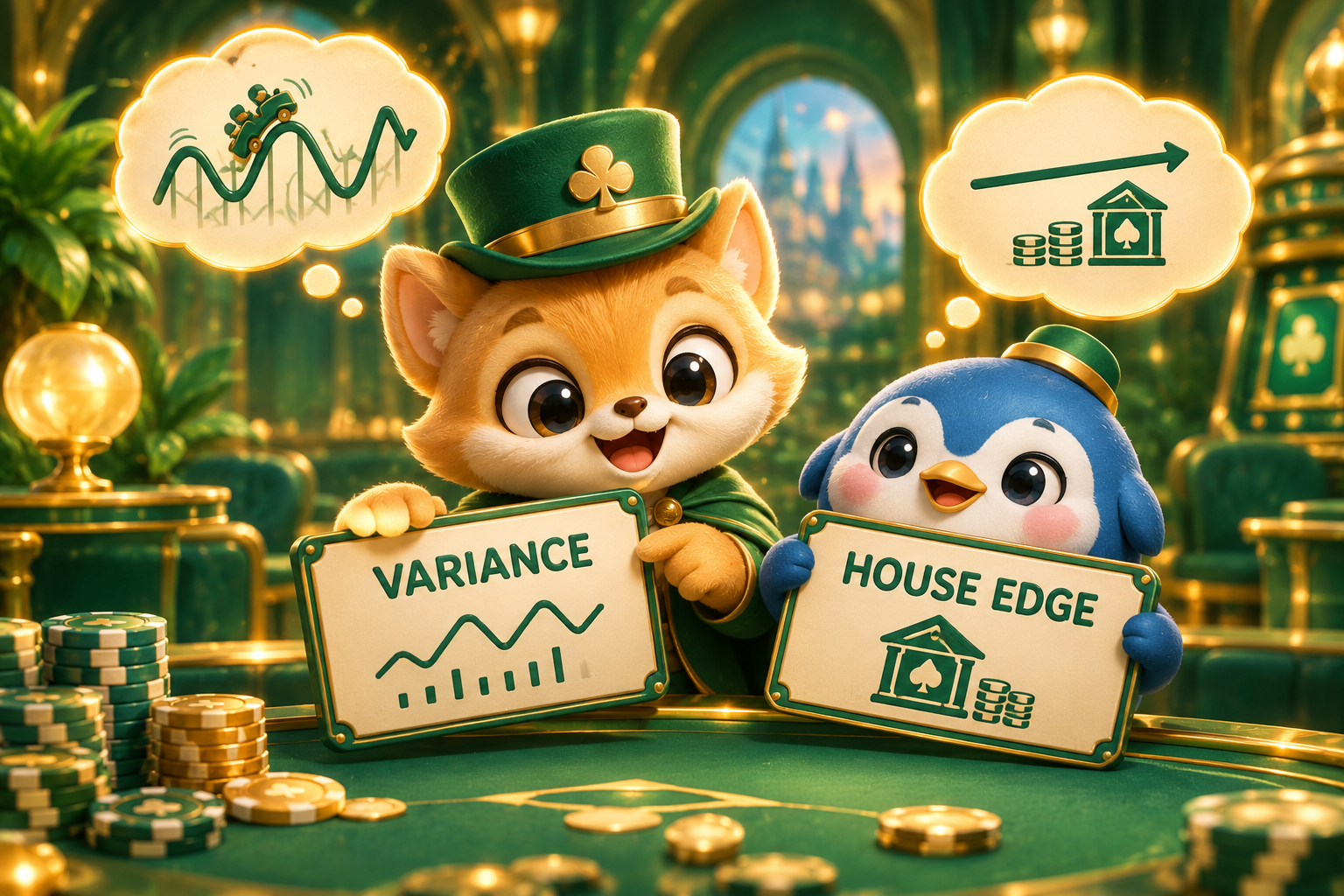
Two numbers describe any casino game, and most arguments about gambling come from treating them as one.
House edge is the average amount the game keeps, per unit staked, over a very long run. Variance is how far individual results scatter around that average.
The edge tells you the destination. Variance tells you how bumpy the road is — and the road is long enough that most people never see the destination at all.
Same edge, completely different experience
Consider two roulette bets on the same single-zero wheel. Both carry a house edge of 2.70%. Identical maths.
Red or black wins about 48.6% of the time and pays even money. You will win nearly half your bets. Sessions drift up and down gently.
A single number wins 2.7% of the time and pays 35 to 1. You will lose thirty-odd spins in a row routinely, then get one back that clears the lot.
The expected cost of a hundred spins is exactly the same for both. What differs is the range of things that can happen along the way — and that range is what you actually experience.
Why short sessions tell you nothing
Here is the uncomfortable part. In any normal session, variance completely overwhelms the house edge.
Play a hundred even-money spins at a 2.70% edge and the maths expects you to lose about 2.7 units. But the ordinary swing over a hundred spins is roughly ten units in either direction. The signal is 2.7; the noise is 10.
Which means a winning session proves nothing about your strategy and a losing one proves nothing about the game being rigged. You cannot see a 2.7% effect through that much static, any more than you could hear a whisper at a concert.
It also explains why people believe in systems. Anything you try will produce winning sessions, because everything produces winning sessions in the short run. The edge only asserts itself over tens of thousands of rounds, by which point almost nobody is still keeping records.
The practical consequences
High variance needs more cushion. A game that pays rarely and large will put you through long dry runs before anything lands. That is normal, not a malfunction, and it is why the same money lasts far longer on even-money bets than on long shots.
Low variance means longer play for the same money. If your goal is time at the table rather than a big result, choose the flatter game. If you want a shot at something dramatic and accept mostly losing, choose the spiky one. Both are legitimate; they are just different products.
Neither one beats the edge. Variance is symmetric — it swings both ways, which is exactly why it cannot be exploited. The edge is not symmetric. Over enough rounds, the wobble averages out and the edge is all that is left.
What to do with this
Judge a game by its house edge, because that is the part that persists. Judge your session by nothing at all, because a session is a sample far too small to mean anything.
And when you finish a night up, enjoy it as luck rather than evidence. That is not pessimism — it is the same reasoning that stops you concluding the game is broken when the next night goes the other way.