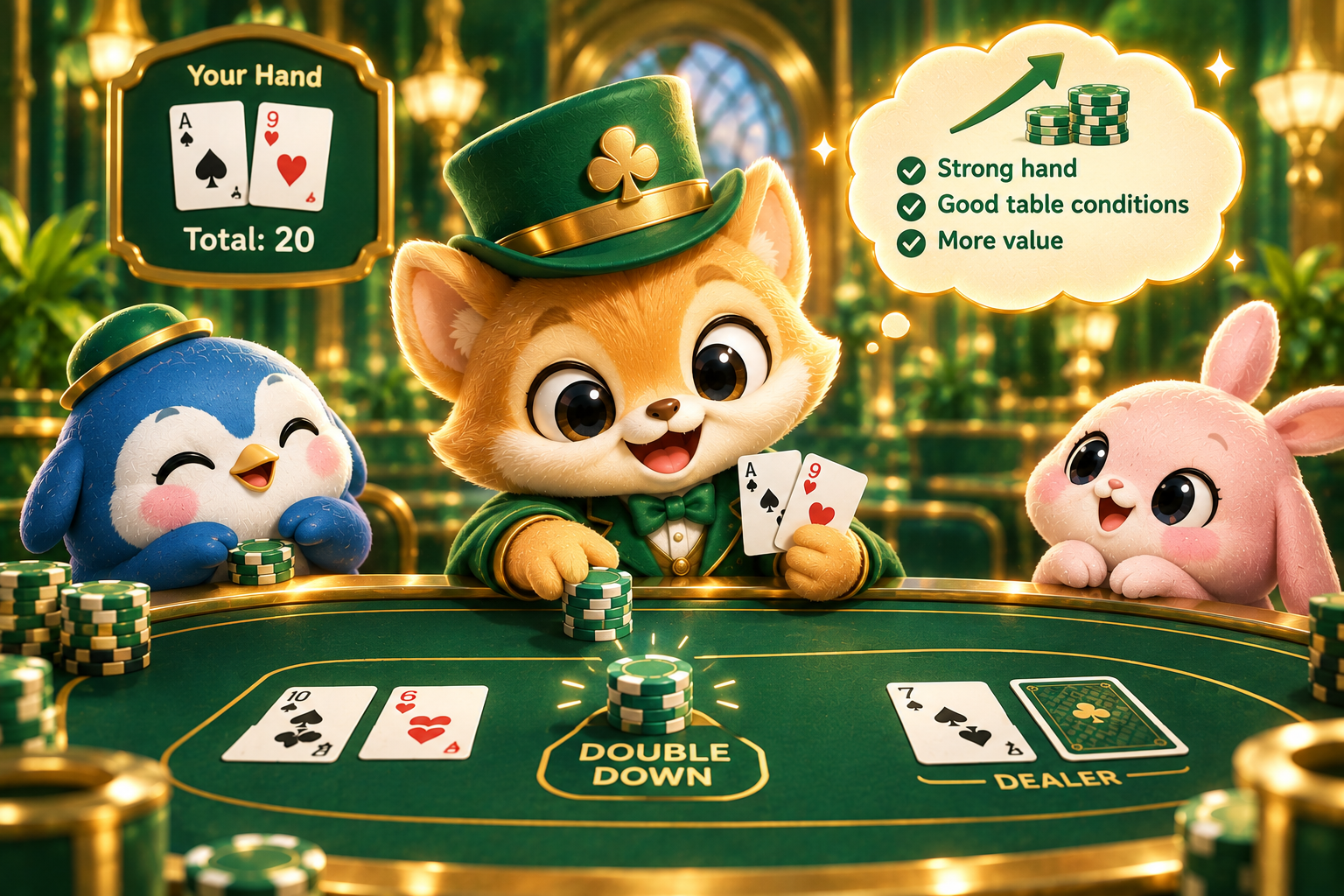
In blackjack you spend most of the game deciding whether to take another card. Doubling down is different: it is the only moment you can increase your bet after seeing something, and it is the closest thing the game gives you to an edge.
You double your stake, take exactly one more card, and that is your hand. No further draws.
The whole decision is the dealer's upcard
Because the dealer plays a fixed script — drawing under 17, hitting a soft 17 once more, standing on a hard 17 or more — their single face-up card tells you almost everything about how their hand will go.
A dealer showing 2 through 6 is in trouble. They are forced to draw into a total that busts often. A dealer showing 7 through ace is strong and will usually make a hand.
Doubling is about pressing your advantage when they are weak, not about how pretty your own cards look.
The hands that are close to automatic
Hard 11. The strongest doubling hand in the game. No single card can bust you, and ten-value cards are the most common thing in the deck, so you make 21 far more often than you have any right to. Double this against almost anything.
Hard 10. Nearly as good. Double when the dealer shows 9 or lower. Against a ten or an ace, just draw normally — they are too likely to have a strong hand already.
Hard 9. A narrower case. Double only when the dealer is genuinely weak: showing 3 through 6.
The soft hands most players miss
A soft hand contains an ace counted as eleven — ace-6 is a soft 17. These are the doubles that get left on the table, and the reason is a misunderstanding.
People avoid doubling a soft hand because it “already has a decent total”. But a soft 17 is not really 17. It cannot bust: draw a ten and the ace simply drops to one, leaving you 7. You are not risking the hand you have — you are getting a free attempt to improve it, at double stakes, against a dealer who is struggling.
Soft 16, 17 and 18 are worth doubling against a dealer showing 4, 5 or 6. Soft 18 against a 6 in particular is a hand most players quietly pass up.
When not to
Do not double a hard 12 or higher. One card can bust you outright, and you have doubled your money for the privilege.
Do not double just because you are behind. Doubling is a response to the dealer's card, not to your evening.
What it is worth
Doubling correctly is one of the few things that measurably narrows the house edge in blackjack. It will not turn the game positive — nothing available to an ordinary player does — but a player who never doubles is handing back one of the only real concessions the house makes.
Worth knowing about our tables: a doubled 21 is paid on the spot, at the doubled stake, without waiting for the dealer. Doubling is not your only extra tool — you can split a pair or surrender on your first two cards as well — but it is the only one that puts more chips behind a hand you already like.
Why the dealer's fixed rules create the edge · Play blackjack free