
Why Chasing Losses Makes Things Worse
Playing casino games for fun can be exciting, especially when you are using a free‑play simulation that does not involve real money. Even in a virtual environment, the same mental habits that appear in real‑money gambling can develop. One of the most common and harmful habits is chasing losses – the urge to keep playing in order to win back credits that have already been lost. This article explains why that approach usually makes the situation worse, how the underlying mathematics and psychology work, and what practical steps beginners can take to stay in control.
Understanding How Casino Games Work
Randomness and Independence
Every spin of a virtual slot, every hand of simulated blackjack, and every roll of virtual dice is generated by a random number algorithm. The result of each event is independent of the previous one, meaning that a win or a loss does not influence what will happen next. In plain language, a “hot streak” does not increase the chance of the next win, and a “cold streak” does not make a win any more likely.
House Edge and Long‑Term Expectation
All casino games are designed with a built‑in advantage for the operator, commonly referred to as the house edge. This edge is a small percentage that ensures, over a very large number of plays, the total amount wagered will be higher than the total amount paid out. The exact size of the edge varies by game, but the principle is the same: the longer you play, the more likely your results will move toward the expected loss dictated by that edge.
What “Chasing Losses” Means
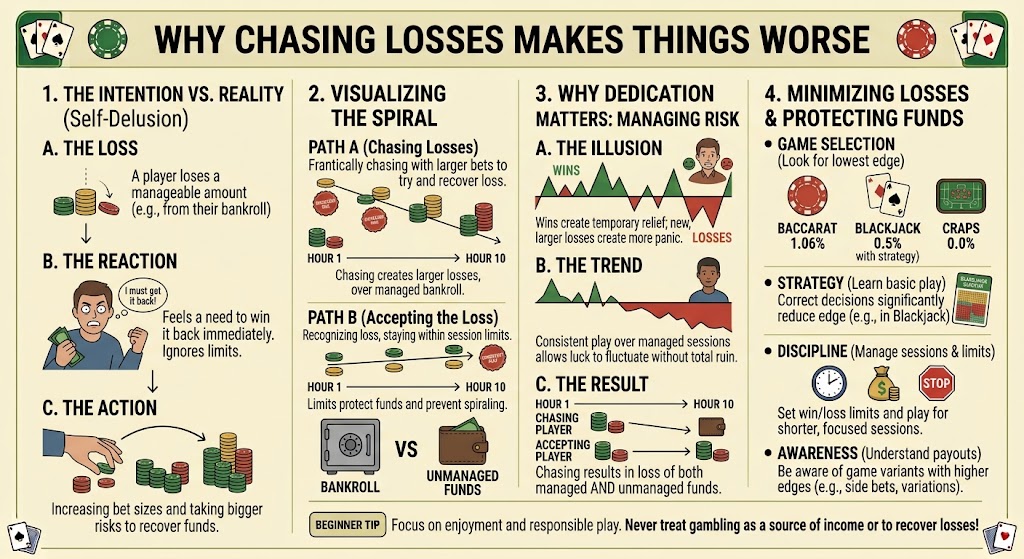
Chasing losses is the impulse to increase the size or frequency of bets after a losing session, hoping that a bigger win will erase the earlier loss. It often involves abandoning a pre‑set budget or time limit and playing until the “losses feel right again.” While it may feel like a logical way to recover, it actually runs counter to the statistical realities of random games.
Why Chasing Losses Leads to Bigger Problems
Psychological Traps
Several mental shortcuts make chasing appealing:
- Loss aversion: Losing feels more painful than winning feels good, so the mind pushes you to fix the pain quickly.
- Gambler’s fallacy: The mistaken belief that a loss makes a win “due” in the near future.
- Escalation of commitment: After investing time and virtual credits, you feel compelled to keep going to justify the initial effort.
These biases are powerful even when no real money is at stake, because the same reward pathways in the brain are activated by virtual wins and losses.
Mathematical Reality
Because each game outcome is independent, increasing the size of bets does not change the probability of a win. In fact, larger bets expose you to higher volatility – the chance of a big swing in either direction. When the house edge is present, larger swings are more likely to move you further away from your original bankroll rather than bring you back.
Consider a simple example: if a game has a 5 % house edge, on average you will lose 5 % of every amount you wager over time. Doubling your bet does not halve the edge; it simply doubles the amount you are expected to lose on average.
Step‑by‑Step: How to Avoid the Chase
- Set a bankroll limit. Decide how many virtual credits you are comfortable spending in a single session. Treat that amount like a budget and stop when it is reached.
- Set a time limit. Decide how long you will play before taking a break. Use a timer or alarm to enforce the limit.
- Use a pre‑determined betting plan. Choose a stake size before you start and stick to it, rather than increasing it after a loss.
- Take regular breaks. Short pauses help you evaluate how you feel and prevent the momentum of a losing streak from pulling you into a chase.
- Accept losses as part of the game. Remember that losing credits is expected; it does not reflect personal failure.
Practical Example
Imagine you begin a session with 100 virtual credits and decide that each spin will cost 5 credits. After ten spins you lose 30 credits, leaving you with 70. The urge to “win it back” might lead you to increase the bet to 10 credits per spin. If the next five spins are all losses, you will have lost an additional 50 credits, dropping your balance to 20. By the time you finally win a spin, the single win may only add back 10 credits, leaving you still far below your starting point. If you had kept the original 5‑credit stake, the same five‑spin losing streak would have cost only 25 credits, preserving more of your bankroll and giving you more chances to recover gradually without a large swing.
Responsible‑Gambling Practices for Free‑Play Simulations
Even though no real money is involved, the habits you develop in a virtual environment can influence how you approach real‑money gambling later. Treat the virtual credits as if they were a real budget:
- Never play for longer than the time you have set aside.
- Never exceed the virtual bankroll you allocated for the session.
- Remember that the games are designed with a house edge; there is no guaranteed way to win.
- Check the laws where you live before engaging with any gambling‑related content, even if it is free‑play.
- If you notice that you feel anxious, frustrated, or compelled to keep playing despite your limits, consider stepping away and seeking support from a local gambling‑help service or a trusted friend.
Frequently Asked Questions
- Is it safe to keep playing after a loss? Continuing to play after a loss is fine if you stay within your pre‑set bankroll and time limits. However, increasing bet sizes in an attempt to recover quickly is risky and often leads to larger losses.
- Can I recover lost credits by increasing my bets? No. Larger bets increase the amount you stand to lose on each spin, and the house edge remains unchanged. The odds of a single win do not improve with a bigger stake.
- What should I do if I feel a strong urge to chase? Pause the game, take a break, and remind yourself of the limits you set. If the urge persists, consider ending the session entirely and engaging in a different activity.
- Where can I find support if gambling feels out of control? Look for a local gambling‑support service, mental‑health professional, or community organization that offers confidential help. Many regions have free helplines and online resources that can guide you toward appropriate assistance.
Conclusion
Chasing losses is a natural reaction to the disappointment of a losing streak, but it conflicts with the mathematics of random games and the psychological biases that make it tempting. By understanding the role of randomness, the inevitability of the house edge, and the ways in which larger bets increase volatility, beginners can see why the chase usually deepens the problem. Setting clear bankroll and time limits, sticking to a consistent betting size, and treating virtual credits with the same respect as real money are practical steps that keep the experience enjoyable and safe. Remember, the goal of a free‑play simulation is entertainment, not profit, and responsible habits today lay the groundwork for healthier choices tomorrow.