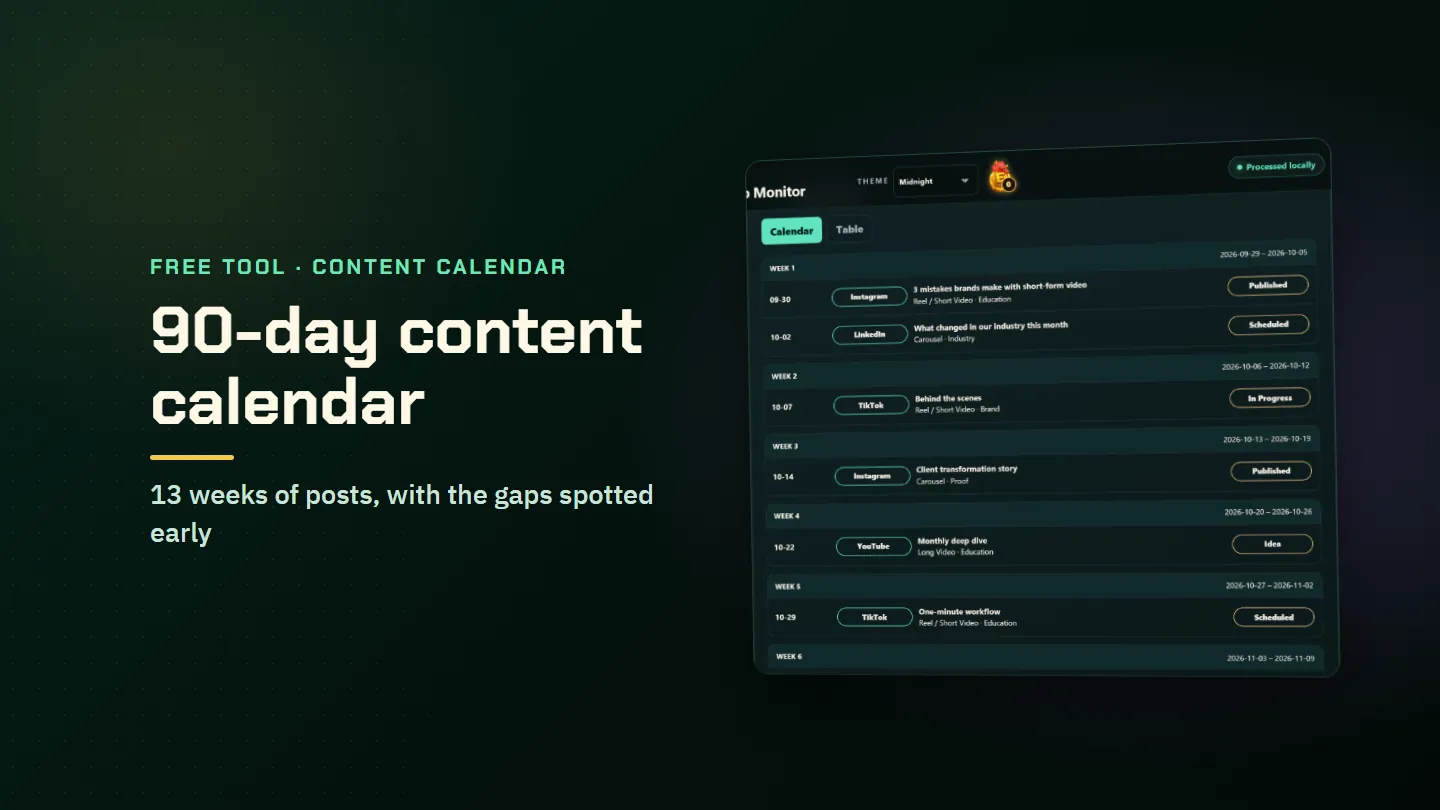
Most small businesses post when they remember to. The result is familiar: a burst of posts after a slow month, then weeks of silence, then a rushed promotion. A content calendar fixes this by deciding in advance what goes out and when. Ninety days, or 13 weeks, is a good length: long enough to plan campaigns and seasons, short enough that the plan stays realistic.
Step 1: Choose three or four content pillars
Pillars are the themes you post about again and again. For a small business they might be:
- Teach: useful tips related to what you sell.
- Show: products, work in progress, behind the scenes.
- Prove: customer stories, reviews, results.
- Sell: offers, launches and clear calls to action.
A common balance is mostly teaching and showing, with selling kept to around one post in five. People follow accounts that are useful, and buy from the ones they follow.
Step 2: Set a rhythm you can actually keep
Consistency matters more than volume. Three posts a week on one platform, kept up for 13 weeks, beats daily posting that stops after two. Decide for each platform:
- how many posts a week;
- which days;
- which pillar each slot usually takes, for example Monday tips, Wednesday behind the scenes, Friday customer story.
Step 3: Mark the dates that matter
Before filling posts, add the fixed points for the 13 weeks: product launches, sales, public holidays, seasonal events, industry dates and anything that affects your customers. Plan the content around a launch two to three weeks ahead, not the day before.
Step 4: Fill the weeks and spot the gaps
Now write a working title for each slot. It does not need to be finished content, just enough to know what the post is. Then look down the calendar for:
- Empty weeks, which are easy to miss in a list and obvious in a calendar;
- Too much selling in a row;
- One pillar crowding out the others.
Step 5: Batch the work
Creating content one post at a time is slow. Set aside a few hours every two weeks to write captions, take photos and schedule posts together. Reuse strong content: a blog post can become three social posts, a short video and a newsletter item.
Step 6: Review at the end of the quarter
After 13 weeks, look at which posts brought comments, clicks, enquiries or sales. Keep more of what worked and drop what did not, then plan the next 90 days. The calendar improves every quarter because it is based on what your own audience responds to.
Plan it in a spreadsheet
The free 90-Day Content Calendar tool plans 13 weeks of posts across platforms, shows which weeks still need content, and exports a formula-driven, Excel-compatible XLSX. It runs in your browser with nothing uploaded. If you track campaigns and budgets too, the budget vs actual template keeps marketing spend in check.
Frequently asked questions
How often should a small business post on social media?
As often as you can sustain with good quality. For most small teams, two to four posts a week on one or two platforms is realistic.
Why 90 days rather than a year?
A year is too far ahead to plan in detail, and a month is too short for campaigns. Thirteen weeks balances both, and fits neatly with business quarters.
What should I do when I miss a week?
Skip it and continue with the next week's plan. Trying to catch up by posting everything at once rarely works.