"Save for a house" is a wish. "Save S$930 a month for five years" is a plan. The difference is one calculation, and once you have the monthly number, every other decision becomes easier: whether the goal is realistic, whether to push the date back, or whether to start with what you already have.
The simple version: no interest
If the money sits in a savings account earning little, the maths is simple:
Monthly saving = (target − amount already saved) ÷ number of months
Example: a S$60,000 home deposit in five years (60 months), starting from nothing, needs S$1,000 a month.
With interest or investment returns
If the savings earn a return, you need a little less each month. The formula for the monthly amount is:
Monthly saving = target × r ÷ ((1 + r)n − 1)
where r is the monthly rate (the annual rate divided by 12) and n is the number of months.
Same example at 3% a year: r = 0.0025 and n = 60. (1.0025)60 is about 1.1616, so the monthly saving is 60,000 × 0.0025 ÷ 0.1616 ≈ S$928. The interest saves about S$72 a month.
Starting with money already saved
Existing savings also grow. At 3% a year, S$10,000 today becomes about S$11,616 in five years. Subtract that from the target first: S$60,000 − S$11,616 = S$48,384 still to save, which needs about S$748 a month.
Three common goals
Home deposit
Include every upfront cost, not just the down payment: stamp duty, legal fees, renovation and furniture. For HDB flats, check how much can come from CPF Ordinary Account savings and how much must be paid in cash, as that changes how much cash you actually need to save.
Wedding
Short timelines and fixed dates suit a plain savings account rather than investments, because there is no time to recover from a market fall. Save the full amount by a month before the date, as deposits are often due early.
Education
University is usually 10 to 18 years away, so fee inflation matters. Estimate today's cost and increase it by an assumed rate, for example 3% a year, before calculating the monthly amount. The longer timeline also makes investing more reasonable than for short goals.
Keep it realistic
- Use a cautious return. An optimistic rate makes the monthly figure look smaller than it needs to be.
- Match the risk to the timeline. Money needed within about three years is usually best kept in cash or deposits.
- Review once a year. Recalculate with the actual balance and adjust the monthly amount.
- Automate it. A standing transfer on payday works better than saving what is left at the end of the month.
Track several goals on one page
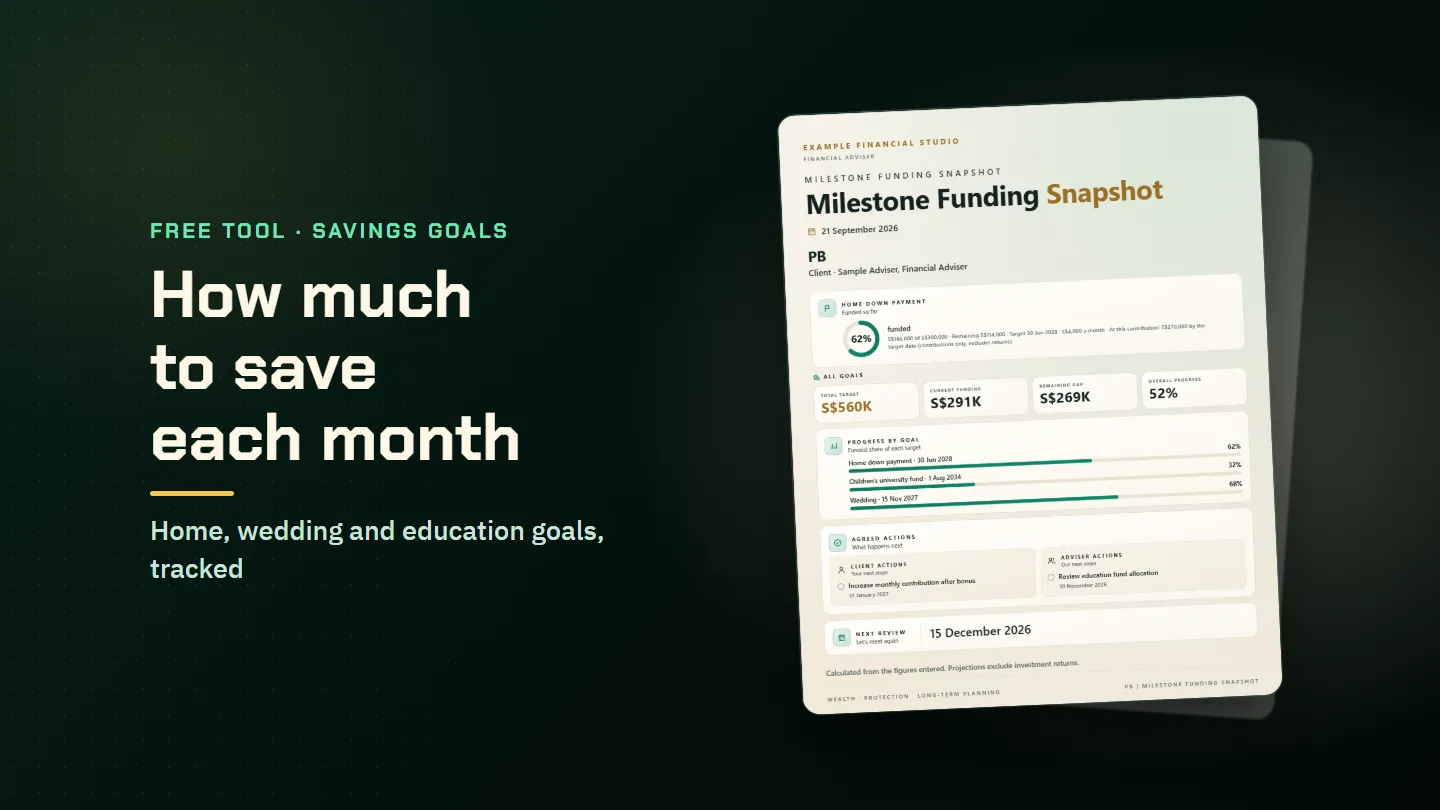
The free Savings Goal Tracker shows progress towards a home, education, wedding or business goal, with the remaining gap and the monthly contribution, as one clear image. It runs in your browser and nothing is uploaded. If spending leaves little to save, start with a subscription audit and a budget vs actual check.
Frequently asked questions
What return should I assume?
For short goals, the interest rate on your savings account or fixed deposit. For long goals, a cautious long-term return, reviewed each year.
Should I save for several goals at once?
Yes, if you can. Give each goal its own monthly amount and, ideally, its own account so progress is easy to see.
Is this financial advice?
No. It is general information to help you plan. Speak to a licensed adviser about your own situation.