Most late invoices are not refused. They are forgotten, stuck in an approval queue, or sent to the wrong person. A clear, polite and regular follow-up gets most of them paid without any awkwardness. The businesses that struggle are usually the ones that wait too long, then send one angry email.
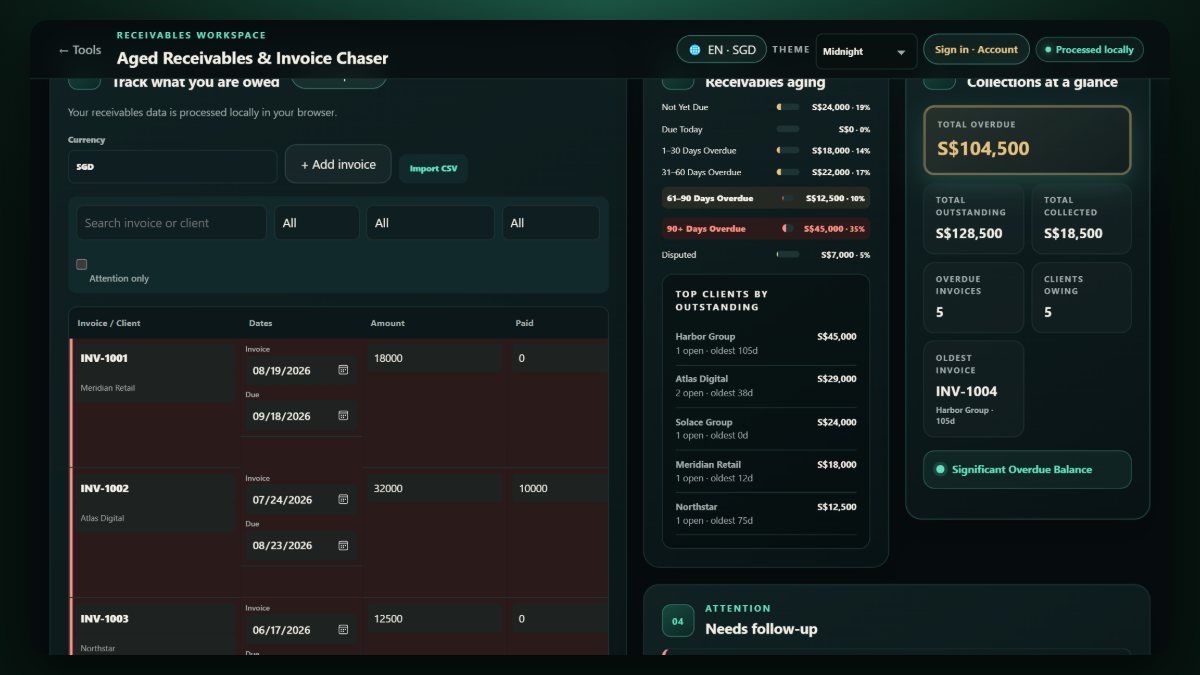
This guide gives you a follow-up schedule, wording for each stage, and a free Receivables tracker that groups invoices by how overdue they are and suggests a polite chaser for each.
Key takeaways
- Make it easy to pay: a clear invoice with the due date, amount and payment details.
- Follow a schedule: a reminder before the due date, then at about 7, 30, 60 and 90 days overdue.
- Stay polite and factual at every stage; get firmer, never ruder.
- Track invoices by age. The older a debt, the harder it is to collect.
- Know in advance what you will do at 90 days, so the decision is not made in frustration.
Before the due date
The best chaser is sent before anything is late. A short reminder a few days before the due date catches invoices sitting in the wrong inbox.
Hi [name], a quick note that invoice [number] for [amount] is due on [date]. The payment details are on the invoice, and I've attached it again for convenience. Thank you!
About 7 days overdue: the gentle nudge
Hi [name], I hope all is well. I couldn't see payment for invoice [number] ([amount], due [date]) yet. Could you check whether it's in your payment run? If it has already been paid, please ignore this, and thank you.
About 30 days overdue: the direct request
Hi [name], invoice [number] for [amount] is now 30 days past its due date. Could you let me know when we can expect payment? If there is a problem with the invoice or the work, please tell me so I can sort it out quickly.
At this stage, a phone call often works better than a third email. Ask who approves payments and whether anything is missing.
About 60 days overdue: the firm follow-up
Hi [name], invoice [number] for [amount] is now 60 days overdue, and I haven't had a reply to my earlier messages. Please arrange payment by [date], or contact me to agree a payment plan. I'd like to resolve this without any further steps.
About 90 days overdue: the final notice
Dear [name], despite previous reminders, invoice [number] for [amount] remains unpaid 90 days after its due date. Unless payment or a written payment plan is received by [date], we will [pause further work / refer the matter for collection / take the next step set out in our terms].
Only state a consequence you are prepared to carry out, and check your contract terms first. For larger amounts, consider professional advice before taking formal action.
Track invoices by age
An aging report groups unpaid invoices into buckets by how long they are overdue, such as current, 1–30, 31–60, 61–90 and over 90 days. It shows at a glance who to chase this week and which debts are getting risky. The Receivables generator builds this for you, suggests the right chaser wording for each overdue invoice, and exports an Excel-compatible XLSX you can update weekly.
Try it free: List your open invoices and due dates to see them grouped by age, with polite chaser wording for each one. Open the Receivables tracker on CREATEFOR.YOU. It runs in your browser, needs no sign-up to build and preview, and the entries you type are not sent to the server.
Habits that reduce late payment
- Agree payment terms in writing before you start the work.
- Invoice promptly, the day the work is delivered.
- Address the invoice to the person who pays, not only the person you worked with.
- For new clients or large jobs, ask for a deposit.
- Offer simple ways to pay, and put the details on every invoice.
Frequently asked questions
How soon after the due date should I send a reminder?
Within about a week. Waiting longer makes the late payment feel acceptable, and makes the eventual reminder feel more awkward.
Should I charge late payment fees?
Only if they are in your agreed terms. Mentioning them in a reminder is reasonable; adding them without prior agreement usually damages the relationship.
What if the client disputes the invoice?
Ask exactly which part is disputed and whether the rest can be paid now. Resolve the specific issue rather than the whole invoice.