A full portfolio statement can run to twenty pages of holdings, transactions and disclosures. Most clients read the first page, if that. The job of a portfolio summary is to answer the questions a client actually has, on one page, in about a minute:
- How much is it worth now?
- How has it done, and is that good?
- Where is the money, and is that still right for me?
Everything else can live in the full statement. This guide covers what belongs on the summary, how to show each part clearly, and the mistakes that make clients stop reading.
1. Total value, with a comparison point
Start with one large number: the portfolio value on a stated date. On its own, that number means little. Put it next to something the client can compare it with, such as the value at the start of the year, at the last review, or the total amount contributed. "S$482,300, up from S$455,900 at our last review in March" says far more than the total alone.
Separate market movement from money added or withdrawn. If a client added S$20,000 during the period, a rise of S$26,400 was mostly their own deposit. Showing contributions and withdrawals on their own line prevents that misunderstanding.
2. Returns that mean something
Show returns over periods the client cares about: since the last review, year to date, and since the portfolio started. Two points make returns honest:
- Say which return you are showing. A time-weighted return measures how the investments performed, ignoring when money went in or out. A money-weighted return reflects the client's own timing. Both are valid; mixing them without saying which is not.
- Give a benchmark. "7.2%" tells a client nothing. "7.2% against 6.1% for a balanced benchmark" tells them how the portfolio did relative to a reasonable alternative.
Show returns after fees where you can, and say so. Clients increasingly ask, and a figure that turns out to be before fees damages trust.
3. Allocation: target against actual
A simple bar or doughnut showing equities, bonds, cash and alternatives is the most useful chart on the page, but only if it also shows the target. "Equities 68% (target 60%)" immediately raises the right conversation: the portfolio has drifted, and it may be time to rebalance.
Keep the number of slices small. Five or six categories are readable; fifteen sub-asset classes are not. Put the detail in an appendix.
4. Account buckets
Many clients hold money in several places: a cash account, an investment account, retirement accounts such as SRS, and perhaps a policy with investment value. Listing each bucket with its value answers "where is my money?" and helps spot idle cash sitting in the wrong place.
5. One or two next steps
End with what happens next: a rebalance to discuss, a top-up to consider, a date for the next review. A summary that ends with a clear next step turns a report into a conversation.
Common mistakes
- Too many numbers. If everything is highlighted, nothing is.
- Unlabelled periods. Always state the date range for every return.
- Jargon. "Duration", "alpha" and "Sharpe ratio" belong in the appendix, if anywhere.
- Inconsistent layout between reviews. Clients learn where to look. Keep the same order every time.
Make the summary in a few minutes
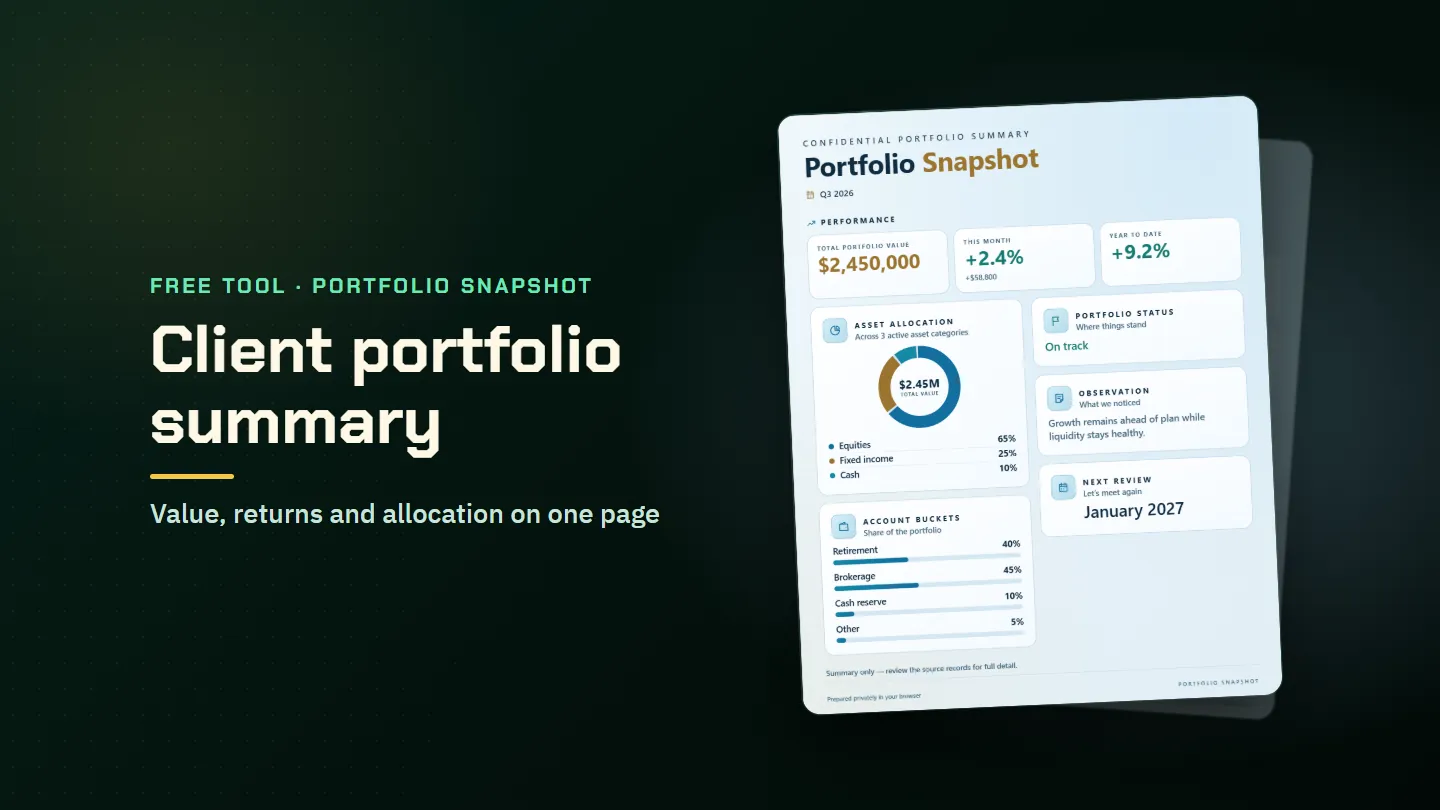
The free Portfolio Snapshot tool lays out exactly this page: value, returns against a benchmark, allocation against target, account buckets and next steps. You type the figures, preview it in ten themes and export a PNG, JPG or SVG. Everything is made in your browser, so client figures are not uploaded anywhere. For the meeting itself, pair it with a client meeting recap.
Frequently asked questions
How often should I send clients a portfolio summary?
At every review meeting, and at least once or twice a year. A consistent one-page summary each time makes changes easy to see.
Should the summary show individual holdings?
Usually not. List the top holdings only if the client asks. The full statement already contains every position.
Is a portfolio summary the same as a statement?
No. The statement is the official record from the custodian or platform. The summary is a plain-language view prepared for the conversation, and should say that the statement is the authoritative source.