
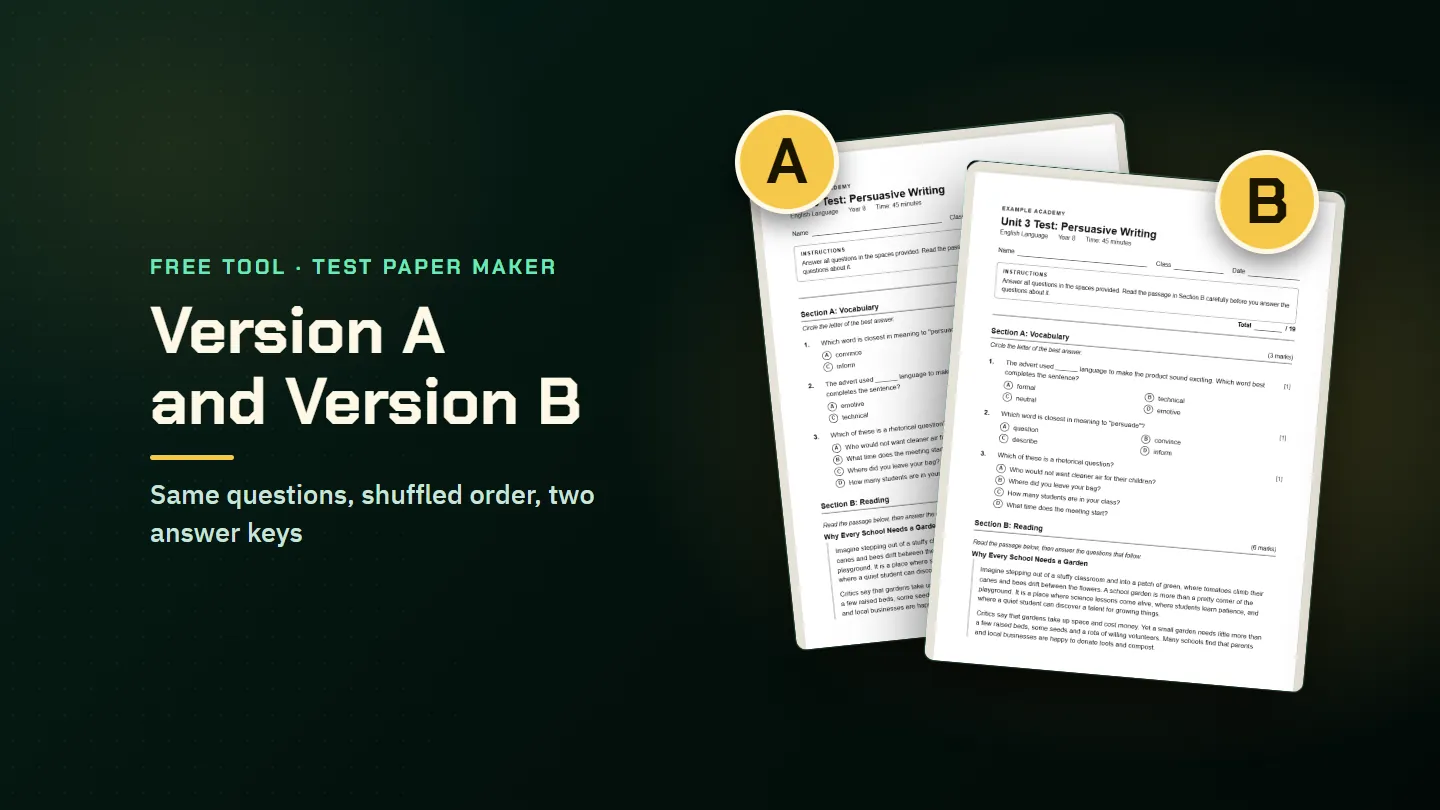
When students sit close together, a single version of a test invites wandering eyes. Giving alternate rows a different version is one of the simplest ways to reduce copying. The challenge is doing it fairly: both versions must test the same things at the same difficulty, and you still need to mark them quickly.
What should change between versions
- The order of the questions. Shuffle within each section so that question 5 on Version A is question 11 on Version B.
- The order of the options in multiple-choice questions, so the correct answer is B on one version and D on the other.
These two changes defeat most copying, because a neighbour's answer to "question 5" or "option B" is useless.
What should stay the same
- The questions themselves. Rewriting questions for Version B risks making one version harder. If you do change wording or numbers, check that the difficulty really is equal.
- The sections and their order. Keep all multiple-choice questions together, then short answers, then longer questions, so students of both versions work through the paper in the same way.
- Marks and time. Identical for both.
Traps to avoid
- "All of the above" and "None of the above". These must stay as the last option, or they stop making sense. Lock their position when shuffling.
- Options that follow an order, such as numbers from smallest to largest or dates. Shuffling them makes the question harder to read; keep them in order.
- Questions that refer to each other, for example "Using your answer to question 4". Either keep them together or reword them.
- Different page breaks. If a diagram falls on a different page in Version B, that version may be harder to follow. Check the layout of both.
Keep the answer keys straight
Most marking mistakes with two versions come from using the wrong key. Three habits help:
- Print the version letter clearly on every page, not just the cover.
- Generate a separate answer key for each version, labelled in large type.
- Sort papers into A and B piles before you start marking.
Seat the versions
Alternate versions by row or in a chequerboard, so no student sits directly beside or behind someone with the same version. Tell students in advance that there are different versions. Knowing that alone discourages copying.
Make both versions automatically
The free Test Paper Maker builds printable tests with multiple choice, true/false, fill-in-the-blank and written questions, an answer key, and a shuffled Version B with its own key. It runs in your browser and exports a PDF. For writing better questions in the first place, see how to write multiple-choice questions, and to plan when each test falls in the term, the school term planner.
Frequently asked questions
Is it fair to give students different versions?
Yes, as long as the questions are the same and only their order changes. If you change the questions themselves, check carefully that both versions are equally difficult.
How many versions do I need?
Two is enough for most classrooms when they are seated alternately. More versions add marking work with little extra benefit.
Does shuffling affect results?
Question order can have a small effect on some students. Keeping sections in the same order and shuffling within each section keeps any effect small.