For a business owner, the annual review with their bank is often the only time someone looks at the whole picture: cash, borrowing, how quickly money comes in and goes out, and what would happen if something went wrong. A relationship manager who arrives with a clear one-page view of those things is remembered. One who arrives with a product list is not.
These five areas cover what matters for most small and medium-sized businesses.
1. Cash position
Start with cash across all accounts and how it has moved over the past year. Look at the lowest balance, not just the average. A business that averages S$300,000 but dips to S$15,000 before payroll every quarter has a very different risk profile from one that never drops below S$200,000.
2. Working capital and the cash conversion cycle
The cash conversion cycle shows how many days cash is tied up in operations:
Cash conversion cycle = days inventory outstanding + days sales outstanding − days payables outstanding
For example, a distributor holding stock for 45 days, collecting from customers in 60 days and paying suppliers in 30 days has a cycle of 75 days. Every sale needs financing for two and a half months. Shortening collection by 15 days frees cash equal to 15 days of sales. This is often the most valuable insight you can bring, and it links directly to receivables management.
3. Facilities and utilisation
List each facility with its limit, amount drawn, rate and expiry: overdraft, revolving credit, trade finance, term loans, guarantees. Two things to watch:
- Utilisation. A facility running near its limit most of the time suggests the business needs more working capital, or a different structure.
- Maturities. Facilities expiring in the next twelve months need planning well before the date.
4. Covenants and headroom
If loans carry covenants, such as a minimum debt service coverage ratio or a maximum leverage ratio, show the current figure against the limit. Headroom matters more than compliance: a covenant met with little room to spare is a conversation to have now, not after a weak quarter.
5. Continuity and protection
- Key person risk: what happens if the owner or a key manager cannot work?
- Succession: is there a plan for ownership and management?
- Concentration: does one customer or supplier account for a large share of revenue?
- Insurance: property, business interruption, key person and trade credit cover.
Keep this section factual. Its value is in making gaps visible, not in selling a particular solution during the review.
The one-page summary
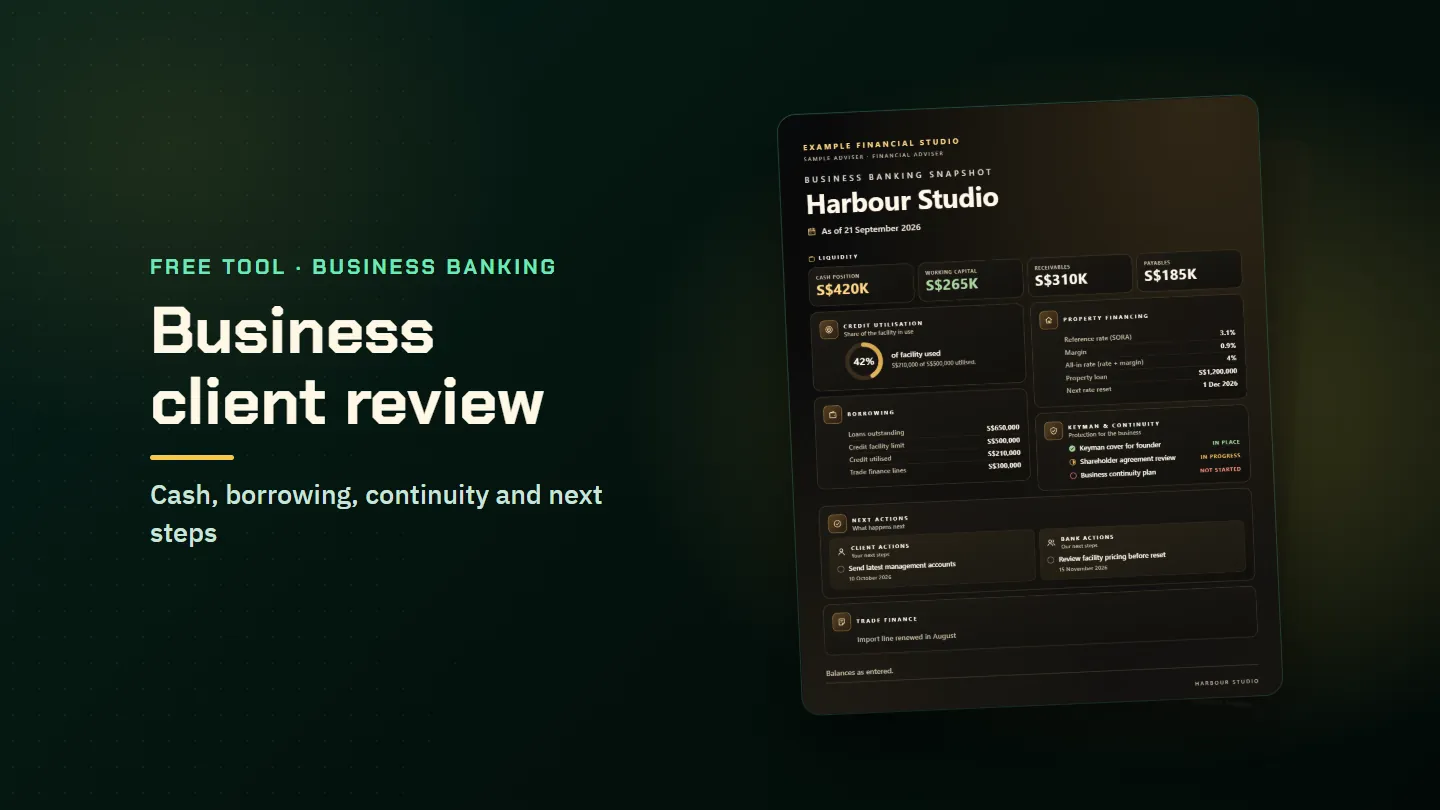
End the meeting by leaving a single page with cash, working capital, facilities, covenant headroom, continuity items and agreed next steps. The free Business Banking Snapshot tool builds that page as a clean image in your browser, with nothing uploaded. For a forward view of cash, pair it with the 12-month cash flow forecast.
Frequently asked questions
How often should business clients be reviewed?
At least once a year, and whenever a facility is renewed or the business changes materially.
What is a good cash conversion cycle?
It depends on the industry. The useful comparison is with the business's own past and with similar businesses, and the trend matters more than any single figure.
Should the summary include confidential figures?
Share the summary only with the client and follow your bank's rules for handling client information.