Every year the last weeks of December bring the same rush: people topping up their CPF accounts and contributing to SRS before the year closes. The reason is income tax. Money that reaches CPF or your SRS account by 31 December 2026 can reduce the tax you are assessed on in 2027, Year of Assessment (YA) 2027. Miss the date and the relief moves to the following year.
This guide explains both reliefs, the limits for 2026, the matched top-ups that do not qualify, what the relief is actually worth at different tax rates, and a checklist to get it done in time. It is general information, not tax or financial advice; the official rules are on the IRAS page on CPF Cash Top-up Relief, the IRAS page on SRS contributions and the CPF Board's guide to top-up relief.
Key takeaways
- CPF cash top-up relief: up to $8,000 a year for topping up your own CPF, plus up to $8,000 for topping up eligible family members. Up to $16,000 in total.
- SRS: contributions of up to $15,300 a year for Singapore Citizens and Permanent Residents, or $35,700 for foreigners, reduce your taxable income dollar for dollar.
- All your personal reliefs together are capped at $80,000 per Year of Assessment.
- Top-ups that attract a government matching grant under MRSS (from 1 January 2025) or MMSS (from 1 January 2026) do not get tax relief.
- CPF top-ups cannot be withdrawn like savings, and SRS withdrawals are taxed later. Relief is a reason to act before the deadline, not the only reason to act.
CPF top-up vs SRS at a glance
| CPF cash top-up | SRS contribution | |
|---|---|---|
| Maximum relief a year | $8,000 for your own accounts + $8,000 for family | $15,300 (citizens and PRs) or $35,700 (foreigners) |
| Where the money goes | Your (or a family member's) CPF retirement or MediSave savings | Your own SRS account with a participating bank |
| Can you take it out? | No. It is paid out under CPF's retirement and healthcare rules | Yes, but withdrawals are taxed, and early withdrawals carry a penalty |
| Tax when it comes out | None on CPF payouts | 50% of withdrawals are taxable from your statutory retirement age |
| Growth | Earns CPF interest | Earns very little unless you invest it |
CPF cash top-up relief in detail
Topping up your own account
Cash top-ups to your own retirement savings qualify for relief of up to $8,000 a year. If you are under 55, that means your Special Account (SA); from 55, your Retirement Account (RA). The CPF Board states that this $8,000 cap is shared with cash top-ups to your MediSave Account, and it also covers top-ups made for you by an employer. It is one $8,000 allowance, not one per account.
Topping up family members
A second, separate cap of up to $8,000 covers top-ups for loved ones. Parents, parents-in-law, grandparents and grandparents-in-law qualify. A spouse or sibling qualifies only if their income in the previous year was $8,000 or less, a condition that does not apply if they have a disability. Topping up a family member's CPF is a gift in every practical sense: the money becomes their retirement savings.
How much can go in
Accounts have ceilings. For members turning 55 in 2026, the Basic Retirement Sum is $110,200, the Full Retirement Sum (FRS) $220,400 and the Enhanced Retirement Sum (ERS) $440,800. Under 55, you can top up your SA up to the current FRS; from 55, you can top up your RA up to the current ERS. MediSave top-ups are limited by the Basic Healthcare Sum. A top-up above a ceiling is not accepted, so check your headroom in your CPF account before paying.
The matched top-ups that get no relief
Two government schemes match cash top-ups for eligible members, and the government has decided that money it matches should not also earn tax relief:
- Matched Retirement Savings Scheme (MRSS): from 1 January 2025, cash top-ups that attract the MRSS matching grant, up to $2,000 of matching a year, no longer get tax relief.
- Matched MediSave Scheme (MMSS): from 1 January 2026, cash top-ups to MediSave that attract the MMSS grant, up to $1,000 of matching a year, no longer get tax relief, starting from YA 2027.
In practice, this mostly affects people topping up an older parent's account. The matching grant is often worth more than the tax relief would have been, so a matched top-up can still be the better use of the money. It just will not reduce your tax.
SRS in detail
The Supplementary Retirement Scheme is a voluntary account you open with a participating bank. Each dollar you contribute, up to $15,300 a year for Singapore Citizens and PRs or $35,700 for foreigners, is deducted from your taxable income for that year, subject to the $80,000 overall cap. The relief is applied automatically from the information your bank provides.
The trade-off is on the way out. From the statutory retirement age that applied when you made your first contribution, only 50% of each withdrawal is taxable, and withdrawals can be spread over ten years to keep each year's taxable amount low. Withdraw earlier and the whole amount is taxable, plus a 5% penalty, except in limited cases such as death, certain medical grounds, or foreigners who have held the account for ten years.
Money left in an SRS account as cash earns almost nothing, so the relief is only half the decision. The other half is what you do with the money once it is there.
What the relief is worth to you
Relief reduces your chargeable income, so it saves tax at your marginal rate, the rate on your top slice of income. Singapore's resident rates rise in bands, from 0% on the first $20,000 of chargeable income to 24% on income above $1 million. Assuming the whole amount falls within one band:
| Your marginal rate | Tax saved on an $8,000 CPF top-up | Tax saved on a $15,300 SRS contribution |
|---|---|---|
| 7% | $560 | $1,071 |
| 11.5% | $920 | $1,759.50 |
| 15% | $1,200 | $2,295 |
| 22% | $1,760 | $3,366 |
Two things follow. The higher your income, the more each dollar of relief is worth. And if your income is low enough that you pay little or no tax, relief is worth little or nothing, so the decision should rest entirely on whether the top-up or contribution makes sense for your retirement.
The 31 December checklist
- Estimate your 2026 chargeable income and the reliefs you already qualify for. If you are close to the $80,000 cap, extra relief will not help.
- Check eligibility: the family member's relationship and, for a spouse or sibling, their 2025 income. Check whether the top-up would attract MRSS or MMSS matching.
- Check the ceilings: the FRS, ERS or Basic Healthcare Sum headroom on the account you are topping up, and your remaining SRS cap for 2026.
- Pay early. The money has to arrive by 31 December, not just leave your account. Transfers can take time over the holidays, and banks may set their own earlier cut-offs for SRS. Aim for mid-December.
- Keep the confirmations of every top-up and contribution.
- Write it down in one place: what was paid, into which account, when, and the relief you expect. It makes filing in 2027 and next year's planning much easier.
For advisers: send the plan as a one-page summary
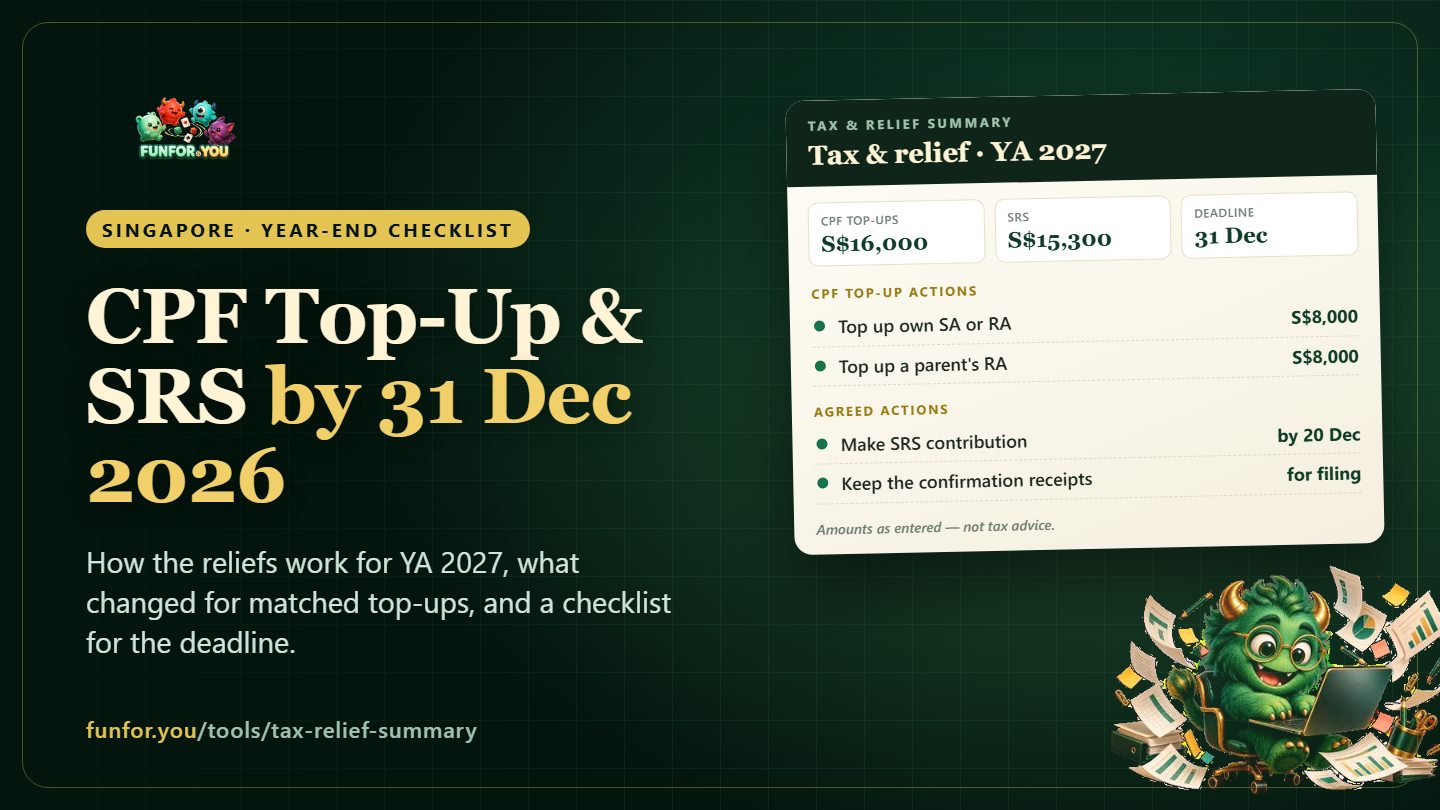
If you help clients with year-end planning, the free Tax & Relief Summary generator turns the agreed plan into a clean image your client can keep: the year of assessment, the deadline, each CPF top-up action with its amount, the SRS contribution, relief items and agreed actions with who does what by when. It shows amounts as entered and does not calculate tax or recommend strategies, and it says so on the summary.
Two related templates fit the same conversation: the Retirement Income Snapshot compares a target retirement income with CPF LIFE and other sources, and the Meeting Recap records what was discussed and the next steps on both sides. All of them run in your browser, and nothing you type is uploaded. For more on writing clear follow-ups, see our client meeting recap guide.
Frequently asked questions
What is the deadline for CPF and SRS tax relief in 2026?
The money must reach CPF or your SRS account by 31 December 2026 to count for YA 2027. Leave a buffer of several working days, and check your bank's SRS cut-off.
Do I need to claim the relief?
CPF cash top-up relief and SRS relief are generally applied automatically, based on information from the CPF Board and your SRS operator. Check that it appears in your tax assessment.
Can I top up my spouse's CPF and get relief?
Only if your spouse's income in the previous year was $8,000 or less, or if they have a disability. Otherwise you can still top up, but without relief.
Can I get my CPF top-up back if I change my mind?
No. A cash top-up becomes CPF savings and is paid out under CPF's rules, for example as monthly retirement payouts. Only top up money you are sure you will not need before then.
Is it better to top up CPF or contribute to SRS?
It depends on your age, income, tax rate, other savings and how much flexibility you need, which is why it is worth discussing with a licensed financial adviser. CPF is locked in but earns CPF interest and pays out tax-free; SRS is more flexible but taxed on withdrawal and only grows if you invest it.