Insurance is usually bought one policy at a time, often years apart, and rarely reviewed as a whole. The result is common: some risks are covered twice, others not at all, and nobody in the family is quite sure what the policies actually pay. A coverage review fixes that by putting every policy on one page and comparing it with what the household needs.
This is general information, not advice for any individual. Speak to a licensed adviser before changing any policy.
Step 1: List every policy
Gather all policies, including group cover from an employer, and record for each one:
- who is insured and who the policyholder is;
- what it pays for: death, total permanent disability (TPD), critical illness, hospitalisation, disability income;
- the sum assured, and whether it reduces over time;
- when cover ends, and the yearly premium.
Mark employer cover clearly. It usually stops when the person leaves the job.
Step 2: Compare with common benchmarks
There is no single correct amount, but widely quoted guidelines give a sensible starting point. Singapore's MoneySense Basic Financial Planning Guide, for example, suggests:
- Death and TPD cover of about 9 times annual income;
- Critical illness cover of about 4 times annual income;
- spending no more than about 15% of take-home pay on insurance premiums.
Adjust for the household. Large debts such as a mortgage, young children, or a partner who depends on one income all increase the need. Substantial savings, or no dependants, reduce it.
Step 3: Find the gaps and overlaps
Put the target and the existing cover side by side for each type of risk:
- Gaps, for example "Critical illness: S$100,000 held against a target of S$320,000".
- Overlaps, for example two hospitalisation plans where only one can be claimed for the same bill.
- Timing problems, such as cover ending at 65 while the mortgage runs to 70.
Step 4: Agree follow-up actions
Record what the client decided: review a policy, compare quotes, update nominations, or leave things as they are. A short list with owners and dates is more useful than a long report. Before cancelling any existing policy, check what would be lost; replacing a policy can mean new exclusions or higher premiums at an older age.
Review checklist
- Have income, debts or dependants changed since the last review?
- Is any cover provided only by an employer?
- Are nominations up to date? (See the estate planning checklist.)
- Do all family members know where the policy documents are?
Record the review on one page
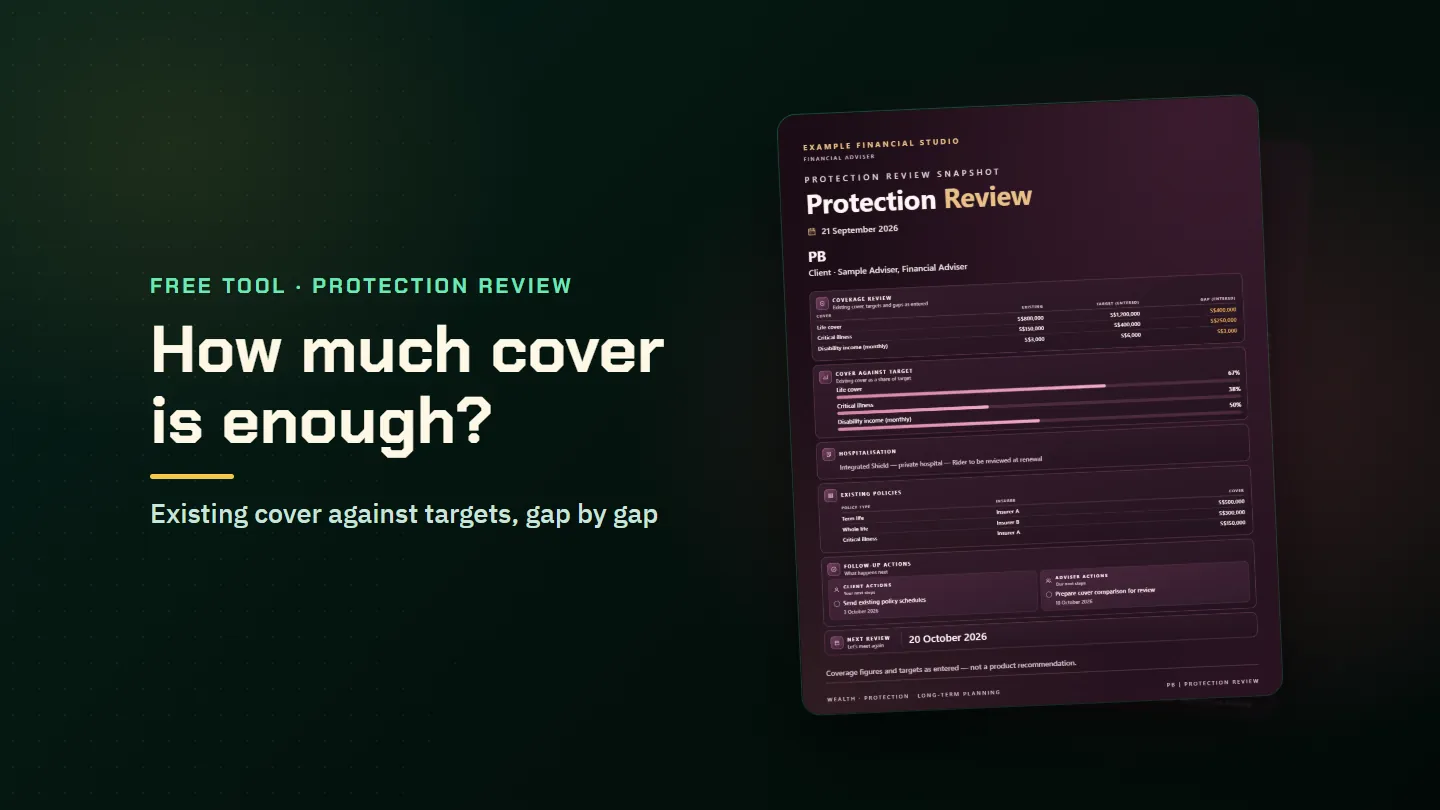
The free Protection Review tool shows existing life, critical illness and disability cover against the targets you set, with the gaps and follow-up actions, as one clear image. It runs in your browser, so policy details are not uploaded. It records the review; it does not recommend products.
Frequently asked questions
How often should insurance be reviewed?
Every two to three years, and after major life events such as marriage, children, a new home or a job change.
Is 9 times income always right?
No. It is a starting point. The right amount depends on debts, dependants, savings and how long the family would need support.
Does group insurance from work count?
Yes, while you have the job. Record it separately so it is clear what would be lost if you left.