Poker looks like it needs a lot of maths. It really needs one comparison, and you can do it in your head between hands.
The question is always the same: does what I stand to win justify what this call costs?
Pot odds
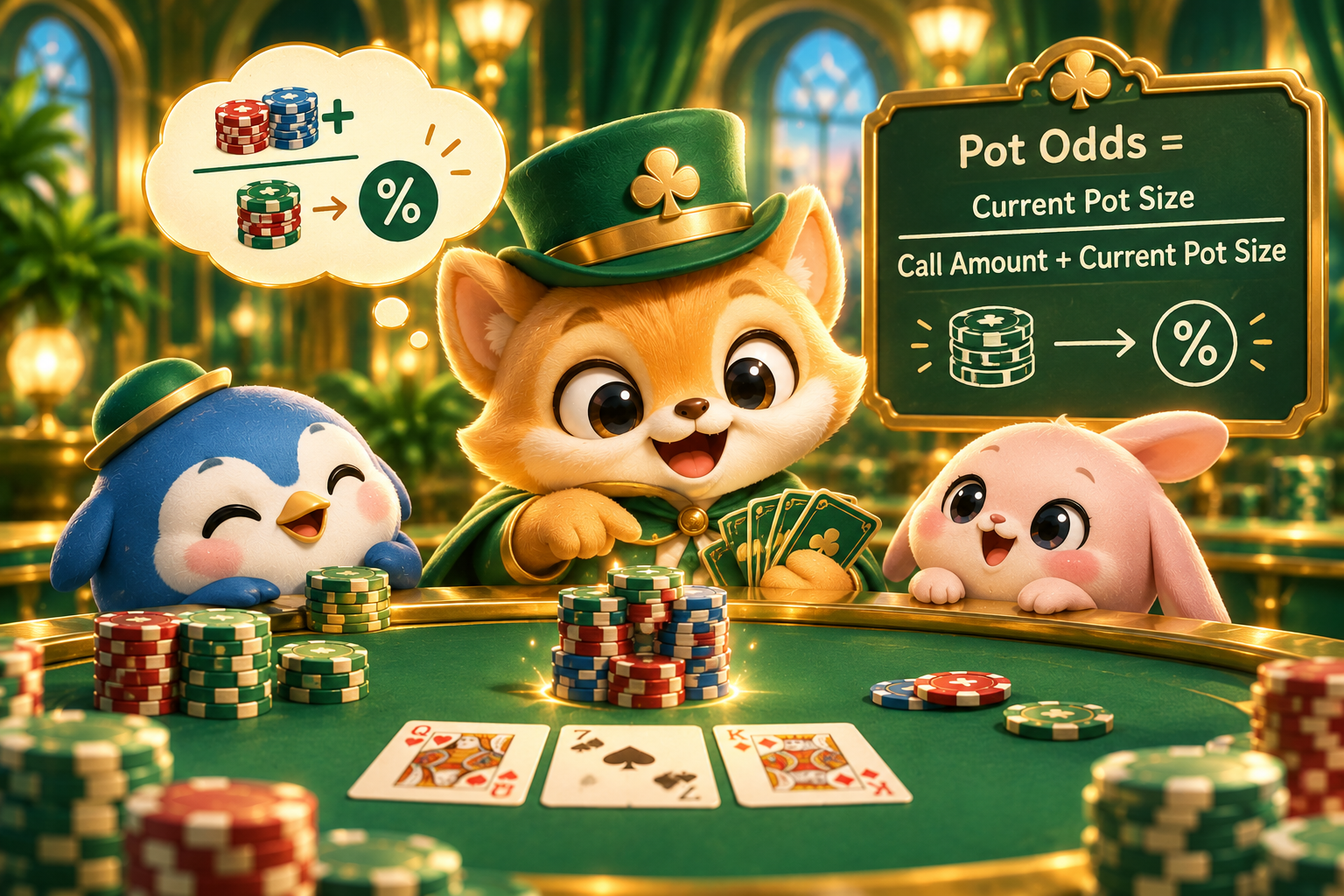
Pot odds are the price you are being offered.
Suppose the pot holds 100 chips and someone bets 20. To call you put in 20 to win 120 — the 100 that was there plus their 20. Your 20 is one-sixth of the 120 pot you would be playing for, or roughly 17%.
That percentage is your break-even point. If your hand wins more than 17% of the time, calling makes money in the long run. If it wins less, it does not — regardless of how the hand happens to end this once.
The general form: call amount ÷ (pot after your call).
Outs
Now the other half. An out is a card that turns your hand into a winner.
Four to a flush means nine cards of your suit remain unseen — nine outs. An open-ended straight draw has eight. A gutshot has four. Two overcards, roughly six.
Count honestly. Cards that improve you but still lose — a flush card that pairs the board when someone is representing a full house — are not outs, and beginners routinely count them.
The shortcut
The rule of four and two converts outs to a percentage fast enough to use in real time.
- On the flop, with two cards still to come: outs × 4.
- On the turn, with one card to come: outs × 2.
Nine outs on the flop is about 36%. Nine outs on the turn is about 18%. Close enough for the table, and always within a point or two.
Putting them together
Back to the example: 20 to call into a 120 pot needs 17%. You hold a flush draw on the flop — nine outs, roughly 36%. Twice what you need. Easy call.
Change the bet to 100 into that same 100 pot and you need 100 ÷ 200, or 50%. Your 36% draw no longer covers it, and the same beautiful flush draw becomes a fold.
Notice what shifted. Not your hand — the price. That is the entire idea, and it is why “is this a good hand?” is the wrong question. The question is whether it is good enough for what is being asked.
The mistake this fixes
Most losing calls are made because a hand felt worth continuing with. Pot odds replace that feeling with arithmetic that does not care how close you are.
The multiplication takes a second. It will save you far more chips than any tell you ever pick up.
One caution: pot odds tell you whether a call is correct at this price. They say nothing about whether you can afford to keep making the call. That is a separate question, and a bankroll answers it.