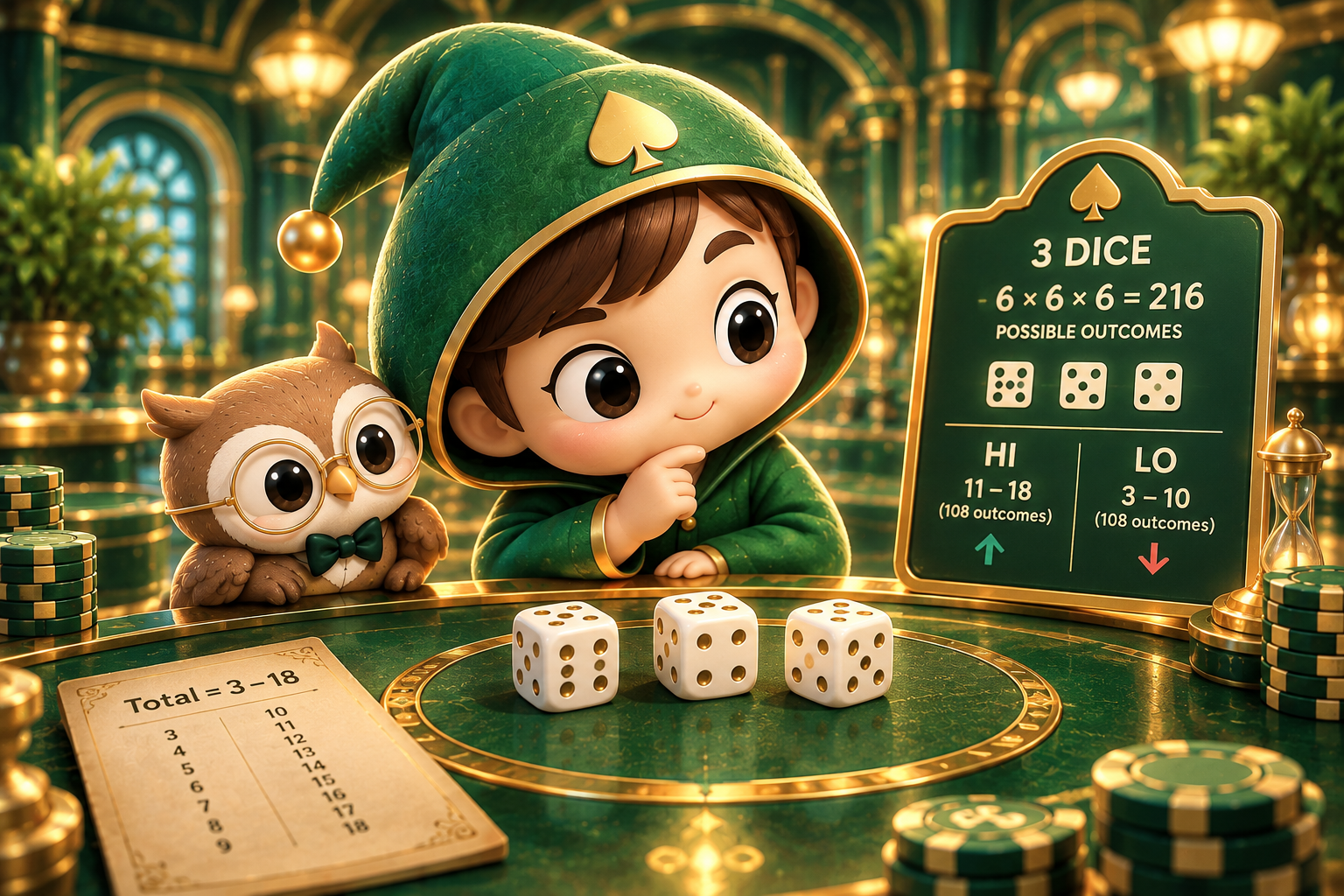
Roll three dice and there are exactly 216 possible outcomes — six faces, three times over. Every one of those 216 is equally likely.
The totals are not. That gap between equal outcomes and unequal totals is where every three-dice game lives.
Why the middle is crowded
A total of 3 needs all three dice showing one. There is precisely one way to do that, so it turns up once in 216 rolls — under half a percent. Same for 18 at the other end.
A total of 10 can be built dozens of ways: 6-3-1, 5-4-1, 4-4-2, 5-3-2, 6-2-2 and so on, each in its various orderings. Twenty-seven of the 216 combinations make 10, so it appears about one roll in eight.
The full picture is a neat hill. Here is how many of the 216 combinations produce each total:
- 3 or 18 — 1 each
- 4 or 17 — 3 each
- 5 or 16 — 6 each
- 6 or 15 — 10 each
- 7 or 14 — 15 each
- 8 or 13 — 21 each
- 9 or 12 — 25 each
- 10 or 11 — 27 each
10 and 11 are twenty-seven times more likely than 3. That is why betting a specific total pays wildly different amounts depending which total you choose — the payouts are tracking that hill.
The Hi-Lo bet
The main bet in these games splits the range in two. Lo covers totals 4 through 10, Hi covers 11 through 17, and both pay even money.
Count the combinations and each side gets 107 of the 216 — a dead heat. So where is the house edge?
In the four missing totals: 3 and 18 are outside both ranges, and, crucially, triples lose to both.
What the triple rule actually costs
This is the rule players skim past, and it is the entire mechanism.
Any three-of-a-kind — 1-1-1 through 6-6-6 — beats both Hi and Lo. Six of the 216 combinations are triples. Two of them (2-2-2 and 3-3-3, totalling 6 and 9) sit inside the Lo range, and two (4-4-4 and 5-5-5, totalling 12 and 15) sit inside Hi. The remaining two are 3 and 18, already outside.
So each side wins 105 times in 216 rather than 107, and loses 111. Both bets are 48.6% propositions paid at even money.
That works out to a house edge of about 2.78% — six combinations out of 216. It is a small, clean edge, and it comes entirely from a rule that fires roughly one roll in thirty-six.
The takeaway
Hi-Lo is close to a coin flip with a modest tax, which makes it one of the friendlier bets on a dice table. The exotic bets alongside it — exact totals, specific triples — carry far heavier edges in exchange for their big payouts.
And 2.78% is still 2.78%. A near-coin-flip is not a fair coin flip, and the difference is the entire business model.