Most people are not saving for one thing. They are saving for a home deposit, a child's education, a wedding, a business, and a cushion for emergencies, all at once, from one salary. Put everything in a single account and it becomes impossible to tell whether any goal is on track. Split the money without a plan and the most urgent goal quietly starves.
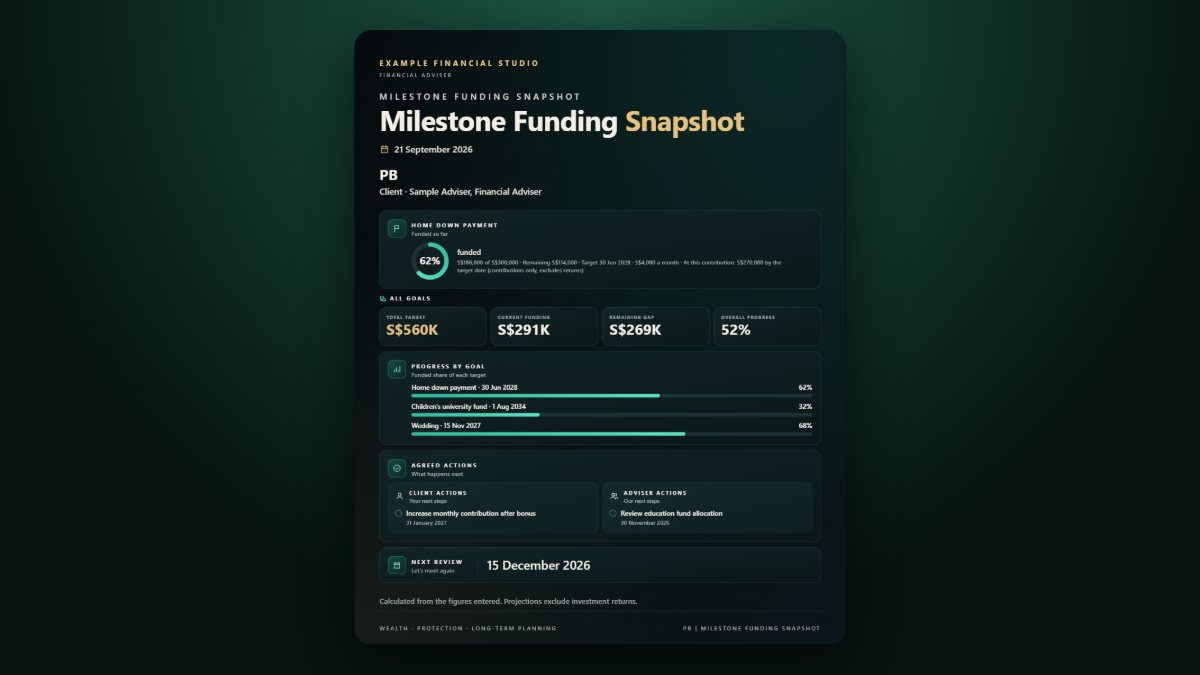
This guide shows a simple way to rank goals, split a monthly amount between them and track each one, with a free Milestone Funding recap generator that shows the progress and remaining gap for every goal on one page.
Key takeaways
- Build an emergency fund first; every other goal depends on not having to raid it.
- Rank goals by date and by how flexible they are, not only by size.
- Give each goal its own target, date and monthly amount: a "bucket".
- Review twice a year and move money between buckets deliberately, not by accident.
- Near-term goals belong in low-risk places; long-term goals can take more risk.
Step 1: List every goal with a target and a date
Write each goal down with three facts: how much, by when, and how much is already saved. "A house someday" is not a goal. "A $90,000 deposit by March 2029, $22,000 saved" is.
Step 2: Rank them
Use two questions for each goal:
- How soon is it? A wedding in 18 months cannot wait; retirement in 30 years can absorb a slow year.
- How flexible is it? Education fees arrive on a fixed date. A business launch can move by a year.
Soon and fixed goals come first. Distant and flexible goals take what is left, and benefit most from time.
Step 3: Work out the monthly amount for each goal
For each goal: (target − already saved) ÷ months left. For the house above: ($90,000 − $22,000) ÷ 30 months ≈ $2,267 a month. Add the monthly amounts for all goals and compare the total with what you can actually save.
If the total is too high, you have four levers, and it is worth deciding which one deliberately: move a date, lower a target, save more, or drop or pause a goal. Pretending the gap is not there is the only option that does not work.
Step 4: Keep each goal in its own bucket
Separate accounts, sub-accounts or clearly labelled investment holdings make progress visible and stop one goal borrowing from another without anyone noticing. Match the risk to the time: money needed within about three years is usually kept in low-risk, easily accessible places; money for goals ten or more years away can be invested for growth.
Step 5: Track the gap, not just the balance
A balance tells you what you have. A gap tells you what you still need, which is what drives decisions. For each goal, show:
- the target and the date;
- saved so far, as an amount and a percentage;
- the remaining gap;
- the monthly contribution needed from now.
The Milestone Funding generator lays this out for property, education, wedding and business goals as one recap image, so a client or a couple can see every goal at once.
Try it free: Add each goal with its target, date and savings so far, and export a one-page progress recap. Open the Milestone Funding generator on CREATEFOR.YOU. It runs in your browser, needs no sign-up to build and preview, and the entries you type are not sent to the server.
Frequently asked questions
Should I pay off debt before saving for goals?
High-interest debt, such as credit card balances, usually comes first, because its interest outpaces most savings returns. Low-interest debt such as a mortgage can run alongside saving for goals.
How big should an emergency fund be?
A common guide is three to six months of essential expenses, more if your income is irregular or you are the only earner.
What if a goal's date moves?
Recalculate its monthly amount and see what that does to the total. Moving one date later often frees enough to keep the others on track.
Related reading
- How much to save each month for a house, wedding or education goal
- How to show a financial plan as a timeline
- Planning retirement income around CPF LIFE
General information only, not financial advice.