Singapore's personal income tax is filed once a year, but several reliefs depend on what you do before 31 December. Top up CPF on 2 January and the relief counts for the following year, not this one. This checklist covers the common personal reliefs, how the overall cap works, and what to gather before you file. It ends with a free Tax Relief Summary generator that turns the plan into a one-page recap.
Key takeaways
- Income earned in a calendar year is taxed in the following Year of Assessment (YA): income for 2026 is assessed in YA 2027.
- Actions such as CPF cash top-ups and SRS contributions must be completed by 31 December to count for that income year.
- Total personal reliefs are capped at $80,000 per Year of Assessment.
- Many reliefs are applied automatically; others must be claimed. Check your pre-filled return.
- Figures change. Confirm the current rules and limits on the IRAS website before acting.
How the timing works
Tax is assessed on the previous calendar year's income. The Year of Assessment 2027 covers income earned from 1 January to 31 December 2026, and the return is filed in early 2027 (the usual deadline is 15 April for paper filing and 18 April for e-filing). Anything that earns a relief for 2026 income, such as a voluntary CPF top-up or an SRS contribution, has to happen by 31 December 2026.
The checklist
Reliefs you can act on before 31 December
- CPF cash top-up relief. Cash top-ups to your own CPF retirement savings can earn relief of up to $8,000 a year, and top-ups for eligible family members up to another $8,000. Check eligibility conditions for the recipient.
- SRS contributions. Contributions to the Supplementary Retirement Scheme earn relief up to the yearly cap: $15,300 for Singapore Citizens and Permanent Residents and $35,700 for foreigners. Withdrawals later are partly taxable, so it is a timing decision as much as a saving.
- Qualifying donations. Donations to approved Institutions of a Public Character (IPCs) receive a 250% tax deduction for donations made up to 31 December 2026. These are usually reported automatically by the charity.
Reliefs based on your situation
- Earned income relief, applied automatically: $1,000 below age 55, $6,000 from 55 to 59, and $8,000 from 60.
- Parent relief for supporting parents or grandparents: $9,000 per dependant living with you, $5,500 if not living with you, with higher amounts if the dependant has a disability. Conditions apply, and siblings can share it.
- Qualifying child relief: $4,000 per qualifying child, or $7,500 for a child with a disability.
- Working mother's child relief: for children born or adopted on or after 1 January 2024 it is a fixed amount ($8,000, $10,000 and $12,000 for the first, second and third and subsequent child); older children follow the earlier percentage-of-income rules.
- CPF relief for compulsory employee contributions, applied automatically for employees.
- Life insurance relief, only if your compulsory CPF contributions for the year are less than $5,000.
- NSman relief for those who served national service, and for their wives and parents, applied automatically in most cases.
The $80,000 cap
From YA 2018, the total of all personal reliefs you can claim in a Year of Assessment is capped at $80,000. Donations are a deduction rather than a relief and are not part of the cap. If you are already near the cap, an extra top-up may not reduce your tax this year, so check before topping up for the relief alone.
What to gather before filing
- Your pre-filled income and relief details in your IRAS account.
- Receipts or confirmations for CPF cash top-ups and SRS contributions.
- Details of dependants for parent and child reliefs, and any sharing agreed with siblings or a spouse.
- Confirmation that donations were made to approved IPCs with your identification number.
Put the plan on one page
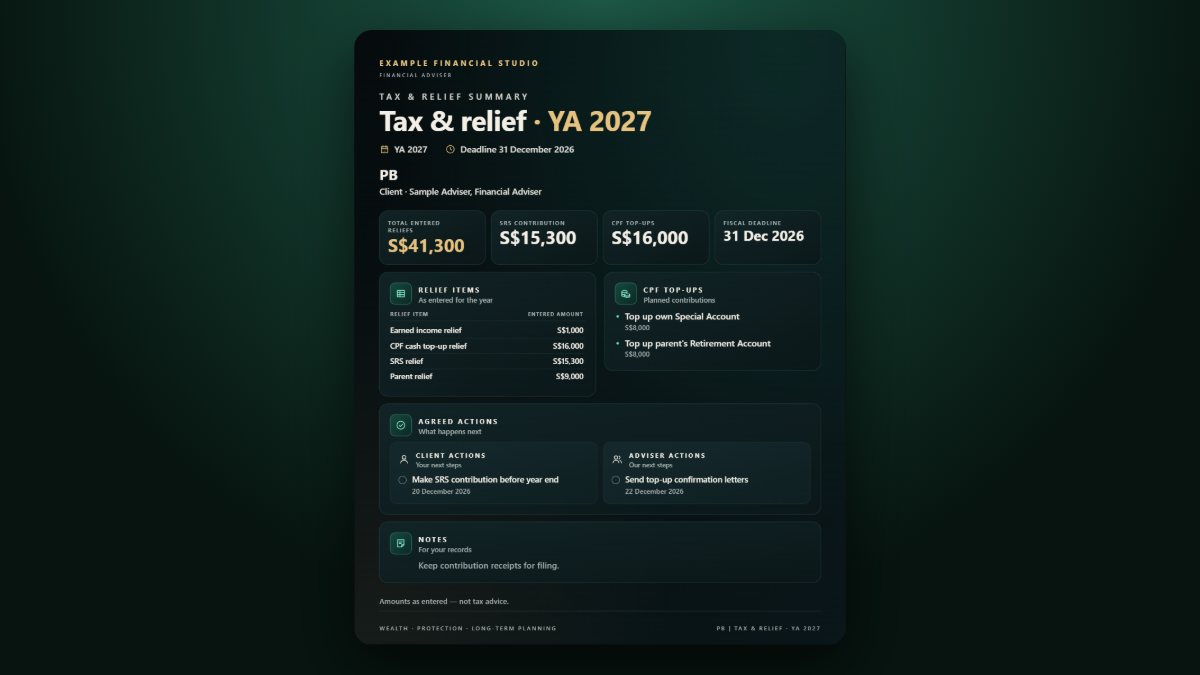
Advisers often need to show a client, in November, what can still be done before the year ends: how much has been topped up, what is still available, and the deadline. The Tax Relief Summary generator does exactly that: CPF top-ups, SRS contributions, other relief items and the 31 December deadline, as a clear recap image. It records the plan; it does not give tax advice.
Try it free: Enter the top-ups and contributions made and planned, add the deadline, and export a one-page summary for the client. Open the Tax Relief Summary generator on CREATEFOR.YOU. It runs in your browser, needs no sign-up to build and preview, and the entries you type are not sent to the server.
Frequently asked questions
If I top up my CPF in January, which year does the relief count for?
The income year in which the top-up is made. A top-up in January 2027 counts towards income earned in 2027, assessed in YA 2028, not YA 2027.
Do I need to claim every relief myself?
No. Several reliefs, such as earned income relief and CPF relief for employees, are applied automatically. Others must be claimed or confirmed. Always check the pre-filled details in your return.
Is the SRS always worth it for the tax relief?
It depends on your tax rate now and expected in retirement, and on whether you need the money earlier. Early withdrawals carry a penalty. Consider it as part of a wider plan.
Related reading
- CPF top-up and SRS before 31 December 2026
- Planning retirement income around CPF LIFE
- Visual recap templates for financial advisers
General information only, not tax advice. Relief amounts and conditions are set by IRAS and can change; confirm the current rules at iras.gov.sg before acting.