Ask most people what their insurance covers and you will hear "I think I'm covered" or the name of the insurer. Few can say what each policy pays for, when, and why it matters to them. That is not a failing of the client. Insurance is usually explained product by product, in the insurer's language, instead of need by need, in theirs.
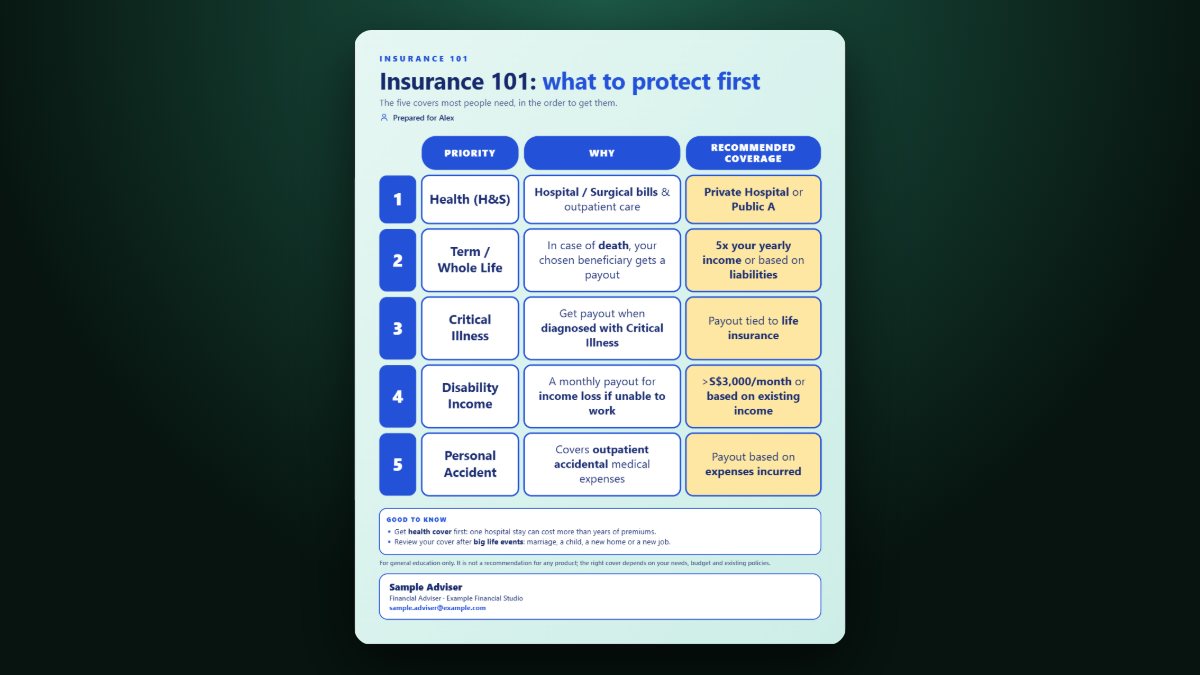
This guide gives you a simple structure for explaining the main types of cover on one page, the questions each type answers, and a free Insurance 101 chart generator that lays it out as a clear chart with your own columns and notes.
Key takeaways
- Explain needs before products: "what happens to your family's income if…", not "this plan has a rider".
- Four questions cover most of it: income if you die, bills if you are in hospital, income if you are seriously ill, income if you cannot work.
- One row per need, three columns: what it is, why it matters to this client, what cover is suggested.
- Keep numbers to the few that drive the decision.
- A chart explains; the policy documents and a licensed adviser decide.
Start with the four questions
Almost every personal insurance conversation comes back to four questions. Put them in this order, because it runs from the most common need to the most overlooked:
- If I am in hospital, who pays the bill? Health or hospitalisation cover.
- If I die, what happens to the people who rely on my income? Life cover (death and total permanent disability).
- If I am diagnosed with a serious illness, how do we live while I recover? Critical illness cover.
- If I cannot work for months or years, what replaces my salary? Disability income cover.
Each question is about a different risk, and a policy that answers one does not automatically answer another. Health cover pays medical bills; it does not pay the mortgage while you are off work. That single sentence clears up a lot of confusion.
What each type of cover does, in plain words
| Cover | What it pays for | The question it answers |
|---|---|---|
| Health / hospitalisation | Hospital and treatment bills, subject to limits, deductibles and co-payment | Who pays the hospital? |
| Life (death and TPD) | A lump sum if the insured dies or becomes totally and permanently disabled | What do my dependants live on? |
| Critical illness | A lump sum on diagnosis of a covered illness, whatever the bills | How do we manage while I recover? |
| Disability income | A monthly income if illness or injury stops you working | What replaces my salary? |
| Personal accident | Payouts for accidental injury, death or medical costs from accidents | What if an accident happens? |
Turn it into one page for this client
A general table explains insurance. A one-page chart for this client explains their priorities. Use one row per need and three columns:
- Type: the cover, in plain words.
- Why it matters: one line about their situation. "Two children under 10 and a mortgage until 2049."
- Suggested cover: a figure or a range, and any note such as "review after the promotion".
Mark the one or two most important rows. Most clients cannot act on five priorities at once, and a highlighted row tells them where to start. The Insurance 101 generator lets you add, remove and reorder rows and columns, highlight a row, and add notes and your adviser card, then export a PNG or JPG.
Words that help, and words that do not
- Say "a lump sum on diagnosis" rather than "an accelerated CI benefit".
- Say "the part of the bill you pay first" for a deductible, and "your share after that" for co-payment.
- Say "cover stops at 65" rather than "coverage term to age 65".
- Avoid acronyms on the chart. If you must use one, spell it out once.
What to leave off the page
- Policy numbers, identity numbers and anything else that identifies the client.
- Detailed product comparisons: put those in a separate side-by-side policy comparison.
- Disclosures and advice that belong in your firm's formal documentation.
Try it free: Start from the sample rows, change them to suit the client, highlight the priorities and export a clean one-page chart. Open the Insurance 101 chart generator on CREATEFOR.YOU. It runs in your browser, needs no sign-up to build and preview, and the entries you type are not sent to the server.
Frequently asked questions
Is critical illness cover the same as health insurance?
No. Health insurance pays medical bills. Critical illness cover pays a lump sum when a covered illness is diagnosed, which the person can use for anything: income while recovering, household costs or care.
Does life insurance cover disability?
Many life policies include total and permanent disability (TPD), which pays out if the insured can never work again. Partial or temporary disability is usually covered by a separate disability income policy.
How much detail should an explainer chart have?
Enough for the client to repeat it to their partner: the need, why it matters to them, and the suggested cover. Everything else belongs in the policy documents.
Related reading
- How to compare two insurance policies side by side
- Insurance coverage review: how much cover is enough?
- How to write a financial needs analysis summary
General information only, not financial advice. Cover, limits and exclusions vary by insurer and policy. Licensed representatives should share client-facing explainers only as their firm's compliance policy allows.